
Americans sing about it at ball games and patriotic events:
And the rockets’ red glare, the bombs bursting in air,
Gave proof through the night that our flag was still there.
The red glare describes the rocket bombardment of Fort McHenry by HMS Erebus on the night of September 13, 1814. Featuring 32 pounds of gunpowder, the rockets were launched one level below deck through scuttles and in large numbers. Fort McHenry was ceaselessly bombarded.
These rockets were invented by Sir William Congreve in 1808, based on rockets used by the Kingdom of Mysore against the East India Company during the Second, Third, and Fourth Anglo-Mysore Wars.
Sir William improved the Mysore rockets and they were used heavily in the War of 1812 at Lewes, Delaware; in the Chesapeake campaign (Battle of Bladensburg, Battle of North Point); and as part of the attack on Washington, DC.

Rockets go back as far as the 13th century in China, perhaps earlier. Over time they were improved, but once launched they were only guided by the original aimpoint. To improve accuracy, some were fin stabilized.
In the late 1940s the US Navy developed the Mk 4 “Mighty Mouse” unguided rocket, designed as an air-to-air weapon to shoot down Soviet bombers at a safer distance than using a machine gun. (The working assumption was that Soviet bombers might be carrying atomic weapons.)

The main innovation was folding fins on the rockets, so they could be launched from multi-tube containers, increasing the firepower of a single aircraft and improving the odds of hitting a target.
The Mighty Mouse set the size standard at 70 mm or 2.75 inches diameter. In the 1970s and 1980s the original Mighty Mouse was further refined and became the Hydra 70 system.
The Hydra 70 comes in different models with multiple types of warheads. However, like the Mighty Mouse and others before it, going back to the Congreve, the Hydra 70 was unguided.
That changed with the development of a laser guidance kit for the Hydra. Developed by BAE systems, the kit is known as the Advanced Precision Kill Weapons System (APKWS).

The kit was developed starting around 2005 and entered service in 2016. More recently, a number of improvements have been made to make APKWS effective against drones. So far these improvements include new proximity fuses replacing mechanical ones, a specialized dual sensor warhead so the operator does not have to keep the laser on the target until a hit is achieved and new software to optimize counter-drone operations.
Hydras with laser kits can be launched from fixed wing aircraft and helicopters.
The VAMPIRE
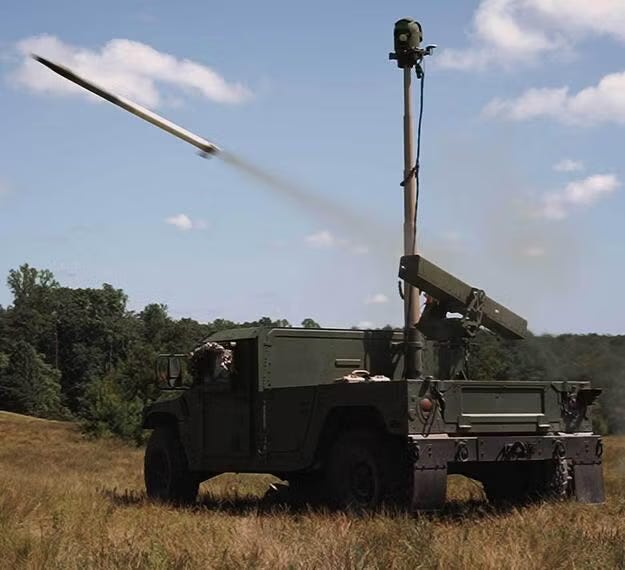
VAMPIRE or Vehicle Agnostic Modular Palletized ISR Rocket Equipment is a portable system developed by L3-Harris. It is proving effective against Group 2 (small to medium tactical drones) and Group 3 UAVs (for example the Shahed-136 and Russian Geran copies, and the Orlan-10, a Russian medium range multi purpose drone.)
VAMPIRE has been deployed on pickup trucks like the Ford 150 or Toyota Hilux and on the M1152 HMMWV (Humvee) and in fixed sites including building rooftops.

In the current Iran war, Hydras with APKWS kits have been effective against Iranian and Hezbollah launched drones. The US A-10, along with other fixed wing aircraft and helicopters, have played a strong role in neutralizing a large number of drones in the war. Similarly the system is used in Ukraine both on aircraft, helicopters and for point defense at fixed sites.
Hydras with kits are effective in any weather, day or night. The system uses laser guidance to lock on to targets, which works in combination with aircraft sensors such as the AN/APG-82 radar and targeting pods (e.g., LANTIRN), ensuring precise engagement, even in total darkness.
Hydra is not alone
Russia has its own version called the S-8L Korvet that is deployed on helicopters (Ka-52M Alligator and Mi-28NM Havoc) and on the Su-25 attack jet. It has a range of 6 km, compared with 1.5 to 5 km for APKWS when air launched. It measures 3.15 inches in diameter.
Not much is known about the performance of the S-8L, but it appears the Korvet is appearing on the Russian Pantsir system, either in the mobile version or on towers with Pantsir components on top.

For example, as of August 2025, Vladimir Putin’s Valdai residence in Russia’s Novgorod region was protected by at least 12 Pantsir-S1 surface-to-air missile systems, many mounted on specially constructed steel towers. The systems are positioned around the “Uzhin” compound (a part of the Valdai residence) to protect against increasing drone attacks.
It isn’t clear if they include the guided S-8L, or a new “mini missile” but it is likely upgrades were installed, especially after it was claimed that 91 Ukrainian long-range drones targeted the Putin residence near Lake Valdai on the night of December 28–29, 2025.

The Pantsir (SA-22 Greyhound) is a Russian family of self-propelled, medium-range surface-to-air missile and anti-aircraft artillery systems. Designed for point defense of military and industrial installations, it combines 12 57E6 missiles and twin 30mm 2A38M autocannons to engage aircraft, drones, and precision-guided weapons.
A new version of the Pantsir-SM has replaced the larger missiles on Pantsir with a pod of four, apparently guided, mini-missiles (which may be the same as the S-8L). The twin 30mm autocannons also have been removed.

Ukraine has said that the Pantsir is the main obstacle to its drone strikes deep inside Russian territory. There are different ways to defeat them, using decoys orswarm attacks, directly targeting Pantsirs using cruise missiles and drones and circumventing them (given their range limitations).
It also is not clear how well Pantsir ground units are integrated with existing air defense assets and command and control facilities.
The future
As the Wall Street Journal has reported, there is a race to develop low cost “cheap” alternatives to shoot down drones. Meanwhile, improvements in existing defenses, such as APKWS, offer the best way forward in the near term, especially against medium drone threats.
Palletized or vehicle-mounted APKWS Hydra rockets could well help protect US domestic military bases, such as Barksdale, the bomber base in Louisiana that was attacked earlier this month, from drone attacks.
While the Pentagon has no real plan to protect American bases here at home, using VAMPIRE makes sense and is affordable and available.
Stephen Bryen is a senior Asia Times corrrespondent and a former US deputy under secretary of defense. This article also appears on his Substack, Weapons and Strategy.