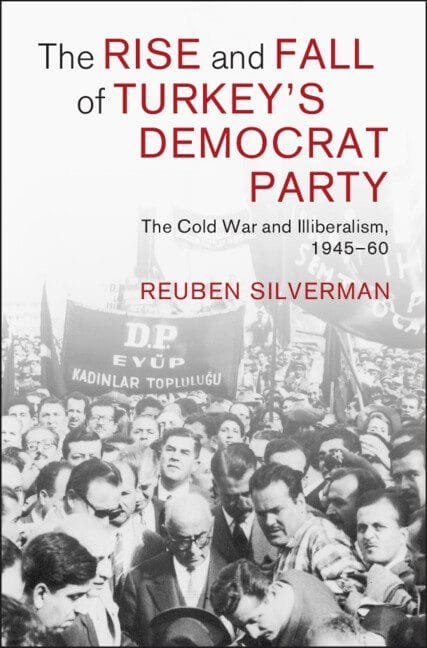
Turkish politics was fundamentally altered by the rule of the Democrat Party (DP) between 1950-1960. It has been often viewed as highly controversial party that ended with its leaders being toppled by a military coup in 1960. The Turkish memory of the DP rule and Prime Minister Adnan Menderes is polarised with some seeing them as democratic heroes and others seeing them as betraying a democratic vision. President Recep Tayyip Erdogan, it is said, draws inspiration from Menderes and in 2020 had a memorial museum built on the island where Menderes was imprisoned. The importance attached to the DP years and why so many different groups remember them differently makes them a critical subject of inquiry. Reuben Silverman’s new book The Rise and Fall of Turkey’s Democrat Party: The Cold War and illiberalism, 1945-60 offers English readers a thoughtful and nuanced account of the Democrat Party. Silverman asserts that contrary to what some argue, the DP sought the same goals and pursued the same interests as their predecessors, “The aims remained largely unchanged; it was the opportunities and, consequently, the strategies that differed.”
The Democrat Party was an outgrowth of the Republican People’s Party or CHP, after Turkiye transitioned from the Ottoman Empire to the republic, the Mediterranean country was placed under a single party rule led by Mustafa Kemal Ataturk. Those who would form the DP in 1946, were part of the CHP during Ataturk’s rule and their connection to Ataturk predates the First World War. Adnan Menderes was a student in Izmir when he got politically involved with the Committee of Union and Progress, a party that would take over the Ottoman state in 1913, who were deeply concerned by the disintegration of the empire and Muslims loss of position and power in society. These formative years meant that leaders of the DP played a role in the formation of the Turkish Republic and came from the same political class as the CHP. Indeed, in Silverman’s study, it is hard to detect discernible disagreements between the CHP and DP in the early years. Even after the DP was formed and broke away from the CHP in 1946, despite anger at the single party rule of the CHP, there was still little ideological difference between them. Both were parties of the same republican political elite. However, what the formation of DP did do was introduce multiparty politics into Turkiye, thus paving the way towards a more democratic era.
BOOK REVIEW: Hebrew Orientalism: Jewish Engagement with Arab-Islamic Culture in late Ottoman and British Palestine
Some of the opponents of the DP accused it of moving Turkiye away from its secular political roots; it was under them that the Muslim call to pray in Arabic was reinstated after being banned by the early republic. Although as Silverman points out the call to prayer in Arabic was drafted by the CHP and DP had only gotten into power when the law came into effect, which actually reflects a bipartisan elite consensus. Nonetheless, Muslim identity and institutions became more prominent during their rule. Marxists critics of the DP point out they further entrenched Turkiye into the American orbit. Indeed, as Silverman shows, “The willingness of DP leaders to participate in Korea [The 1950-1953 Korean War] and root out domestic communists demonstrated to their US peers that Turkey was committed to the anti-communist bloc.” The Cold War helped shift the orientation of Ankara, which the DP helped oversee, but this also produced a crisis. A few weeks after announcing troop deployments to Korea, Communist Bulgaria told Ankara that Turkiye must accept the return of 250,000 Turks, who lived in Bulgaria. The refugee crisis that this produced led the DP leaders to highlight the fact the cost of resettling thousands of people would eat into their military budget. While Washington officially told Ankara this was their problem, American leaders understood the pressure this would place on the country and so began developing a closer economic relationship.
While the Korean war ensured US aid and investments, which ensured a growing economy, the ending of the war would see Washington less willing to provide funds to Turkiye. This would play a role in an economic crisis and due to the DP’s commitment to rural Turkish voters, meant they were unable to enact effective policies that would ease the strain on Turkish urban areas. By the late 1950s, the proportion of the DP vote shrank and the party was increasingly becoming authoritarian, cracking down on political freedoms and attempting to suppress protests. In the end, a military coup would finish them off. Reflecting on their legacy, Silverman argues that while the DP’s rule is associated with radical shifts in Turkyie, their attempts to hold onto power and not make significant compromises that they felt would undermine them, harmed them. “The contradictions in these ambitions ultimately proved their undoing.”
The Rise and Fall of Turkey’s Democrat Party offers a nuanced and critical look at one of Turkiye’s most influential political movements that still informs political memory today. It makes for interesting reading and enables better analysis of the historical development of Turkish politics.
BOOK REVIEW: The New Byzantines: The Rise of Greece and the Return of the Near East