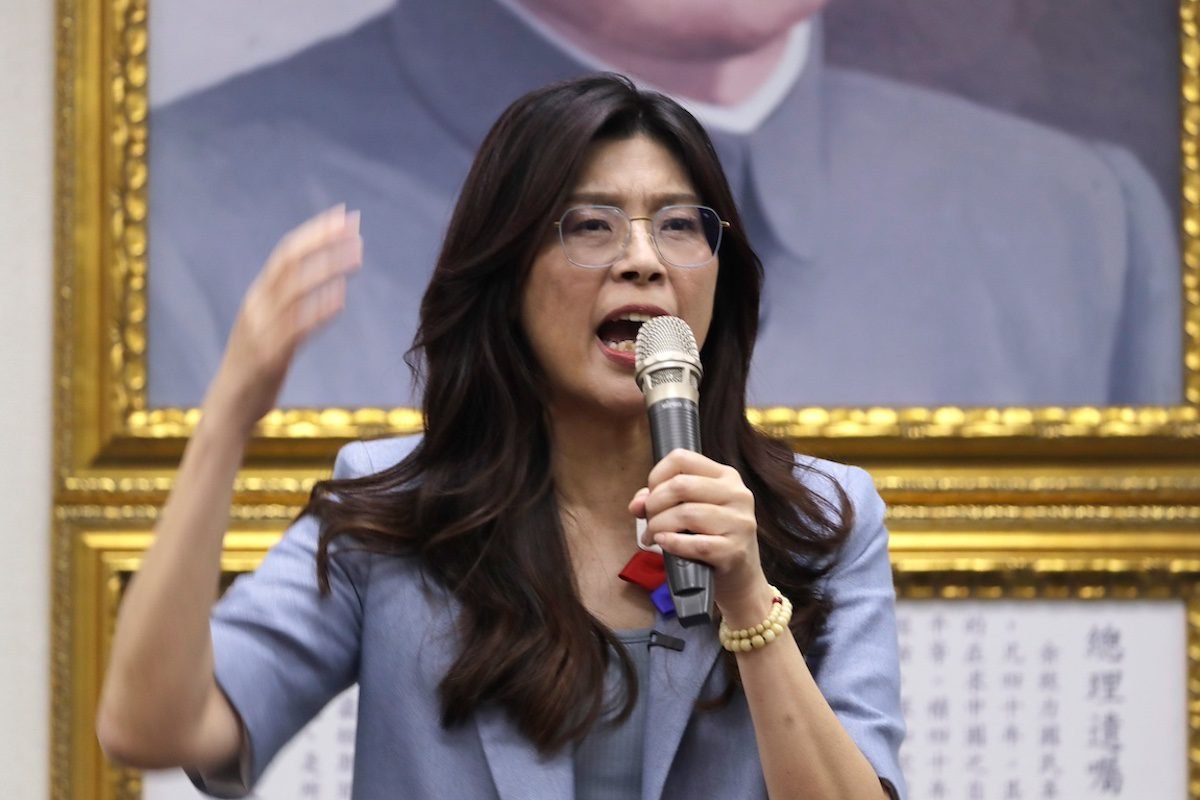
Cheng Li-wun, chairwoman of Taiwan’s main opposition Kuomintang (KMT), plans to visit mainland China from April 7-12.
Cross-Strait dialogue is crucial for managing tensions, which have risen sharply over the past decade, and the KMT has long played an important role in maintaining these channels. But the timing and circumstances around this trip expose Cheng and the party she leads to political risks that will be difficult to navigate.
Cheng’s visit follows a precedent of KMT leaders traveling to mainland China, beginning with Lien Chan’s groundbreaking 2005 meeting with then-Chinese leader Hu Jintao. Some subsequent KMT chairmen made similar trips.
Although Cheng’s immediate predecessor, Eric Chu Li-luan, refrained from visiting during his most recent term, which ran from 2021 until last November, he frequently dispatched Vice Chairman Andrew Hsia to the mainland.
Chu also personally visited Beijing to meet with Xi Jinping in 2015, during an earlier stint as chairman. That meeting helped pave the way for an unprecedented summit between Xi and then-Taiwan president Ma Ying-jeou later that year in Singapore.
But public opinion has shifted dramatically since 2015. The last KMT chairperson to visit mainland China was Hung Hsiu-chu, back in 2016, and her visit was sharply criticized in Taiwan.
More recent visits by Taiwanese politicians and former president Ma have drawn similarly harsh criticism on the island. The United States, Taiwan’s primary security partner, which used to encourage cross-Strait dialogue, has also become more skeptical of such outreach.
With official dialogue between Taipei and Beijing largely frozen, the KMT’s role as an informal intermediary may matter more than ever. Cheng’s desire to promote “peace and reconciliation” is commendable. But in going to mainland China, she may walk her party straight into a political minefield.
First, from the perspective of optics, she should have visited the US before mainland China. She reportedly plans to visit Washington this year, but the sequence of these trips matters.
For the leader of a major political party to visit Beijing before Washington creates an impression that the party prioritizes its relationship with China over its relationship with the US. This is almost certainly not the message Cheng intends to convey, but it’s how her trip will be perceived in both Taiwan and Washington.
In addition, Cheng’s visit will occur barely a month before US President Donald Trump meets with Xi in Beijing. This timing might be coincidental, but there are fears that her hosts will try to get her to make statements Xi can use to nudge Trump to adjust elements of America’s Taiwan policy in ways that favor Beijing.
While this risk isn’t contingent on her visiting the mainland, any offhand remark she makes during her trip that appears to echo Beijing’s narratives will be even harder for Cheng and the KMT to live down. If Xi talks Trump into endorsing a position that further erodes Taiwan’s international profile, Cheng’s critics will pin part of the blame on her.
Even if Cheng makes no major missteps, the optics of this trip will test her party. Her eagerness to engage Beijing is controversial even within the KMT. Some see an opportunity for her to help stabilize cross-Strait relations much like Lien Chan did during the administration of openly pro-independence president Chen Shui-bian (2000-2008).
Should Cheng achieve similar results, she could become a transformational leader capable of unifying the party and leading it back to electoral victory.
Others, however, worry that she is harming the party by appearing too close to Beijing. They also support dialogue but are more skeptical of the Chinese Communist Party’s willingness to engage in good faith. They fear Cheng’s approach to this engagement will deepen public distrust in the KMT and hinder the party’s chances in future elections.
The ruling Democratic Progressive Party (DPP) has long portrayed the KMT as “pro-Beijing,” and much of the Taiwanese and international press echo this view. Many within the KMT have worked for years to counter this narrative. Cheng risks undermining this progress unless she and the party convincingly demonstrate their efforts to engage Beijing won’t come at the expense of Taiwan’s security.
That said, Cheng is saying some of the right things. She insists her outreach to Beijing is part of a strategy that also includes maintaining strong deterrence. But on deterrence, critics—and much of the public—don’t see action to match the rhetoric.
One way the KMT could preempt and mitigate negative narratives about Cheng’s trip would be by ending the legislative stalemate over the $40 billion special defense budget that President Lai Ching-te proposed last November.
Political opponents already accuse the party of stalling and diluting the budget on behalf of Beijing. Taiwan’s Mainland Affairs Council has claimed that one of Xi’s objectives in inviting Cheng to China is to “cut off Taiwan’s military procurement from the United States.”
If the KMT-controlled Legislative Yuan doesn’t pass at least a large portion of the requested funding in the coming weeks, it will be difficult for the party to counter these narratives. Many in the KMT — including Taichung Mayor Lu Shiou-yen, who is widely seen as the party’s front-runner for the 2028 presidential nomination — publicly call for a significantly larger budget than the US$12 billion the KMT caucus has put forward.
Ultimately, Cheng will have to decide how to balance her ambitious agenda with the KMT’s challenges on the public opinion front. Many, including in her own party, are concerned about her trip to mainland China. It will be up to her to prove them wrong.
Michael Cunningham is a senior fellow with the China Program at the Stimson Center.





, plans to visit mainland China from April 7-12. Cross-Strait dialogue is crucial for)