The United States Department of Justice’s recent moves to prosecute executives of a server supplier and individual agents and to accuse them of smuggling Nvidia’s high-end chips to China via Thailand may signal a trend toward tighter export control enforcement, according to industry observers.
On March 19, US authorities charged Yih-Shyan “Wally” Liaw, a co-founder of Super Micro Computer, along with Ruei-Tsang “Steven” Chang and Ting-Wei “Willy” Sun, with conspiring to divert US-made artificial intelligence servers with restricted graphics processing units (GPUs), including A100, to China. Liaw and Sun were arrested in California, while Chang remains at large.
Separately, US prosecutors charged Stanley Yi Zheng, a Chinese national who was arrested on March 22, and Matthew Kelly and Tommy Shad English, both Americans who surrendered on March 25, in connection with an alleged conspiracy to smuggle advanced AI chips out of the United States, including restricted Nvidia A100 processors.
Prosecutors did not say whether the two cases were linked, but both involved a transshipment route from the United States to Taiwan, then Thailand and onward to Hong Kong and mainland China.
The disclosures were followed by a Reuters report on March 27 that said four Chinese universities, including two with ties to the People’s Liberation Army, had purchased Super Micro Computer servers equipped with restricted AI chips over the past year, according to procurement records, although it remained unclear how the systems were sourced.
Following Liaw’s arrest, US Senators Jim Banks and Elizabeth Warren urged Commerce Secretary Howard Lutnick to immediately suspend Nvidia’s export licenses for advanced AI chips to China and Southeast Asian intermediaries, citing what they described as a serious national security risk stemming from the large-scale diversion of US technology.
They called on the Department of Commerce to take the following actions without delay:
- Pause and comprehensively review all active export licenses for Nvidia’s advanced AI chips and server systems to China and Southeast Asian intermediaries, including Malaysia, Thailand, Vietnam and Singapore, pending in-person end-user verification and stronger compliance controls.
- Require future license applications to include binding, independently auditable end-user commitments, with automatic revocation for any verified breaches.
- Examine whether Nvidia’s prior representations about the absence of chip diversion were misleading and whether they affected licensing decisions, thus warranting further investigation.
These developments carry geopolitical implications as they come ahead of a planned summit between US President Donald Trump and Chinese President Xi Jinping in Beijing on May 14-15.
New permit requirements
Super Micro said on March 19 that it was not named as a defendant. It identified those charged as Liaw, a senior vice president and board member; Chang, a Taiwan-based sales manager; and Sun, a contractor. It added that the two employees had been placed on administrative leave and that its relationship with the contractor had been terminated.
The company said the alleged conduct violated its policies and export control requirements, adding that it maintains a robust compliance program and is cooperating with US authorities. On March 20, it said Liaw had resigned from the board with immediate effect, leaving eight directors and no changes to committee structures.
Teng Honghou, an Anhui-based commentator, said the cases could trigger a chain reaction in global AI development.
“Smuggling methods have also evolved in recent years. Early schemes relied on individuals physically carrying chips across borders, but networks have since shifted to using shell companies to procure and re-label hardware and, more recently, to complex transshipment chains with interim warehousing and inspection in a Southeast Asian country,” he said.
On China’s market dynamics, Teng said the cases highlight demand for Nvidia’s advanced chips strong enough to have created lucrative opportunities that have drawn even senior executives of US companies into actions alleged alleged to violate export control rules.
“Western countries may further tighten export approvals, shifting the focus from checking product models to scrutinizing the credibility of companies and individuals,” he said. “Firms that have been penalized or found in violation could face stricter reviews, longer approval cycles, reduced quotas or even blacklisting of specific personnel. For the broader industry, that means more friction, lower efficiency and higher costs.”
On March 5, Bloomberg reported that Washington is considering a new export regime that would require permits for advanced AI chips produced by major US firms such as Nvidia and AMD.
The proposed framework would introduce a tiered licensing system based on computing scale, with smaller shipments facing lighter scrutiny and larger deployments subject to tighter controls:
- Smaller shipments of up to about 1,000 high-end GPUs could face a simplified review.
- Mid-sized deployments would require pre-authorization and tighter compliance checks.
- Large-scale AI clusters would require government-level approval, tied to national security and investment commitments in the US.
Last July, media reports said the Trump administration was already considering tighter export controls on Nvidia’s high-end AI chips, with the US Commerce Department drafting a rule that would require licenses for exports to Malaysia and Thailand to prevent Chinese firms from accessing the processors via third countries.
However, progress on drafting the rule appeared to slow in the second half of 2025, as the White House shifted strategy to allow exports of Nvidia’s H20 chips while capturing a share of the company’s China-related revenue.
In January, Trump approved exports of the H200 to China, but Beijing urged domestic firms to prioritize homegrown alternatives. As of early March, no shipments had been made, prompting Nvidia to halt production of H200 chips designated for China.
Although Nvidia founder Jensen Huang later said the company had received some Chinese orders, observers noted Beijing is unlikely to promote wider use of Nvidia chips unless Washington permits exports of the company’s more advanced Blackwell processors.
‘Dummy servers’
The Super Micro case now offers fresh context for why the Trump administration may consider tightening export controls.
On May 13 last year, the US Commerce Department’s Bureau of Industry and Security (BIS) rescinded the Biden administration’s AI diffusion rule and replaced it with three guidelines prohibiting the use of Huawei’s Ascend chips, the deployment of US chips to support Chinese AI model training, and the re-export of advanced US chips to China.
Before these measures took effect, Super Micro had already shipped about US$2.5 billion worth of servers, many of which were assembled in the US, to a Thailand-based company in 2024 and 2025.
“The defendants’ scheme became more brazen over time and resulted in massive quantities of servers with controlled US AI technology being sent to China,” the Department of Justice said. “Between late April 2025 and mid-May 2025 alone, at least approximately US$510 million worth of the US manufacturer’s servers were diverted to China in violation of US export control laws.”
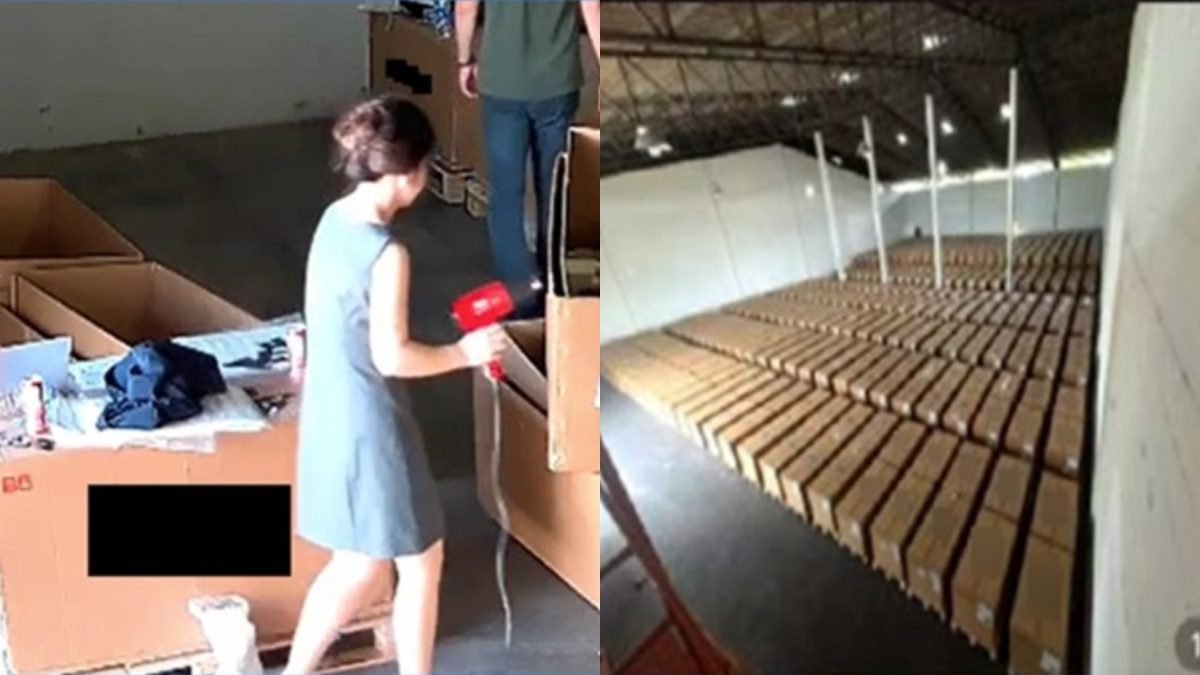
Prosecutors alleged that, after the new guidelines were implemented last May, the defendants used non-functional “dummy” servers, physical replicas designed to resemble genuine equipment, to pass inspections by the US manufacturer’s compliance team last August. These units were placed at declared storage sites in Thailand so that auditors would see inventory that appeared consistent with official purchase records.
In reality, prosecutors said, the actual servers had already been diverted and shipped to China. To reinforce the deception, the defendants allegedly reused packaging, labels and serial-number stickers on the dummy units, in some cases using tools such as hair dryers to remove and reattach identifiers, allowing the staged inventory to match documentation and withstand routine visual checks.
Read: Nvidia halts H200 production as China backs Huawei AI chips
Follow Jeff Pao on Twitter at @jeffpao3