Religious and cultural communities across the region mark overlapping observances centered on fasting’s end, the new year, and redemption
A rare calendar alignment is bringing together two of the most widely observed celebrations across the Middle East and beyond, as Eid al-Fitr and Nowruz fall within hours of each other in March 2026, creating a unique overlap of religious observance and cultural renewal.
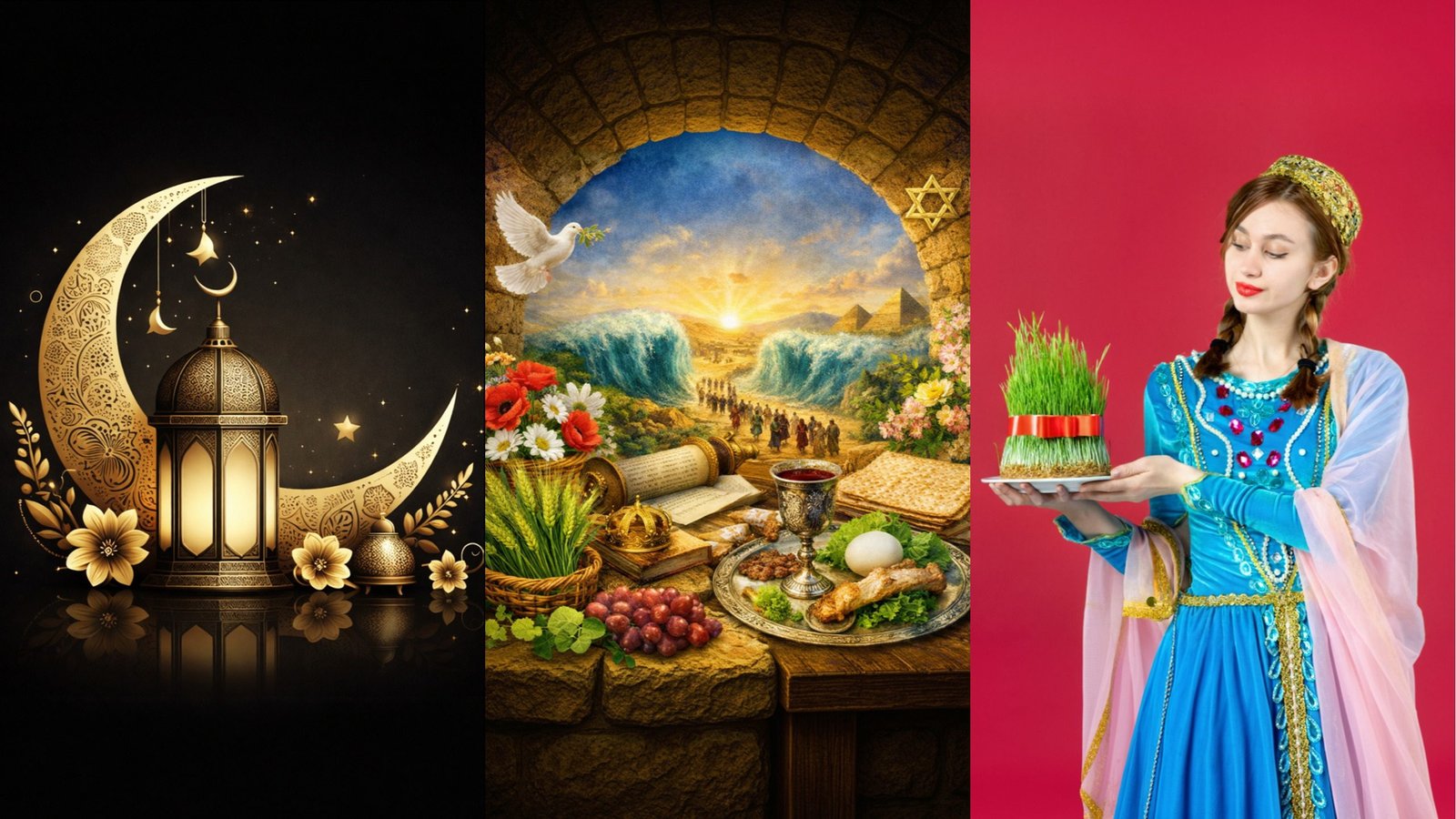
Eid al-Fitr, the Islamic holiday marking the end of the fasting month of Ramadan, is expected to begin at sunset on March 20, with the main day of celebration on March 21, depending on the sighting of the new moon. At nearly the same moment, Nowruz—the Persian New Year—arrives with the spring equinox on March 20, ushering in a tradition that predates Islam by thousands of years.
The convergence is more than a quirk of the calendar. In countries where both holidays are observed, particularly Iran and parts of Central Asia, it creates a layered period of celebration that reflects the region’s complex identity, where religious practice and ancient cultural traditions coexist and often reinforce one another.
Adding another layer to the moment, the Hebrew calendar marked Rosh Hodesh Nisan—the first day of the month of Nisan—on Thursday, March 19. In Jewish tradition, Nisan holds a special status as the beginning of the religious year, even though Rosh Hashanah in the fall marks the civil new year. The Talmud famously teaches that there are “four new years” in the Jewish calendar, and Nisan is counted as the new year for kings and for the cycle of biblical festivals—meaning that in ancient times, the regnal years of Jewish monarchs were calculated from Nisan, with each new year of a king’s reign effectively beginning in that month.
Nisan is closely associated with themes of redemption and renewal. It is the month of the Exodus from Egypt and the setting for Passover, which begins on the 15th of Nisan. In that sense, it represents not just a change of date but a foundational moment in Jewish historical memory—the transition from slavery to freedom. Like Nowruz and, in a different register, Eid al-Fitr, it carries a strong sense of renewal. Passover is also a spring festival, historically linked to the barley harvest in the land of Israel, but its defining emphasis is on historical and spiritual redemption rather than the seasonal cycle itself.
Eid al-Fitr, known as the “Festival of Breaking the Fast,” marks the conclusion of Ramadan, during which Muslims abstain from food and drink from dawn to sunset. The holiday begins with a special communal prayer held shortly after sunrise, followed by gatherings with family and friends. A key religious component is zakat al-Fitr, a charitable donation given before the prayer to ensure that even the poorest members of society can participate in the celebrations.
The tone of Eid is both spiritual and social. After a month defined by discipline and reflection, the holiday emphasizes generosity, gratitude, and community. Families prepare festive meals—often featuring sweets such as ma’amoul and baklava—while children receive gifts or money in a tradition known as “Eidiya.” Visits to relatives and neighbors are central, reinforcing social bonds that extend beyond the immediate family.
Nowruz, by contrast, is rooted in the rhythms of nature rather than a religious calendar. Celebrated on the exact moment of the spring equinox, it marks the beginning of the new year in the Persian calendar and symbolizes renewal, rebirth, and the triumph of light over darkness. Its origins lie in Zoroastrianism, but today it is observed by people of diverse religious backgrounds, including Muslims, Jews, Christians, and secular communities.
Central to Nowruz is the Haft-sin table, a carefully arranged display of symbolic items—such as apples, garlic, coins, and sprouted wheat—each representing themes like health, prosperity, and growth. In the days leading up to the holiday, many families take part in “Chaharshanbe Suri,” a fire-jumping ritual meant to symbolically cleanse the past year’s misfortunes.
The Nowruz holiday period typically extends for nearly two weeks, culminating in Sizdah Bedar, a day spent outdoors that reflects the holiday’s deep connection to nature. As with Eid, family visits play a central role, particularly the custom of paying respect to elders.
The overlap of Eid al-Fitr, Nowruz, and Rosh Hodesh Nisan in 2026 highlights both the diversity and the shared rhythms of life across the region. One holiday follows the Islamic lunar calendar and marks the completion of a sacred fast; another is anchored in the solar calendar and the turning of the seasons; the third is rooted in an ancient lunisolar system tied to historical memory and religious law. Yet all three, in different ways, center on renewal—spiritual, seasonal, and historical.
For millions of people, the coincidence of these observances offers a rare moment in which those forms of renewal unfold simultaneously, blending prayer and tradition, faith and heritage, into a single extended season of reflection and celebration.