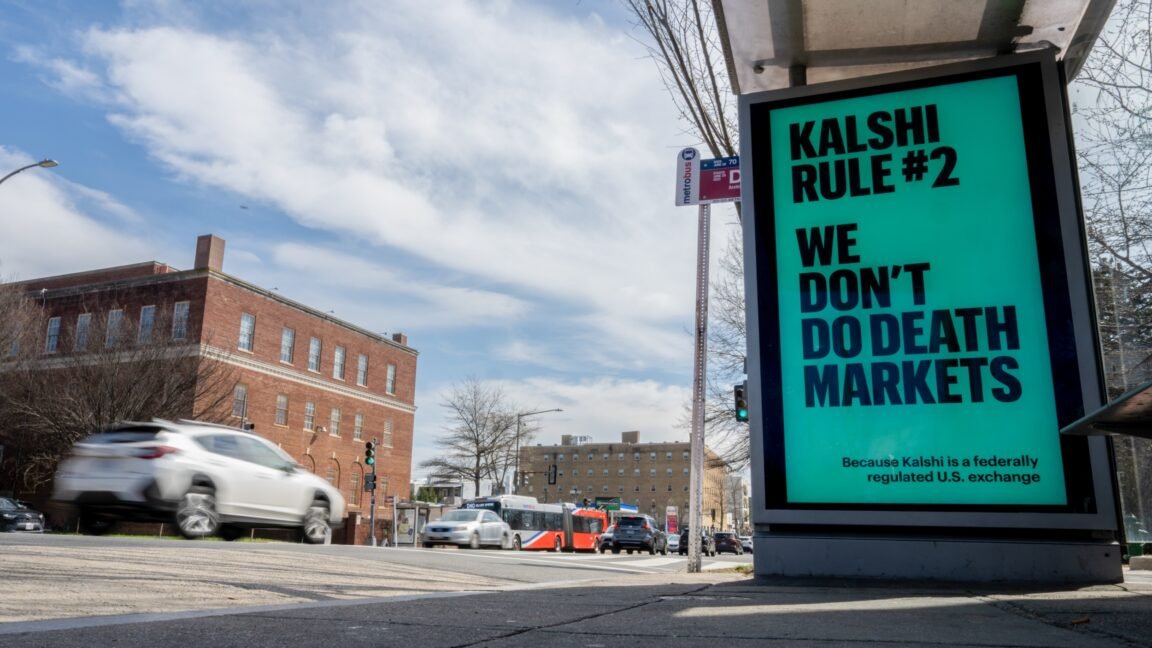
A federal appeals court ruled that New Jersey cannot regulate sports bets on prediction markets because the US Commodity Futures Trading Commission (CFTC) has exclusive jurisdiction.
Kalshi, which is registered with the CFTC as a designated contract market (DCM), last year won a preliminary injunction preventing the New Jersey Division of Gaming Enforcement from enforcing a state law against its sports-related event contracts. The injunction issued by a district court was upheld today in a 2-1 decision by judges at the US Court of Appeals for the 3rd Circuit.
The CFTC has exclusive jurisdiction over DCMs under the Commodity Exchange Act, a US law. The question in the Kalshi lawsuit is whether the CFTC’s exclusive jurisdiction “preempts New Jersey gambling laws and the state constitution’s prohibition on collegiate sports betting,” the appeals court majority wrote. “New Jersey frames the issue broadly (regulating all sports gambling) rather than narrowly (regulating trading on federally designated contract markets).”
Chief Judge Michael Chagares and Circuit Judge David Porter sided with Kalshi in a decision written by Porter, saying that the federal law’s text “suggests that the narrow framing is the better reading.” It thus “preempts state laws that directly interfere with swaps traded on DCMs. Kalshi’s sports-related event contracts are swaps traded on a CFTC-licensed DCM, so the CFTC has exclusive jurisdiction.”
The case began last year after New Jersey sent a cease-and-desist letter to Kalshi, alleging that it was listing unauthorized sports wagers in violation of the New Jersey Sports Wagering Act and the New Jersey constitution. The state’s Sports Wagering Act requires licenses to offer sports wagers, and the state constitution prohibits betting on college sports.
“Virtually indistinguishable” from online sportsbooks
Circuit Judge Jane Roth dissented, writing that the Kalshi “offerings are virtually indistinguishable from the betting products available on online sportsbooks, such as DraftKings and FanDuel.” Roth recounted looking at the Kalshi page for the Carolina Panthers versus Tampa Bay Buccaneers football game on January 3, 2026, and seeing an extensive list of available bets.
“I could have bet on the winner (game outcome). I could have also bet on whether I believed Tampa Bay would win by more than 2.5 points (point spread), whether the two teams would collectively score 45 or more points (game props), or whether former Tampa Bay wide receiver Mike Evans would score a touchdown (player props),” she wrote.
Online sportsbooks offering similar wagers are regulated by states such as New Jersey, but “Kalshi asserts that it is outside the bounds of state regulation because it does not offer gambling products,” Roth wrote. “Instead, Kalshi contends its offered sports-event contracts are swaps, subject to the exclusive jurisdiction of the CFTC. The Majority agrees, holding that Kalshi’s registration as a DCM and branding of its wagers as sports-event contracts are acts of alchemy that transmute its products from sports gambling to futures trading. I see Kalshi’s actions as a performative sleight meant to obscure the reality that Kalshi’s products are sports gambling. Because Kalshi is facilitating gambling, it can be subjected to state regulation.”
This is apparently the first appeals court ruling on the topic, but it probably won’t end the ongoing debate about the regulation of sports wagers on prediction markets. As law firm Holland & Knight wrote in February, Kalshi has gotten favorable rulings at the US district court level in New Jersey and Tennessee, but suffered losses in Maryland and Nevada.
“With nearly 50 active cases addressing the oversight of event contracts—involving multiple platforms across jurisdictions from New York to Nevada to Tennessee—courts at every level are now grappling with fundamental questions of federalism, preemption and statutory interpretation,” Holland & Knight wrote.
CFTC defends “exclusive” authority
The CFTC filed lawsuits last week against Arizona, Connecticut, and Illinois to challenge the states’ attempts to regulate prediction markets. “The CFTC will continue to safeguard its exclusive regulatory authority over these markets and defend market participants against overzealous state regulators,” CFTC Chairman Michael Selig said on Thursday. The agency is also seeking public comment on how it should regulate prediction markets, including those related to gaming.
Congress could step in. On March 23, Senator Adam Schiff (D-Calif.) and Senator John Curtis (R-Utah) introduced legislation to prohibit CFTC-registered entities from listing prediction contracts that resemble sports bets or casino-style games.
“Sports prediction contracts are sports bets—just with a different name,” Schiff said. “And yet, these contracts have been offered in all fifty states in clear violation of state and federal law. Rather than enforce the law, the CFTC is greenlighting these markets and even promoting their growth. It’s time for Congress to step in and eliminate this backdoor which violates state consumer protections, intrudes upon tribal sovereignty, and offers no public revenue.”
Curtis said he’s worried about young people being “exposed to addictive sports betting and casino-style gaming contracts that belong under state control, not under federal regulators. Our bipartisan legislation clarifies regulatory jurisdiction, ensuring that states can maintain their authority over sports betting and casino gaming.”
Swaps defined broadly in US law
The 3rd Circuit ruling said the Dodd-Frank Act of 2010 amended the Commodity Exchange Act by “adding a new class of futures known as ‘swaps’ and expanding the CFTC’s exclusive jurisdiction ‘with respect to accounts, agreements… and transactions involving swaps or contracts of sale of a commodity for future delivery… traded or executed on a [DCM.]’”
Under the law, swaps include event contracts, judges noted. The Dodd-Frank Act gave the CFTC discretionary power to review and prohibit six categories of contracts if it concludes any violate the public interest. Those categories include gaming contracts. So far, the CFTC “has not yet acted to review or prohibit any sports-related event contracts,” the ruling said.
“Congress gave the CFTC exclusive jurisdiction over trades on DCMs, provided for continued state regulation of trades conducted off DCMs, and recognized that while event contracts could involve gaming, the CFTC has discretionary power to review and prohibit those contracts,” the majority said. “Thus, it was reasonable for the District Court to conclude that Kalshi was likely to succeed in showing that the Act preempts New Jersey law from reaching into Kalshi’s CFTC-licensed DCM to ban sports-related event contracts.”
Roth’s dissent acknowledged that a plain reading of the US law’s “text suggests that Kalshi’s sports-event contracts fit comfortably within the statutory definition” of swaps. “On the other hand, we should not read statutes literally ‘if reliance on that language would defeat the plain purpose of the statute,’ or would ‘def[y] rationality,’” she said. “As New Jersey argues, Kalshi’s proffered definition would likely encompass virtually every kind of wager that could exist, including classic casino games and charity raffles.”
The law defines swap to include contracts in which payment “is dependent on the occurrence, nonoccurrence, or the extent of the occurrence of an event or contingency associated with a potential financial, economic, or commercial consequence.” Roth said that with this expansive definition, “even a bet over the outcome of a friendly neighborhood ping pong match” would qualify.
“Moreover, because the trading of swaps outside DCMs is illegal under 7 U.S.C. § 2(e), any individual who engages in gambling outside of a DCM would commit a felony were we to take the definition of swaps to its logical extreme,” Roth wrote. “Congress could not have intended for such a rationality-defying outcome.”