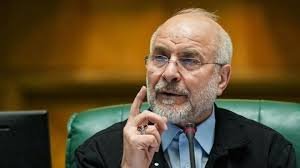
It’s tempting to see as a clear escalation Iran Parliamentary Speaker Mohammad Bagher Ghalibaf’’s declaration on Sunday that all those holding US Treasury bonds are now legitimate targets of violent reprisals.
Iran has – by attacking US bases in the region as far away as Cyprus, by restricting traffic through the Strait of Hormuz, by attacking Israeli communities near secretive nuclear research sites and by threatening to destroy critical infrastructure in Gulf nations – already escalated to levels that many observers, including in the White House, seemingly had not anticipated.
And with a lack of clear off-ramps and with Iran now under the impression that concessions or performative responses only invite further attacks from the US and Israel, it stands to reason that this conflict could accelerate further – in new and deadly ways.
Still, there are reasons to think that Iran won’t make good on this specific threat, regardless of what the US does over the coming days.
For one, “financial entities that finance the US military budget” extend far beyond American institutions, or Western ones that Iran would be inclined to blame as US collaborators (regardless of their actual view of the conflict).
Entities associated with the People’s Republic of China have reduced holdings considerably in the last decade and a half, from the peak of more than 9% in 2011, to somewhere north of 2% today. It is true that the PRC has not exactly rushed to Iran’s defense since the war began, but aggression against a country that shares Iranians’ goal of undermining US global hegemony is not in Iran’s interest.
Nor is it in Iran’s interest to attack other major debt holders less friendly to the Iranian cause, such as South Korea, Germany, the United Kingdom or – the biggest US debt holder of all – Japan.
At the moment, the US and Israel are acting alone in their campaign to cripple Iran as a threat – an effort that has done no favors for either country’s international reputation. Escalating against currently neutral countries carries unnecessary risks, namely that neutrality might become untenable.
Ghalibaf’s declaration therefore can be read a different way if one considers Tehran’s overall approach to conflict escalation, along with internal conditions in both Iran and the US.
Iran cannot hope to defeat the US – much less the combined forces of the US and Israel – in combat, but the Tehran regime has the time to make the conflict unbearable for the Trump administration because it knows that its hold on power is more secure than that of its Washington foe.
Donald Trump’s percentage approval ratings have hovered somewhere between the mid 30s and low 40s for months now as his tariffs have failed to restore US manufacturing and American jobs, as Immigration and Customs Enforcement’s occupation of major American cities has generated headlines for all the wrong reasons, and as the administration’s handling of the Epstein files has created more problems for the president than it has solved.
Polling indicates a severe setback ahead for Trump as of this fall, with the main question being whether his party can cling to its hold over the Senate once its narrow House majority is gone.
Perhaps expected to produce a rally-round-the-flag effect upon the announcement of the conflict – such as both presidents Bush experienced upon the launch of their wars with Iraq – Trump’s Iran campaign instead has faced broad disapproval from the beginning, with Democrats and independents, and even a narrow (but appreciable) slice of his former supporters denouncing it.
Contrast this with Iran. Initial statements from the president encouraged an uprising by the Iranian people, perhaps to be expected following their recent shows of discontent. Additionally, Israel reportedly has attempted to pave the way for a Kurdish offensive.
None of this has come to pass, however, as Iranian protestors cannot see a path to overthrow the regime and Kurdish aspirations, as ever, are undermined by complex regional dynamics.
Iran’s Islamic Revolutionary Guard Corps remains as omnipresent and firmly in control of domestic politics as ever. The Iranian opposition is divided and distrustful of US intent.
Whether the shots are being called by the son of the recently deceased Ayatollah Khamenei, the leadership of the IRGC or Ghalibaf himself, there is no serious prospect for reform that will lead to an erosion of Iran’s theocratic autocracy under current conditions – at least, barring a large-scale invasion that would risk extraordinary loss of life, including for Americans.
Iran has pressed this advantage by restricting the Strait and sending gas prices spiraling, in effect asking Americans how long they can tolerate this conflict. Gas prices are already up around 30 percent since the conflict began.
It would make sense for the US to look for an exit ramp rather than let this continue. The question is whether Washington will yield before it can be certain Tehran will allow traffic through the Strait again, before Iran has backed down on its maximalist demands and with the full knowledge that Operation Epic Fury may have only strengthened Iran’s regional position.
Holders of US debt probably will not take the speaker’s bait. But even a minor erosion of confidence in the US position, when coupled with the increasing pain Americans now feel at the pump, serves the interests of Tehran – which gives up very little in trying to advance on this front.
How the US can brunt the impact of such financial and political warfare tactics in the future will be one of the great challenges for American policymakers in the coming years.
Rob York, PhD, is director for regional affairs at Pacific Forum in Honolulu.