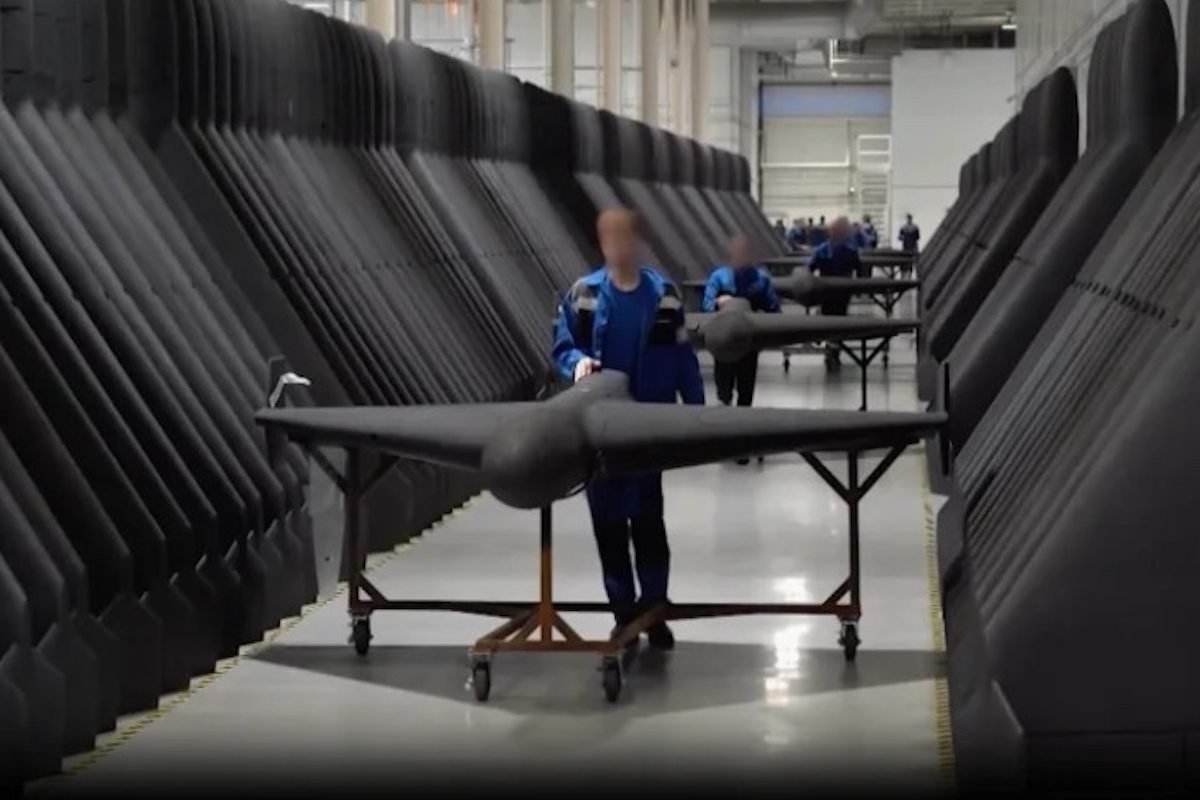
In a striking role reversal, Russia appears to be preparing to supply its embattled partner Iran with one-way attack drones, just as Iran previously supplied Russia to sustain its fight in Ukraine.
The Financial Times (FT) reported that Russia is nearing the completion of phased deliveries of drones to Iran, representing Russia’s provision of lethal aid to Iran since the war began.
Western intelligence reports referenced by FT indicate that senior Russian and Iranian officials began secret talks on drone deliveries soon after Israel and the US carried out attacks on Iran.
These shipments commenced in early March and are expected to conclude by the end of the month, according to the FT report. Russia, a strong ally of Iran, is said to have offered support, which may include intelligence sharing, satellite imagery and targeting information.
Russia has denied such reports, with Kremlin spokesperson Dmitry Peskov dismissing them as media fabrications and urging people not to pay attention to them.
Previously, Russia has allegedly supplied Iran with targeting intelligence against US warships and bases in the Middle East, according to prior reports. Such intelligence may have allowed Iran to conduct more accurate missile strikes, despite US General Dan Caine mentioning in a US Department of Defense (DoD) briefing this month that Iran’s ballistic missile attacks have declined by 90% since the start of hostilities.
Kelly Grieco, in a recent Bloomberg article, notes that open-source intelligence indicates that a quarter of Iran’s ballistic missiles now slip through missile defenses. Grieco states that targeting fewer missiles and drones at carefully chosen targets is more effective in inflicting costs.
In terms of drones, Caine says that Iran’s one-way drone attacks have decreased by 83% since the start of operations. He adds that US and Israeli strikes have destroyed or damaged two-thirds of Iran’s drone, missile, and naval production shipyards and facilities. Those strikes might have significantly degraded Iran’s drone capabilities, with a pre-war production rate of 10,000 units per month, according to Reuters.
However, Grieco says in a recent War on the Rocks article that an 83% decline in Iranian drone launches reflects observable behavior rather than confirmed destruction of capacity.
Grieco warns that reduced launch rates may stem from tactical recalibration, stockpiling for larger strikes, shifting operational priorities, or deliberate pacing, rather than attrition. She warns that dispersed drone systems like the Shahed are inherently difficult to track and assess, while uncertain stockpile estimates further complicate evaluation.
As a result, she says, interpreting fewer launches as degraded capability risks overstating battlefield success and misjudging Iran’s remaining threat. Still, Iran could use a hand in replenishing its drone capabilities, with Russia well-positioned and strategically aligned to do so.
As noted by Joseph Bermudez and other writers in a Beyond Parallel report this month, Russia’s Yelabuga drone factory produces 5,500 Iranian-designed Shahed-type drones a month, supported by a labor force of some 12,000 North Korean workers.
This reflects Russia’s broader strategy in Iran, which, as Grégoire Roos noted in a recent Chatham House article, is calibrated and opportunistic, providing diplomatic backing alongside military-technical cooperation and economic coordination.
By remaining close enough to shape outcomes—including possible intelligence sharing—yet distant enough to avoid confrontation with the US or Israel, he positions Russia as a “spectator, beneficiary, and player,” benefiting from higher energy revenues, complicating Western strategy, and reinforcing its global relevance.
Beyond Russia and Iran, China may also be playing a key role, supplying the latter two with critical technologies and keeping them in the fight, with David Kirichenko noting in a July 2025 article for the Center for European Policy Analysis (CEPA) that China supplies 80% of the critical electronics used in Russian drones and also provides machine tools, gunpowder and other materials to at least 20 major Russian military factories.
More importantly, China is navigating the Iran war through what Eka Khorbaladze, in a Think China article this month, terms as “strategic patience,” combining public diplomatic restraint with calibrated, deniable support.
Khorbaladze points out that while China condemns violations of sovereignty, calls for ceasefire and dialogue and avoids direct military involvement, it may provide indirect assistance—including satellite imagery, BeiDou navigation support and technical inputs—to strengthen Iran without entanglement.
The writer adds that China is insulating itself by stockpiling energy, diversifying supply and leveraging Iran’s role in Eurasian connectivity, treating the conflict as secondary to its rivalry with the US and as an opportunity to turn regional instability into long-term geopolitical and economic advantage.
Taken together, these dynamics form what Kimberly Donovan and Emily Ezratty describe in an Atlantic Council article this month, an “Axis of Evasion” characterized by indirect yet deeply integrated cooperation built around sanctions-resistant supply chains.
Donovan and Ezratty say China acts as a key enabler by supplying dual-use technologies, components, and procurement networks that feed Iran’s drone and navigation systems, as well as broader missile-related capabilities, while Russia complements this by scaling production, exchanging drone technology, and sharing operational insights, including satellite imagery and targeting support.
They add that this has evolved into a self-reinforcing production network in which Iran provides designs, China supplies key inputs and procurement channels, and Russia expands manufacturing capacity—dispersing production across jurisdictions to evade Western controls while sustaining and expanding Iranian capabilities.
But what could this confluence of interests mean for the US? As Jordan Ryan argues in a March 2026 article for the Toda Peace Institute, this convergence represents a strategic setback by accelerating a durable alignment the US has historically sought to prevent, eroding US strategic coherence, and weakening alliance structures.
He notes that the Iran War is enabling deeper China-Russia integration across energy, defense, and diplomatic domains, with Russia benefiting from higher energy prices while China secures alternative overland supply routes that reduce its vulnerability to maritime disruption.
He adds that military and intelligence support to Iran imposes indirect costs on US forces, and emphasizes that the longer the conflict persists, the more it allows this bloc to consolidate, advance a multipolar order, and erode US global influence and legitimacy, a trend that resonates strongly in the Global South.
If sustained, this Russia-China-Iran nexus could turn the Iran war into a strategic inflection point, accelerating the formation of a resilient anti-sanctions bloc that erodes US military leverage, economic influence and global primacy.