Welcome to Edition 8.35 of the Rocket Report! The headlines this week are again dominated by the big changes afoot in NASA’s exploration program, with the announcement of a Moon base and a nuclear-powered rocket to Mars. The shakeups come as the agency is just a week away from launching Artemis II, a circumlunar flight carrying a crew of four around the Moon. The Ars space team will be writing extensively about this mission in the days ahead, and we may skip the Rocket Report next week to focus on our Artemis II coverage.
As always, we welcome reader submissions. If you don’t want to miss an issue, please subscribe using the box below (the form will not appear on AMP-enabled versions of the site). Each report will include information on small-, medium-, and heavy-lift rockets, as well as a quick look ahead at the next three launches on the calendar.

NASA announces nuclear rocket demo. NASA’s announcement Tuesday that it will “pause” work on a lunar space station and focus on building a surface base on the Moon was no big surprise to anyone paying attention to the Trump administration’s space policy. But what should NASA do with hardware already built for the Gateway outpost? NASA spent close to $4.5 billion on developing a human-tended complex in orbit around the Moon since the Gateway program’s official start in 2019. There are pieces of the station undergoing construction and testing in factories scattered around the world. The centerpiece of Gateway, called the Power and Propulsion Element, is closest to being ready for launch. NASA’s rejigged exploration roadmap, revealed Tuesday in an all-day event at NASA headquarters in Washington, calls for repurposing the core module for a nuclear-electric propulsion demonstration in deep space, Ars reports.
Introducing SR-1 Freedom... Nuclear-powered rocket engines are more efficient than chemical rockets. They come in two forms: nuclear-thermal and nuclear-electric engines. Nuclear-thermal rockets produce higher thrust, using heat from a reactor to heat up a chemical rocket fuel. Nuclear-electric engines have lower thrust but greater efficiency. Neither have been demonstrated in space. NASA’s new nuclear mission, named Space Reactor-1, will use the latter approach. “We will launch the first-of-its-kind interplanetary mission called SR-1 Freedom before the end of 2028, demonstrating fission power and the extraordinary capabilities to move mass efficiently in space,” said NASA Administrator Jared Isaacman.
Isar scrubs test launch. Isar Aerospace halted the launch of its Spectrum rocket Wednesday on the cusp of its scheduled liftoff, delaying the German startup’s second attempt to get its spacecraft to orbit from a launch pad in Norway, Bloomberg reports. The launch was aborted late on Wednesday after a hold in countdown because an unauthorized boat violated the danger area of the rocket, the company said in a statement. The countdown reset exceeded the launch window, Isar said, adding it’s working to determine a suitable time for a new attempt.
An important flight... This will be the second flight of Isar’s privately developed Spectrum rocket, following a test launch a year ago that failed shortly after liftoff. The Munich-based company leads a crop of European launch startups developing small commercial rockets. The two-stage Spectrum vehicle is designed to haul payloads of up to 1 metric ton (2,200 pounds) to low-Earth orbit. On this flight, Isar will attempt to launch five small CubeSats for European universities. (submitted by EllPeaTea)
Mystery launch from Cape Canaveral. An unidentified missile launched and zoomed across the Atlantic Ocean on Thursday from Cape Canaveral Space Force Station in Florida, leaving a slim white contrail against the afternoon blue sky, Florida Today reports. No public announcements have been made about the mysterious launch, which occurred at roughly 12:30 pm EDT. None of the Space Coast’s major rocket-launch providers had missions scheduled Thursday. The launch was foretold by an unusual Coast Guard-Department of Homeland Security launch hazard zone extending eastward across the sea.
This is probably what it was... The circumstances of Thursday’s launch were similar to two previous missile tests that originated from Cape Canaveral. In April 2025, a hypersonic missile streaked skyward at great speed during a test flight conducted by the US Navy’s Strategic Systems Programs. Previously, in December 2024, the US Army and Navy conducted an unannounced, successful Dark Eagle hypersonic weapon test from Launch Complex 46 at Cape Canaveral Space Force Station. It is likely Thursday’s flight was related to those tests.

Russia’s Starlink takes flight. A Soyuz rocket launched from the Plesetsk Cosmodrome in northern Russia on Monday carrying the first batch of Rassvet satellites for a low-orbital Internet network developed by a Moscow-based enterprise named Bureau 1440, RussianSpaceWeb.com reports. The Rassvet project has not been immune to publicity in the past, but the launch itself was surrounded by “military-level secrecy,” RussianSpaceWeb said. “No launch date had been officially announced for the mission and no visuals of the payload processing had been published ahead of the launch.” Russia’s military and civilian space agency also did not issue a post-flight statement confirming the launch, as they typically do, even for classified space missions.
Details, please... Despite this secrecy, we know a few things about the Rassvet satellites. The Soyuz rocket deployed 16 of the spacecraft, each around 815 pounds (370 kilograms), into a low-altitude orbit less than 200 miles above the Earth. Bureau 1440 is backed by Russian state funding and has announced plans to deploy a constellation of around 900 satellites by 2035. It is not clear how long it will take for the constellation to begin providing meaningful connectivity for consumers or, more importantly, for Russia’s government and Russian forces fighting in Ukraine. Up to now, Russia’s space industry has not proven it has the ability to scale production of satellites. (submitted by EllPeaTea)
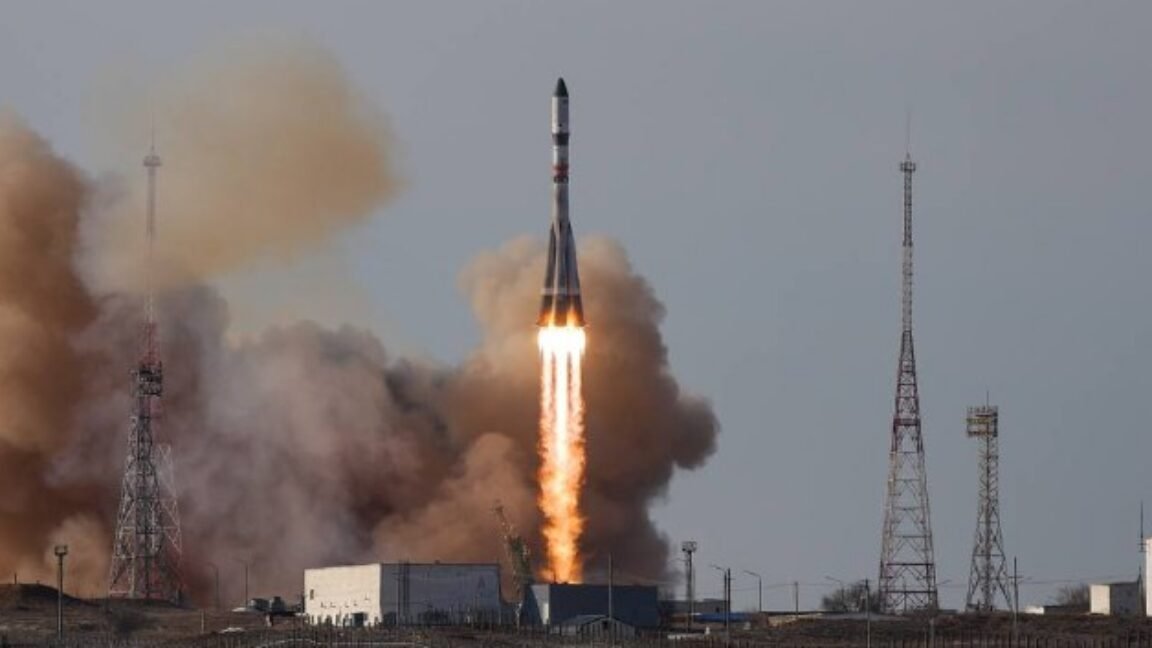
Site 31 is back in business. Russia’s only human-rated launch pad at the Baikonur Cosmodrome in Kazakhstan is back in service less than four months after being damaged during liftoff of a Soyuz rocket last year. Workers erred in leaving the site’s servicing platform unsecured, and it fell into the pad’s flame trench after being blasted by the Soyuz booster’s engines. Russian officials delayed the next Soyuz launch from Baikonur as technicians scrambled to install a new platform. The repairs were completed a few weeks ago, and a Soyuz rocket lifted off from the pad Sunday with a Progress supply ship heading for the International Space Station.
Manual docking… The Progress MS-33 cargo freighter delivered several tons of fuel, water, and supplies to the International Space Station and its seven-person crew Tuesday, but the craft’s trip to the station was not free of trouble. One of the spacecraft’s Kurs rendezvous antennas failed to deploy after launch, forcing Russian cosmonaut Sergey Kud-Sverchkov to take over remote control of the Progress supply ship for a manual docking at the complex. Russia’s Tele-robotically Operated Rendezvous Unit, or TORU, system allows cosmonauts on the space station to remotely pilot cargo ships as they approach the outpost. (submitted by EllPeaTea)
Amazon plans to ramp up launch cadence. Amazon vowed this week to double the annual launch rate for its low-Earth orbit broadband constellation to more than 20 missions, hinging largely on rockets yet to prove themselves at scale, Space News reports. The Amazon Leo constellation now has 212 production satellites in orbit, less than 7 percent of the network’s planned 3,232 satellites. But the pace of Amazon’s satellite manufacturing appears to be going well. The company says it has more than 200 additional satellites “stacked and ready for launch.” Three more launches are planned over the next month—two on United Launch Alliance Atlas V rockets and one on Europe’s Ariane 6 rocket. That would bring Amazon to 11 launches in the first year of Amazon Leo’s full-scale deployment.
Waiting on rockets… “Every satellite adds coverage and capacity to the network, and we’re on pace to more than double our annual launch rate to over 20 missions and send even more satellites to space at a time,” Amazon wrote in a post on its website. “As of mid-March, we have six fully stacked payloads at our satellite processing facility in Florida—more than 200 satellites in total—and another payload being prepared in French Guiana.” The problem is that ULA’s Vulcan rocket, which Amazon chose to launch the bulk of the Amazon Leo constellation, is grounded after a booster anomaly last month. In the meantime, ULA’s soon-to-retire Atlas V rocket will launch the next two sets of Amazon satellites, with 29 flying on each rocket. That is an increase over the 27 satellites flown on prior Atlas V launches. An Ariane 64 rocket will launch another Amazon package from French Guiana in late April. Meanwhile, Amazon confirmed earlier this year it purchased 10 more Falcon 9 launches from SpaceX to help hasten the deployment of Amazon Leo. (submitted by EllPeaTea)
Fortifying spaceports from cyber attacks. The US Space Force has established two new cyber squadrons to defend against potential cyber attacks during launches, Breaking Defense reports. The new units at Patrick Space Force Base in Florida and Vandenberg Space Force Base in California will help the military “stay ahead of the threat,” said Maj. Torius Davis, commander of the 630th Cyberspace Squadron at Vandenberg. Both ground terminals and satellites have become targets for cyber operations in recent years.
Securing the range… “Much like the anti-jamming capabilities we build into our modern satellites, our new Cyberspace Squadrons will work to secure our launch systems from a myriad of potential threats, from hijacking satellites or ground systems to using malware to gain unauthorized access to our systems,” Lt. Col. John Quinn, commander of the 645th Cyberspace Squadron at Patrick. The emphasis on cyber defense follows work done to protect launch sites from physical intrusions and drone threats, which have been on the rise in recent years.

Artemis II back on the pad. NASA’s Artemis II rocket returned to the launch pad March 20 after repairs inside the cavernous Vehicle Assembly Building at Kennedy Space Center in Florida, Spaceflight Now reports. The 322-foot-tall (98-meter) Space Launch System rocket took about 11 hours to cover the 4-mile journey to Launch Complex 39B atop a mobile launch platform and crawler-transporter. The rocket’s arrival at the pad keeps NASA on schedule to launch the Artemis II mission no earlier than next Wednesday, April 1, with a two-hour window opening at 6:24 pm EDT (22:24 UTC).
Crew arriving soon… The four astronauts who will fly around the Moon on Artemis II will travel from Houston to Kennedy on Friday. Commander Reid Wiseman, pilot Victor Glover, mission specialist Christina Koch, and Canadian astronaut Jeremy Hansen will spend more than nine days in space, traveling farther from Earth than any human in history.
Once again, ULA’s Vulcan can’t answer the call. For the fourth time in a little more than a year, the US Space Force needs to send up a new satellite to replenish the military’s GPS navigation network. And once again, the company the Pentagon is paying to launch it can’t answer the call, Ars reports. United Launch Alliance, a 50-50 joint venture between Boeing and Lockheed Martin, was supposed to launch the final satellite for the Space Force’s GPS Block III program this month. Space Systems Command, responsible for buying spacecraft and rockets for the military, announced March 20 it has transferred the launch to a Falcon 9 rocket from SpaceX, ULA’s chief rival in the market for launching US government satellites.
More to come?… Lt. Gen. Doug Schiess, the Space Force’s deputy chief of operations, told a House subcommittee Wednesday that the military was looking at moving more missions off of ULA’s Vulcan rocket to other providers. Currently, only ULA’s Vulcan and SpaceX’s Falcon 9 and Falcon Heavy rockets are certified for national security launches. The Vulcan rocket is expected to be grounded until at least this summer as engineers investigate a recurring problem with the vehicle’s solid rocket boosters.
NASA is blowing things up. A team of NASA engineers is intentionally blowing up models of methane-fueled rockets in Florida to see just how big of a bang they make when they explode, Ars reports. Methane is the launch industry’s chic new rocket fuel because it is better suited for reusable engines. Heavy- and super-heavy-lift rockets like Blue Origin’s New Glenn, ULA’s Vulcan, and SpaceX’s Starship now use it. But rockets sometimes blow up. The US Space Force and NASA, the agencies responsible for range safety at America’s federally owned spaceports, want to better understand how the hazards from an exploding methane-fueled rocket might differ from those of other launchers. This is important as launches become more routine, with companies foreseeing multiple flights per day from launch pads that are, in some cases, just 1 or 2 miles apart.
For good reason… Federal safety officials require the evacuation of blast danger areas around each launch pad as rockets are fueled for flight, and some companies have raised concerns that SpaceX, which has the largest of the methane-burning rockets, could disrupt their operations on neighboring launch pads. The ongoing explosive yield tests at Eglin Air Force Base, Florida, are meant to help officials fine-tune their hazard analyses to determine the proper size of the danger areas for methane-fueled rockets. Hopefully, the data will show the danger areas are too conservative, and the keep-out zones will shrink. The concept is simple. “We put fuel in a rocket, blow it up in a remote location, and measure how big the boom is,” said Jason Hopper, deputy manager for the methalox assessment project at NASA’s Stennis Space Center.
Next three launches
March 28: Electron | Daughter of the Stars | Māhia Peninsula, New Zealand | 09:14 UTC
March 28: Spectrum | Onward and Upward | Andøya Rocket Range, Norway | 20:00 UTC
March 29: Atlas V | Amazon Leo LA-05 | Cape Canaveral Space Force Station, Florida | 07:53 UTC