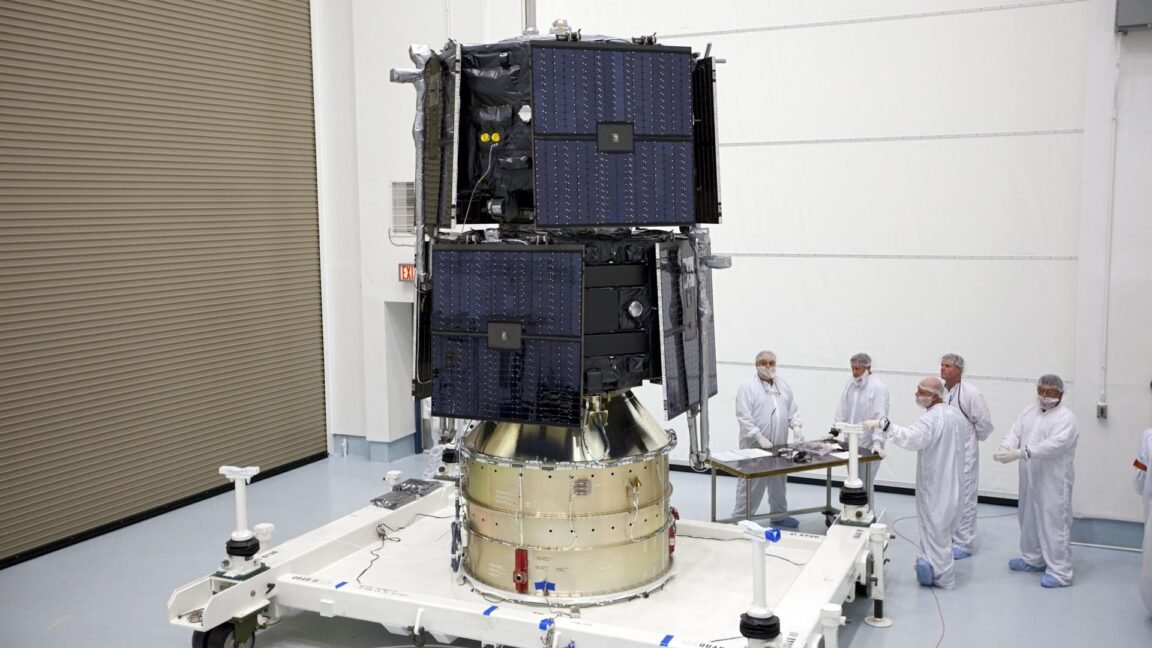
A NASA satellite that spent more than a decade coursing through the Van Allen radiation belts encircling Earth is about to fall back into the atmosphere.
Most of the spacecraft will burn up during reentry, but a fraction of the material making up the 1,323-pound (600-kilogram) satellite will likely reach Earth’s surface without vaporizing in the atmosphere. Uncontrolled reentries of satellites with comparable mass happen quite regularly—multiple times per month, according to one recent study—but most of them are older spacecraft or spent rocket bodies.
This reentry is notable because it poses a higher risk to the public than the US government typically allows. The risk of harm coming to anyone on Earth is still low, approximately 1 in 4,200, but it exceeds the government standard of a 1 in 10,000 chance of an uncontrolled reentry causing a casualty.
“Due to late-stage design changes, the potential risk of uncontrolled reentry increased,” a NASA spokesperson told Ars. “After taking into account the mission’s scientific benefits and the low risk of harm to anyone on Earth, NASA granted a waiver to address the non-compliance with the US Government Orbital Debris Mitigation Standard Practices. Consistent with national policy, NASA notified the US Department of State about the exception.”
Plus or minus 10
The spacecraft, called Van Allen Probe A, launched in 2012 as part of a two-satellite mission to study Earth’s radiation belts. The belts are a collection of charged particles trapped by Earth’s magnetic field, and they help protect our planet from cosmic radiation and solar storms.
It is difficult to predict satellite reentries. The density of the upper atmosphere varies, and the latest prediction from the US Space Force showed Van Allen Probe A will reenter the atmosphere early this week, with the reentry window open from late Monday through late Wednesday.
No one on the ground has ever been injured by falling space junk, but there are examples of space debris causing property damage.
NASA’s two Van Allen Probes launched into elliptical orbits ranging from a few hundred miles above Earth up to an apogee, or high point, of nearly 20,000 miles. The orbits are inclined 10 degrees to the equator, limiting the risk of injury or damage to a swath of the tropics. NASA ended the mission in 2019 when the satellites ran out of fuel.
At that time, NASA engineers expected the spacecraft to reenter the atmosphere in 2034. But higher-than-anticipated solar activity caused the atmosphere to swell outward, increasing atmospheric drag on the satellites beyond initial estimates, according to NASA. Van Allen Probe B is expected to reenter no earlier than 2030, with a similar risk to the public.
The two spacecraft were built by the Johns Hopkins University Applied Physics Lab. NASA said the mission made several major discoveries, including “the first data showing the existence of a transient third radiation belt, which can form during times of intense solar activity.”
Several NASA satellites have reentered the atmosphere without complying with the government’s risk standard. One of the satellites, the Rossi X-ray Timing Explorer, fell out of orbit in 2018 with a 1-in-1,000 chance of harming someone on the ground. No one was hurt. RXTE was launched in 1995, just four months before NASA issued its first standard on orbital debris mitigation and reentry risk management.
While NASA has exceeded its standards before, the US government is not a top offender when it comes to unmitigated reentry risks. China launched four heavy-lift Long March 5B rockets between 2020 and 2022, and left its massive core stages in orbit to fall back to Earth. The four abandoned rocket cores, each nearly 24 tons in mass, reentered the atmosphere uncontrolled. Two of them dropped wreckage on land—in the Ivory Coast and Borneo—but no injuries were reported.