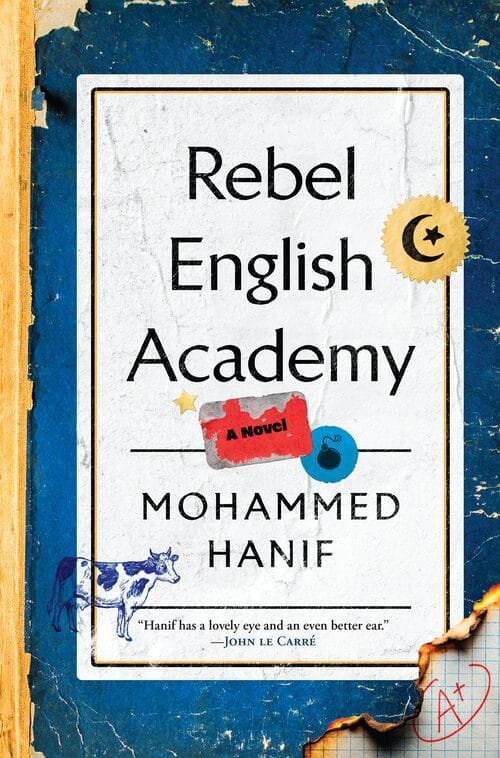
‘He didn’t believe in peaceful resistance but he was not a happy murderer either,’ Salim Ahmed Salim aka Sir Baghi, an English teacher and revolutionary socialist activist, is confronted with a tough choice. A known radical in OK Town, tensions reach boiling point following the execution of Pakistani Prime Minister Zulfikar Ali Bhutto and the imposition of martial law, Sir Baghi feels the pressure from a student who seeks revenge. Mohammed Hanif’s latest novel Rebel English Academy deals with one of Pakistan’s most troubled periods in the late 1970s. The execution of Bhutto brought to an end a certain post-independence and post-partition politics in the South Asian nation and ushered in a very different country. Mohammed Hanif, a graduate of Pakistan’s Air Force Academy turned journalist, has previously dealt with the military involvement in politics in his novel A Case of Exploding Mangoes, which earned him international critical acclaim and established him as offering a sharp eye.
Rebel English Academy centres on two characters in OK Town during the aftermath of Prime Minister Bhutto’s execution by the military. Sir Baghi and Captain Gul, a military intelligence officer, who is tasked with crushing dissent and protests in the town. Gul’s womanising leads him into a romantic dilemma, which compromises his job and undermines efforts to control the town. Rumours circulating in the town that Bhutto is still alive unnerves the authorities. Captain Gul, who was present at Bhutto’s execution and helped with putting the slain PM into his coffin, finds himself being dressed down rather than praised by his senior officer. The existence of the rumour leads to an accusation that he didn’t do his job properly as he was in charge of making sure the event was properly photographed. While Captain Gul has high aspirations, ‘He hopes to be on the world stage. He hopes his name will be whispered in Westminster and Langley, in the ruined palaces of Afghanistan and solitary cells in high-security Indian prisons,’ he quickly discovers that failure to quash rumours and stifle dissent in the town will jeopardise his career, personally.
BOOK REVIEW: The Rise and Fall of Turkey’s Democrat Party: The Cold War and Illiberalism, 1945–60: 73
Sir Baghi, who boasts teaching English to officials, activists and others, has a record of political dissent. During Bhutto’s reign, Sir Baghi wrote an open letter that got him arrested, addressed to 38 heads of state of Muslim-majority countries attending a summit in Lahore, ‘we see you for what you are: you eat the flesh of your people and you devour it with a healthy dose of our blood.’ The open letter reveals not only his anger but also the extent of his activism, while he belongs to a left-wing militia, he adheres to a belief that to kill someone is to kill a piece of yourself and the one time he did use a gun that led to someone getting a shattered knee and forced him to go underground for three years. This is a source of tension between Sir Baghi and his comrades, ‘Baghi believes that some revolutionaries were basically gleeful murderers.’ But when a young woman seeks refuge in his academy, which is based inside a mosque, this tension comes to the forefront. Sabiha Bano is out for blood, her parents are political prisoners and her husband dead, she turns up in the academy brandishing a gun. Sir Baghi encourages her to write and the novel has smatterings of her works about her life.
Rebel English Academy makes for an intriguing and eventful read. Told from the perspective of a town rather than a major urban centre like Karachi or Lahore, the novel explores responses of Pakistanis to the death of Bhutto, which was a seminal moment in the country’s history. But through the prism of a non-believing and homosexual English teacher, a small-time military officer with dreams of grandeur and a militant young woman, it offers international readers a nuanced, contradictory and more authentic view of the South Asian country during martial law. Hanif’s novel reads-like you are watching a country on edge about to spiral into violence playing out in front of you. While the book is set in the past, it very much feels like the present is unfolding and so there is a genuine tension the reader feels as the plot unfolds.
BOOK REVIEW: The New Byzantines: The Rise of Greece and the Return of the Near East