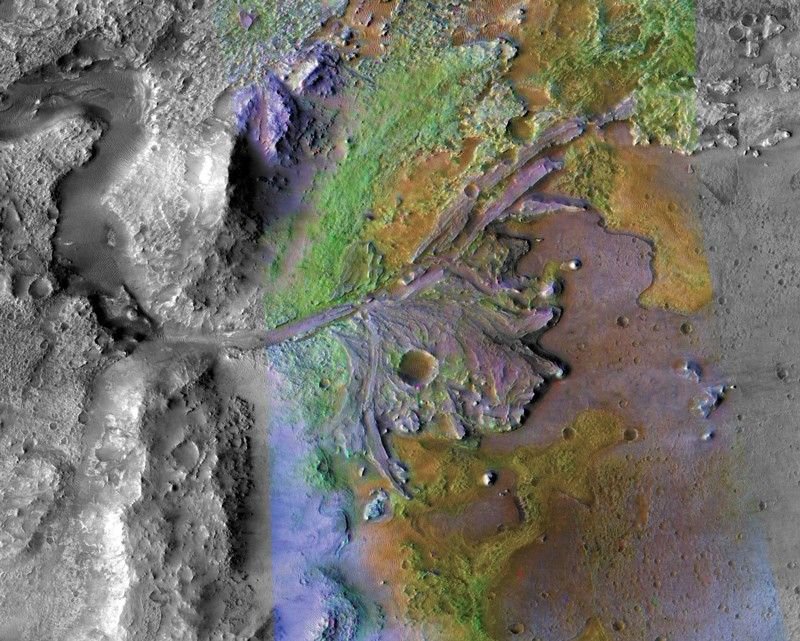
When NASA’s Perseverance rover landed in Jezero Crater in 2021, its primary mission was to scour the remnants of a dried-up Martian lakebed for signs of ancient life. Scientists have been focused on the crater’s spectacular Western Delta, a fan-shaped geologic feature deposited by a river flowing into the basin billions of years ago. But now Perseverance’s ground-penetrating radar (called RIMFAX) detected what is likely another, even older river delta buried tens of meters beneath it.
“I think it’s a promising place to look for signs of biosignatures at depth,” says Emily L. Cardarelli. “Microbial life could have potentially developed in those types of environments.” Cardarelli, an astrobiologist at the University of California Los Angeles, led the team interpreting RIMFAX imagery.
Peeking underground
Perseverance’s RIMFAX, the Radar Imager for Mars Subsurface Experiment, continuously fires radar waves into the ground, acquiring soundings each time the rover traveled 10 centimeters. When these radio waves hit boundaries between different types of rock, ice, or sediment layers, some of the signal bounces back. The timing and intensity of these reflections allow scientists to construct a two-dimensional, vertical slice of the subsurface, much like a sonogram of the Martian crust.
During a campaign spanning from September 2023 to February 2024, or over 250 Martian sols, Perseverance drove across a geological zone known as the Margin unit. The Margin unit is an expansive deposit flanking the inner rim of Jezero’s inlet valley, occupying the space between the western fan deposits and the crater rim. It is rich in magnesium carbonates, which was one of the main reasons Jezero Crater has been chosen as the Perseverance’s landing site: on Earth, carbonates are exceptionally good at preserving the chemical fingerprint of life. “You can think of the Cliffs of Dover, for example, that are all carbonate—they have tons of fossils in them,” Cardarelli says.
Cardarelli’s team analyzed the RIMFAX data and found that the rock comprising the Margin unit was exceptionally transparent to the radar’s waves. This homogenous, low-loss material allowed the radar signals to penetrate deeper than they had in any other previously explored region of Jezero Crater. Soundings reached down more than 35 meters, roughly 1.75 times deeper than measurements taken on the crater floor or the overlying Delta units. Taking into account the surface topography, the team estimates the true thickness of the Margin unit to be at least 85 to 90 meters.
But the real jackpot was the highly structured geometry of geologic features the radar saw at these depths.
The hidden delta
When geologists look at the cross-section of a river delta on Earth, they see distinct features that tell a story of water flow, sediment dumping, and changing water levels. The RIMFAX data revealed exactly this kind of structured layering beneath the Margin unit, with features ranging from tens of centimeters to hundreds of meters across. “We saw really high complexity in the subsurface,” Cardarelli says.
The radar readouts displayed parallel layers dipping toward the center of the Jezero basin at angles of three to 15 degrees. These sweeping, laterally continuous lines are classic signatures of what geologists call clinoforms, layers of sediment that build outward into the water as the river deposits material, forming underwater ramps.
When a fast-moving river carrying sand and gravel suddenly hits the still, deep waters of a lake, it loses its kinetic energy and drops its contents. The heaviest sediments settle quickly on the lake bottom, forming flat, horizontal layers known as topsets. As the sediment continuously piles up and pushes further out into the lake, it eventually reaches a critical angle at the edge of existing sediments and cascades down the underwater slope, forming angled layers called foresets. At the very bottom of the lake, finer sediments fan out into horizontal bottomsets.
The RIMFAX images seemingly captured these transitions, known as rollover points, spread throughout the Martin crust. These rollover points, the team thinks, are the telltale signs of a dynamic fluvial environment that didn’t just bring lots of dirt once, but experienced multiple distinct episodes of continuous deposition over a long period of time. The now-underground river delta looks remarkably similar in scale and structure to ancient delta environments preserved here on Earth.
Watery timeline
This subsurface architecture reframes the timeline of Jezero Crater’s watery past. The radar data from the rover’s 6.1-kilometer traverse makes it clear that the Margin unit physically sits underneath the rocks of the Western Delta. In geology, the stuff on the bottom is usually older.
If Cardarelli’s interpretation is right, it means that, long before a Martian river system carved out the massive Western Delta that we see from orbit today, an entirely different river system had already built a vast delta in the same exact spot. This hidden delta formed during the Noachian period, an era of Martian history when the planet was significantly warmer and wetter, which ran approximately from 4.2 to 3.7 billion years ago. The presence of these deep sedimentary layers suggests that early Mars wasn’t just briefly wet but likely maintained consistent, long-lived conditions that allowed massive amounts of sediment to be systematically transported and deposited over expansive geologic timescales.
But Cardarelli’s team admits an ancient river delta, while very probable, is just one of several hypotheses that could explain RIMFAX data.
Explaining layers
The first of the alternatives is that the geologic features detected by RIMFAX formed through igneous processes. “We talk about volcanic activity—pyroclastic events and volcanic ash fall moving through,” Cardarelli explains. The layers her team found could be solidified magma and ash that rained down from distant volcanic eruptions.
Another idea suggested by the team is the angled layers could also be remnants of a shoreline of an ancient lake. The team also considered a scenario where the Margin unit was just an area in front of a glacier where meltwater streams deposited materials washed out from the ice, forming broad, layered plains.
“But I think what led us to favor the fluvial, deltaic hypothesis is simply the number and scale of the features we observed and their complexity,” Cardarelli says.
Her leading explanation is also the one most favorable to potential Martian life. If microbial life ever existed on Mars, it would have needed stable, long-lasting aquatic environments. A massive delta system pouring into a crater lake should, in principle, provide the right mix of nutrients, water, and chemical energy. “We know that there are potential signs of past microbial life at the surface of Jezero Crater,” Cardarelli says. “Now we see there was an aqueous history there for quite a long time.” And she thinks there’s a lot more left to see in Jezero Crater.
Cardarelli’s study was based on data from 6.1 kilometers of Perseverance’s traverse. “And we have 40 kilometers of data, so please look for upcoming RIMFAX papers,” Cardarelli says. “We have more to say about this area. There’s a lot of stories to be told.”
Science Advances, 2026. DOI: 10.1126/sciadv.adz6095