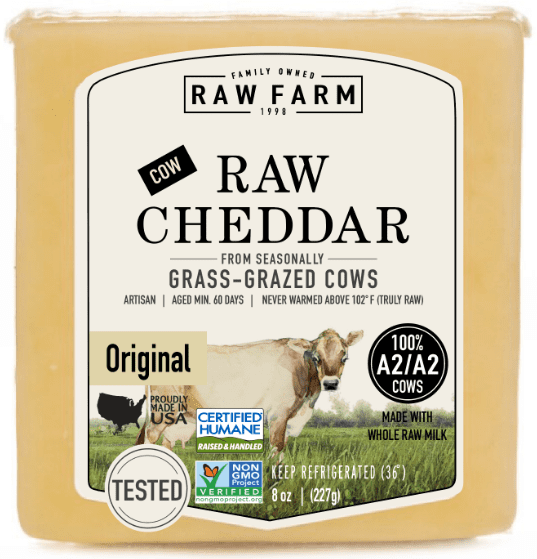
Two more illnesses have been identified in an E. coli outbreak linked to unpasteurized cheese and milk, the Food and Drug Administration reported Thursday. The maker of the products, California-based Raw Farm, continues to deny the link and has refused to issue a recall.
According to the FDA, at least nine people have been sickened in three states, an increase of two cases since the outbreak was announced earlier this month. Three of the nine cases required hospitalization, and one person developed a life-threatening complication called Hemolytic uremic syndrome, or HUS, which causes a type of kidney failure.
Outbreak investigators have interviewed eight of the nine people sickened. All eight reported consuming unpasteurized dairy. One person couldn’t recall a brand, but the remaining seven all singled out products from Raw Farm. Five people ate Raw Farm’s raw cheddar, and two drank Raw Farm’s raw milk. Whole genome sequencing of the E. coli isolates from the patients shows high similarity, suggesting they came from a common source.
The FDA highlighted that the people sickened in this outbreak are young, with over half being less than 5 years old. Children under 5 are particularly vulnerable to severe complications, including HUS, from the type of E. coli in this outbreak, which is a Shiga toxin-producing E. coli, or STEC.
In an infection, STEC makes its way into the intestines and burrows into the mucous layer, where it starts secreting toxin. The toxin can bind to a receptor on certain cells (Gb3) and shut down protein production, causing the cell to die and triggering inflammation. In the progression to HUS, the toxin gets into the bloodstream and takes is cell-killing abilities body-wide. But the tiny blood vessels in the kidney—which have the highest prevalence of receptor Gb3—are most vulnerable. Flooded with toxin, the kidney’s small blood vessels become damaged, red blood cells start bursting, platelets form clots, and the vessels start shutting down entirely, causing parts of the kidney to die and the body to run low on red blood cells and platelets.
Dangerous contamination
For patients, the symptoms of HUS can develop from abdominal pain and bloody diarrhea to signs of kidney failure, including less urine production, blood in the urine, and fluid overload. Signs of anemia (paleness, fatigue, fainting) and low platelets (easy bleeding and bruising) may also be present. With supportive treatment, the fatality rate is only about 5 percent, but up to 25 percent of cases will develop long-term kidney problems.
One of the most common causes of HUS is drinking STEC-contaminated, unpasteurized milk—which is milk that hasn’t been briefly heated to kill off disease-causing microbes, like STEC. Cattle asymptomatically carry STEC and other pathogens in their digestive systems, and those germs can easily transfer to milk during the milking process. Cheeses made from unpasteurized milk can be aged to reduce—but not eliminate—pathogenic bacteria. FDA testing of a survey of various cheeses aged 60 days on the market found that the pathogen contamination rate was less than 1 percent. The raw cheese linked to the current outbreak is labeled as having been aged a minimum of 60 days.
Raw Farm, a high-profile anti-pasteurization dairy producer, has been linked to over a dozen other outbreaks and many recalls in the last 20 years, including a Salmonella outbreak in 2024 that included at least 171 illnesses. But in repeated social media posts, Raw Farm owner Aaron McAfee (son of founder Mark McAfee) has rejected any responsibility for the illnesses and says they “100% disagree” with the FDA’s findings.
In a social media post Thursday, McAfee touts that testing of their dairy came back negative for STEC. But food safety experts have cautioned that low-level contamination can be very difficult to detect in sample testing. For instance, detecting a single bacterium in a 25-gram food sample is equivalent to detecting 1 in 5 trillion parts or “a small needle in multiple haystacks,” according to a food testing review published last year. The review also notes that negative sampling doesn’t mean the rest of the batch is free of pathogens, as disease-causing germs are often distributed unevenly in batches of foods.