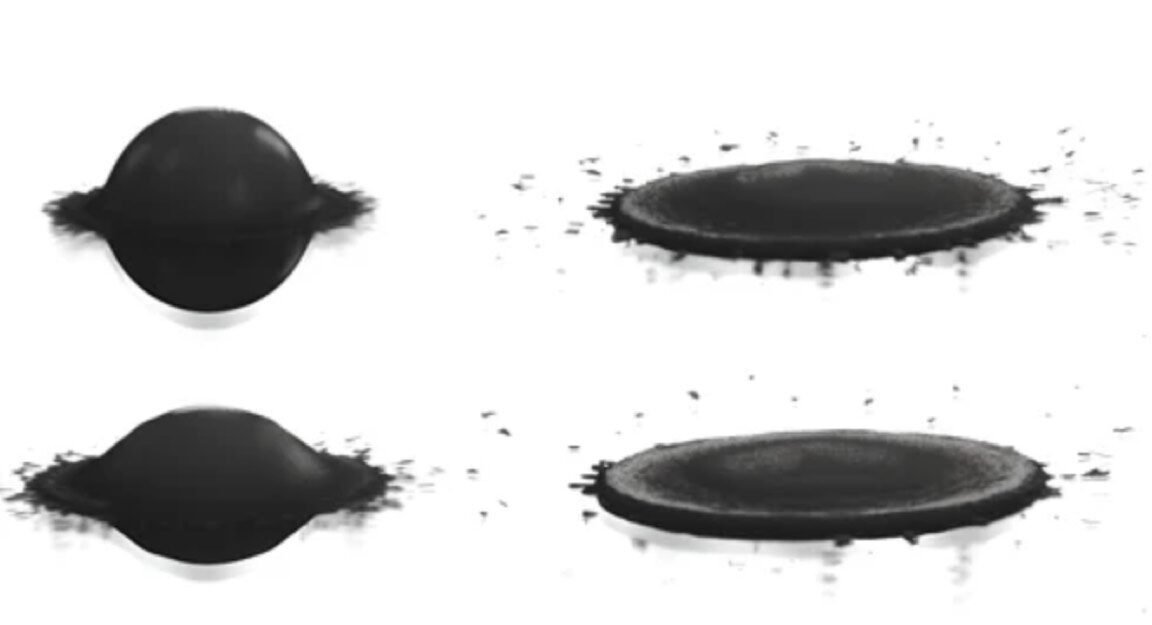
Mixing corn starch and water in appropriate amounts produces a slurry that is liquid when stirred slowly but hardens when you punch it—a substance colorfully dubbed “oobleck.” (The name derives from a 1949 Dr. Seuss children’s book, Bartholomew and the Oobleck.) High-speed imaging and force measurements have revealed another surprising property of oobleck drops hitting a flat surface, according to a new paper published in the journal Physical Review Letters.
As previously reported, in an ideal fluid, viscosity largely depends on temperature and pressure: Water will continue to flow regardless of other forces acting on it, such as stirring or mixing. In a non-Newtonian fluid, the viscosity changes in response to an applied strain or shearing force, thereby straddling the boundary between liquid and solid behavior. Stirring a cup of water produces a shearing force, and the water shears to move out of the way. The viscosity remains unchanged. But for non-Newtonian fluids like oobleck, the viscosity changes when a shearing force is applied.
Ketchup, for instance, is a shear-thickening non-Newtonian fluid, which is one reason smacking the bottom of the bottle doesn’t make the ketchup come out any faster; the application of force increases the viscosity. Yogurt, gravy, mud, pudding, and thickened pie fillings are other examples. And so is oobleck.
The underlying physics principles of this simple substance are surprisingly nuanced and complex, and thus fascinating to scientists. For instance, back in 2023, molecular engineers at the University of Chicago used dense suspensions of piezoelectric nanoparticles to measure what is happening at the molecular level when oobleck transitions from liquid to solid behavior.
The following year, researchers at the University of California, Merced, made conductive polymer films that actually toughen up in response to impact rather than breaking apart, much like oobleck. The films could be used for wearable electronics like smartwatch bands and sensors, as well as flexible electronics for health monitoring.
For this latest study, Anahita Mobaseri, a physicist at the University of Minnesota, and several colleagues wanted to explore the dynamics of drops of oobleck splashing onto a flat surface—an effect of great interest to controlling fluid flows in 3D printing, soft robotics, and the application of industrial coatings, among other applications. So they prepared cornstarch suspensions of varying viscosities, from shear-thinning to shear-thickening regimes, monitoring the drop dynamics with both force sensors and a high-speed camera.
Mobaseri et al. observed the expected oobleck behavior: more dilute drops flowed more like a liquid, and concentrated drops stiffened like solid pellets in response to the shearing force. But they also noticed something unexpected regarding dense drops with particularly high shear rates. Those drops would very (very) briefly spread like a Newtonian liquid before stiffening into a solid. The work “provides new insights into the unusual behavior of shear-thickening fluids under ultrafast deformation and offers a comprehensive understanding of the impact dynamics of shear-thickening drops,” the authors concluded.
Physical Review Letters, 2026. DOI: 10.1103/fyx7-jb1d (About DOIs).