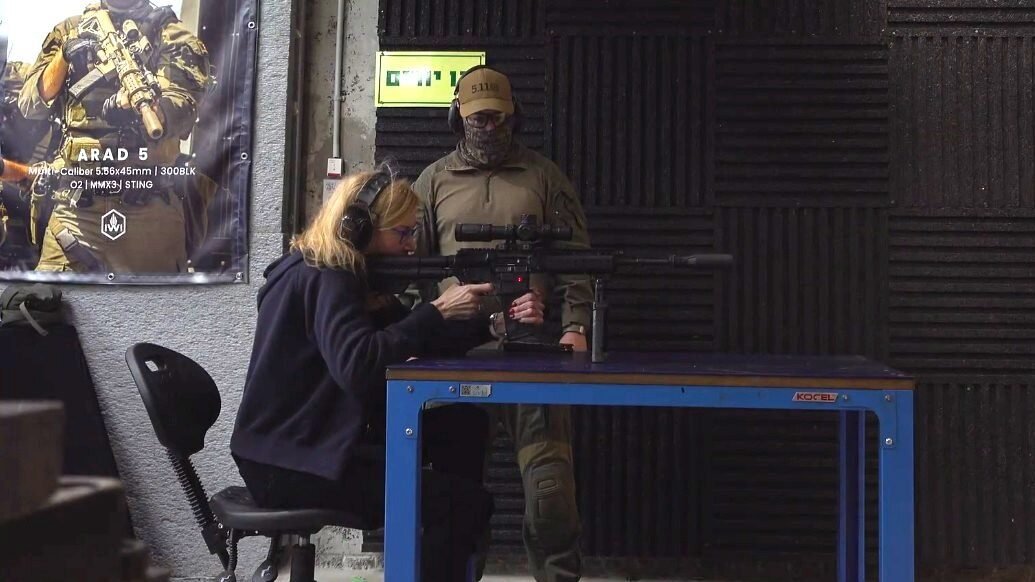
IWI’s Arbel system brings computing power to the trigger mechanism, aiming to help soldiers land fast, consecutive hits on fleeting threats—especially small tactical drones
Drone warfare is here to stay, and at Israel Weapon Industries (IWI), the answer taking shape is not a separate anti-drone gun but a standard rifle upgraded at its most decisive point: the trigger. The company’s Arbel system brings computing power into light arms so that soldiers can land multiple hits in the brief, high-pressure moments when a target appears and disappears just as quickly.
I visited the expansive and sophisticated headquarters of Israel Weapon Industries to learn how the anti-drone system works.
Semion, IWI’s director for Europe, whose surname is withheld for security reasons, described the concept plainly. “Arbel is actually the first computerized weapon system we put into light arms and specifically to assault rifles and light machine guns,” he said.
“It takes a computer to the trigger mechanism and enhances the performance of the soldier, of the operator on the field, to actually hit the target when he has a short time frame to hit it, and he has to hit it more than once,” he explained.
That need for multiple hits is central to how IWI frames the problem. “One bullet will not be enough,” Semion said.
It’s the same weapon you’ve had before, and once you keep the trigger pulled, the system goes into effect
Arbel is designed to preserve the shooter’s familiar first shot while changing what happens next. “What you do as a shooter, you aim at your target, you shoot at it, the first bullet is purely mechanical,” he said. “It’s the same weapon you’ve had before, and once you keep the trigger pulled, the system goes into effect.”
From the second round onward, Semion said, the system times follow-up shots by analyzing the shooter’s “micro-movements,” stability, and circumstances to determine when there is “the best probability” of hitting the next round.
“So, the system is relevant from the second round onwards,” he said, and “as long as you keep the trigger pulled, it will understand how stable you are, and according to the situation, it will allow and time the next consecutive round when you have the best probability to hit.”
While Arbel was built with a broad set of battlefield problems in mind, Semion said the rise of small tactical drones sharpened its relevance. “As we learn, and as the battlefield emerged in the last few years, we understood a new threat called drones,” he said.
He described those drones as “usually very small” and used mainly for three missions: reconnaissance and intelligence gathering, dropping explosives from above, or carrying “a small charge” intended to strike a target directly.
IWI’s argument is that the danger becomes acute at the individual-soldier level because reaction time collapses. “So, we came to understand that this is no different from other hard targets you can have on the battlefield,” Semion said, adding that the company’s goal is to offer “the same solution also against these tactical drones.”
Just as important as performance, he suggested, is how little Arbel asks the soldier to change. “The whole concept is that you still hold your own weapon, your own firearm, which is your main weapon,” he said.
“You don’t need to change anything, you don’t need to switch to a secondary weapon,” he added. Troops can also use “your own ammunition,” meaning “not special ammunition, not something more expensive.”
In practice, Semion said, Arbel is installed by replacing the lower receiver with a computerized one while keeping the upper receiver unchanged. “The whole upper stays the same,” he said. Installation, he added, is simple: “It’s just two pins that you put in and it’s ready to operate.”
Weight is part of any infantry conversation, and Semion addressed it directly. “It weighs the same,” he said, with “additional about 400 grams, mostly because of the battery that we need to use,” but argued that the burden is less noticeable because “it’s in the buttstock.”
Training, too, is presented as incremental rather than disruptive. Semion said that because the platform remains an AR-15, little changes in basic operation beyond “the operation of the safety” and, mentally, learning to keep the trigger pulled after the first round. I saw that firsthand when I put my hand on the trigger and tried the system myself at IWI’s range. The sensation was not of learning a wholly new weapon, but of adjusting to a new rhythm: the first round felt familiar, while the follow-up shots depended on staying steady and letting the system time the next opportunity. He described the learning curve as manageable, requiring “minimum training in terms of time and in terms of ammunition.”
The company’s range serves both as a testing site and as a place to demonstrate the system. “We shoot 100% of the weapons going out of the factory,” Semion said, adding that potential users are also invited to test products themselves.
For drone demonstrations, he said, IWI uses simple platforms because of presentation constraints. “We keep to the simplest ones, smallest ones, just to demonstrate the idea,” he said. As for engagement distance, he rejected the notion of a neat rule. “There is no real measurement,” Semion said. “The limitation is the ability for the shooter to see the drone and to aim at it.”
Still, he offered examples of what IWI says it has achieved under test conditions. “We’ve been able to shoot down drones from 450 meters in daytime using regular day scopes,” and at night, “using thermal vision from about 250 meters.” He returned to the same caveat: “the real limitation is the ability of the user to really see the target by himself.”
In one demonstration at the range, the result was described in blunt mechanical terms. “We made five shots and four out of them were actually able to reach the destination,” a speaker said. “The first one went straight into the battery compartment,” the speaker explained; another hit “was able actually also to hit the camera, disabling it completely,” while additional shots “hit the pieces that hold the propellers.” The distance was “100 meters.”
The handling method itself is deliberate and controlled. “When we’re shooting our belt, I want you to squeeze the trigger slowly, slowly, slowly, slowly,” an instructor said. “The moment you start shooting, just hold it all the way back. Hold the trigger all the way back. Let the gun shoot by itself.”
If Arbel’s appeal rests on timing and probability, its market case rests on cost as much as innovation. Asked whether there is a precise formula for how many rounds it takes to bring down a drone, Semion said, “There is not a concrete math or something you can pinpoint,” while repeating the basic premise: “one bullet is usually not enough.”
Using standard ammunition is part of the logic. Semion said the ability to use “your own 5.56 ammunition, SS109, the standard ammunition,” is “a big advantage,” because it is inexpensive. “It’s about, let’s say, a dollar for a bullet.”
Performance varies, he said, but he offered a baseline claim. “We’re able to hit drones as low as four to five rounds being shot, which takes about two to three seconds.” That matters, he argued, because drones are “very, very cheap,” and militaries cannot rely on “very expensive ammunition,” especially “when talking about a large number of drones.”
For that reason, he said, the more meaningful measure is not just rounds fired but interception time. “Our solution gives you a very short interception time,” Semion said, “so it takes a very small window for you to really intercept and make the drone fall down.”
He declined to state Arbel’s purchase price publicly. “Of course, there are price points, which we don’t really discuss out in the open,” he said, but argued that it falls within familiar procurement territory. “We’re in the areas of pricing of standard assault rifles, not something dramatically increasing.”
When you keep it down to $10 to $20 to interception, it makes it much more reliable and much more resilient for the long run
Instead, he emphasized cost per engagement. “When you keep it down to $10 to $20 to interception, it makes it much more reliable and much more resilient for the long run,” he said.
Arbel’s development took several years and was shaped in part by events in Israel. “It took a few years to develop the initial idea until a working device,” Semion said. “It was launched in 2024,” he added, noting that the rollout had originally been planned for late 2023 but was delayed “because of the events in Israel.”
He described a field-feedback approach in which systems are placed in users’ hands early “to feel it, to see real situations, to see real fields, to get real feedback,” calling that part of the research and development phase.
Demand, especially in Europe, has accelerated as drones have become a defining feature of what he called “the new methodology of war.” Semion said IWI already sees “about 10 to 15 countries in different stages of implementation” and projected that “about 40% to 50% of the European countries” could be engaged with the system in 2026. Asked who the buyers are, he answered broadly: “Basically, everyone.”
When asked about Arbel’s local use and whether IWI could provide operational figures, Semion drew a line. “We, as manufacturers, don’t correspond or don’t know what is being used with our systems,” he said. While the company receives feedback that the system works, he described “a healthy distance” from specific performance tallies, saying IWI is “not into the numbers and the performance and specifics.”
On manufacturing, the message was blunt. Asked whether production is outsourced, Semion replied, “Everything in Israel.”
He described IWI as export-oriented by design. “The whole idea of this company is to focus mostly on export,” he said, adding that even during wartime periods of higher domestic demand, “it did not affect our supply chain and our supplies to different customers around the world.”
Part of that resilience, he said, comes from expanded capacity. “This is a new facility that moved about a year and a half ago,” he said, adding that it had increased space, capacity, efficiency, and storage.
Although Arbel’s first implementation focused on the AR-15 because it is “the most common today and the most widely used,” Semion said the concept is not locked to a single platform. “It is technically possible to implement it on other platforms as well,” he said, adding that the company has “the know-how, the ability, and the will to do that relatively fast.”
He also characterized Arbel as “a family of products,” saying the concept has already been applied to light machine guns, specifically IWI’s Negev platform. In that version, the focus changes. “It’s not about timing the consecutive rounds; it’s about managing the cadence of fire to make it more manageable,” he said.
Arbel also sits within a broader corporate structure that IWI argues gives it an advantage in offering bundled solutions. Semion described SK Group as “the biggest privately held defense company in Israel,” a holding company that includes IWI alongside other defense-sector businesses.
For procurement officials, he said, that structure can simplify packaging, especially in pairing weapons with optics. “A natural combination is with Meprolight, a sister company of IWI,” he said, because “very naturally you combine the weapon with optics as an accessory to the weapon.”
The advantage, he argued, is practical. “Now you have one POC or one company that you deal [with] and you can get the complete package.”
And while he acknowledged crowded markets in each category, Semion said the breadth of that integrated offer helps distinguish the company. “I don’t think there is a company that can offer assault rifles, light machine guns, submachine guns, pistols in high quality, together with the optics, and of course together with systems like Arbel,” he said. “This is pretty unique.”