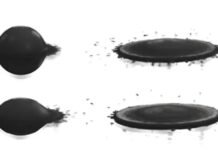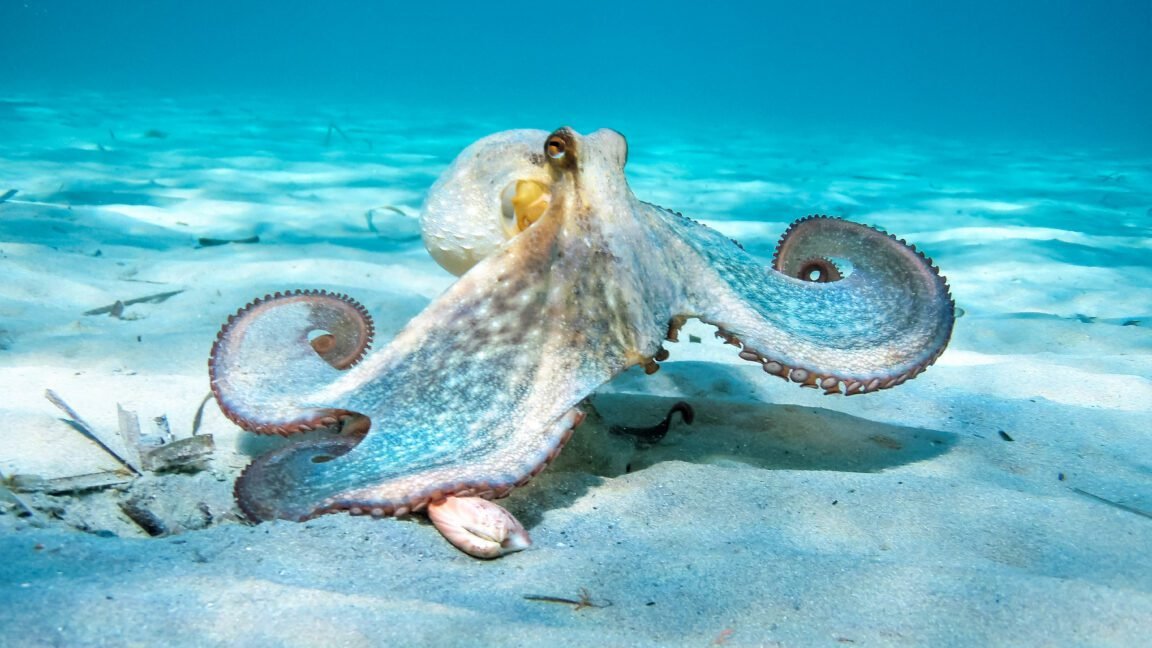
Pohlsepia mazonensis, a visually underwhelming fossil from Illinois, fundamentally broke our understanding of cephalopod evolution. Described in 2000 and hailed as the oldest known octopus in the fossil record, the specimen dated back to the late Carboniferous period, roughly 311 to 306 million years ago. Pohlsepia was an outlier—all other fossil records strongly suggested that crown coleoids, the group containing octopuses, squid, and cuttlefish, diverged much later, during the Jurassic.
To solve this puzzle, Thomas Clements, a paleontologist at the University of Leicester, and his colleagues put this supposed oldest octopus fossil through a series of high-tech imaging tests. They found Pohlsepia was not an octopus at all. Instead, it was a decomposed, squashed nautiloid.
A Rorschach test
The reason a nautiloid managed to masquerade as an octopus for almost a quarter of a century was due to the way that fossils from the Mazon Creek Lagerstätte formed. Around 300 million years ago, this area was a brackish, tidal marine basin that was periodically inundated by massive amounts of iron-rich river mud. When organisms died and were buried in this sediment fan, the high iron content triggered the precipitation of the mineral siderite around their decaying bodies, locking them inside hard geological nodules.
This process can preserve soft tissues, but it doesn’t turn the dead animals into three-dimensional statues. Instead, the soft parts of Mazon Creek organisms are typically preserved as flat, two-dimensional stains that contrast only slightly with the dark rock around them. Essentially, the first paleontologists who worked with Pohlsepia were staring at a vague smear on a rock, trying to interpret its anatomy. It’s a bit like interpreting Rorschach test drawings.
The researchers thought they were looking at a creature with a fused, sac-like head and mantle, an arm crown, symmetrical fins, and a pair of eyespots. There was no evidence of an internal or external shell. So the original team declared it a cirrate octopod—one of the deep-water octopuses. “Superficially, it looks very much like a deep water octopus,” Clements said.
But there were issues with that hypothesis.
Questioning eyes
Right off the bat, the fossil lacked features like a single row of suckers or the arm cirri—hair-like strands that line the sides of the suckers in finned octopuses. The internal shell vestige that defines cirrate octopods is also missing. The original researchers noted some cryptic light stains protruding from the main body, but they dismissed those as fluids that leaked from the carcass during burial.
The first real doubt came in 2019, when a separate research team examined the supposed eyespots of Pohlsepia. The researchers were looking for melanosomes, the melanin-synthesizing organelles that are responsible for eye pigment. Melanosomes usually preserve beautifully in other Mazon Creek fossils. But in Pohlsepia, they found nothing; the chemical signature of the spots didn’t match coleoid ocular pigments at all. This led some researchers to question the octopus interpretation.
To settle this once and for all, Clements and his team took the Pohlsepia holotype (both parts of the concretion it was found in) to the SOLEIL synchrotron facility in Paris, where they blasted it with high-energy X-ray beams.
Blasting the stain
Clements and his colleagues were looking for the exact chemical composition of the Pohlsepia fossil. “We decided to throw as many different techniques as possible at this fossil to try to work out what it was,” Clements said.
His team used a monochromatic X-ray beam that causes the different elements trapped in the rock to fluoresce, allowing researchers to build high-resolution maps of the specimen’s chemical composition. They also ran the fossil through scanning electron microscopy, micro-CT scanning, and multispectral imaging at different wavelengths to get a full picture.
All this advanced imaging systematically left the octopus narrative untenable. The fins seen by the original team were revealed to be just part of the general body outline, with no definitive tissue folding. The multispectral images showed vague appendage-like structures but yielded no hard evidence for eight distinct arms or specialized tentacles. When the team ran micro-CT scans over the putative arms, they found no biomineralized hooks, which coleoids of that era possessed. Even the famous ink sac turned out to be a three-dimensional lump enriched with clays and pyrite. The supposed eyespots were also mineral deposits: shallow impressions filled with a dark, pyritic matrix but lacking any ocular pigments.
Finally, the cryptic light stains that the original authors dismissed as “expressed fluids” weren’t biological in origin, either. They just lacked the slight elevations in copper, arsenic, and kaolinite clay found in the fossil’s main body stain.
Based on all this, Clements and his colleagues concluded that Pohlsepia was not an octopus. So what was it?
Tongue and teeth
To find out what Pohlsepia actually was, the team had to look near its mouth. While mapping the elemental iron in the fossil, the synchrotron X-rays penetrated just 30 micrometers into the siderite matrix, but that was enough to reveal a previously undetected structure. “Underneath the top layer of rock, we saw a beautifully preserved radula,” Clements said.
Finding a radula, the chitinous, toothed, conveyor-belt-like tongue used by mollusks to scrape food, was the definitive proof that Pohlsepia was indeed a mollusk. A more precise answer came in the form of the teeth. The synchrotron scan was sharp enough to let researchers count the tiny, individual tooth impressions across the radula’s transverse rows. They observed a central rachidian tooth, pairs of lateral teeth, marginal teeth, and smooth marginal plates, adding up to at least 11 distinct elements per row. The only animals matching this exact 11-element configuration are Nautiloids, ancient, shelled relatives of modern cephalopods.
“Pohlsepia mazonensis is a nautiloid that died, decomposed, lost its protective shell and was subsequently flattened into the mud and preserved as an ambiguous stain,” Clements said.
Switching titles
But while the fossil’s “oldest octopus” badge is most likely gone, it managed to earn itself some new superlatives. “The first is of course the most difficult fossil to work on that I’ve ever worked on,” Clements said. “The second would probably be the most fun fossil I’ve ever worked on.”
The results of his study also made Pohlsepia the oldest unequivocal piece of evidence of nautiloid soft tissues ever found in the entire Paleozoic fossil record. “I’d say unequivocal because other nautiloid soft tissue fossils are a bit questionable,” Clements said.
His team now plans to use the same advanced imaging on other fossils. “Mazon Creek in particular is full of very interesting and very weird fossils which have not been looked at for a long time, and you know, all of these new techniques can be used on them,” Clements said.
He thinks that even for Pohlsepia itself, it’s not yet the end of the story. “It’s the oldest nautiloid now, so it would be interesting to study it more.”
Clements’ study on the Pohlsepia mazonensis is published in Proceedings of the Royal Society B Biological Sciences: https://doi.org/10.1098/rspb.2025.2369