So, baby, can’t you see
I’ve got to break free
I’ve got to break free
I want to break free, yeah
– Queen
The world cannot possibly absorb more exports from China, screamed the pundits.
After the US and Israel ignited the Middle East powder keg? Oh yes it can! And oh yes it will!
Now more than ever, the world – especially the Global South – will buy everything China has to sell.
China set off alarm bells after its 2025 trade surplus grew 20% year-on-year to $1.2 trillion, in defiance of Trump tariffs. China’s 2025 exports increased 5.4% while its already low imports fell marginally. The 20% collapse in exports to the US was more than offset by growth everywhere else – particularly Global South countries with exports to ASEAN and Africa surging 13% and 26%, respectively.


Concerns were compounded by January and February 2026 data showing that China’s exports increased 22% in dollar terms (19% in Rmb terms). Exports to the EU, ASEAN and Africa rocketed 25%, 27% and 47%, respectively.


Handwringing over the world’s ability to absorb China’s output is now irrelevant. The war in the Middle East marks the end of the oil age. With the Strait of Hormuz closed and Gulf States under attack, every petroleum importing country will do whatever it takes to remove oil from its energy stack – even if Iran folds and opens the strait tomorrow. Confidence has been shattered. The damage has been done.
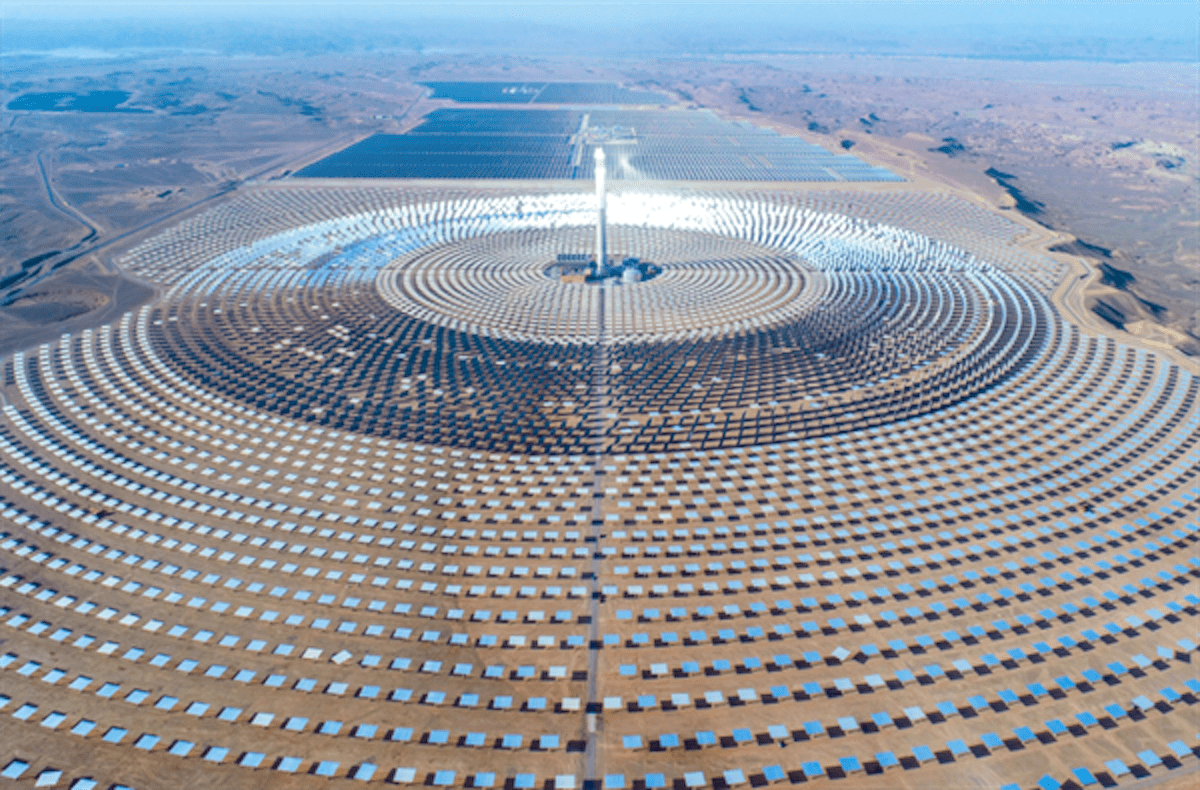
China – the world’s dominant producer of EVs, batteries, solar panels, wind turbines, nuclear reactors, electric motors, ultra-high voltage power lines etc. – will quickly replace oil exporting countries as the world’s most important supplier of energy security.


For most of our careers grey haired energy analysts have lived by the mantra, “Transportation is transportation and electricity is electricity… and never the twain shall meet.” We’ve carried in our heads two energy models – one for motor vehicles and one for electricity.
Oil had a monopoly on transportation – gasoline for cars, diesel for trucks, kerosene for jet fuel and bunker for shipping. Nothing had a monopoly on electricity, which is generated promiscuously – coal, nuclear, hydro, natural gas, solar, wind, geothermal, biofuels and, yes, even oil. Anything that burns. Anything that flows. You can split atoms. You can even catch the sun.
Young energy analysts have no clue what we old timers are droning on about. China’s advances in battery technology – energy density, cost and charging times – have broken oil’s monopoly on transportation.
All pain points of electric vehicle ownership have been removed. Battery prices have plummeted 90% in the past 15 years. BYD’s newest models have 1,000 km ranges with 5-10 min charging times. NIO has battery swapping stations all over China. And to top it off, EVs with over 500 horsepower – exotic sports car league a decade ago – are now common in mid-market sedans and SUVs.

Similarly, solar panel costs have fallen 85% in the past 15 years as China’s solar companies increased photovoltaic efficiency and, more importantly, automated and massively scaled production.
Largely because of solar, China’s CO2 emissions peaked a couple years ago, well ahead of its 2030 target. China is on track to becoming carbon neutral in 2040, 20 years ahead of its 2060 target (see here).
About 45% of the world’s oil (48 mmbbl/d) is refined into gasoline for passenger vehicles. Another ~30% (32 mmbbl/d) becomes diesel for trucking. All of these barrels will come under intense market assault by China’s advances in batteries, electric vehicles and solar power (with assists from wind, nuclear, hydro and power transmission). Global initiatives to diversify transportation away from oil intensify the urgency.
EVs have already captured over 50% of China’s new car sales. China’s EV production has increased over 10x in the past 5 years and ~50x in the past 10 years. Adoption has been lower in other markets as their governments lacked urgency. Nonetheless, China’s EV exports have increased 15x in the past 5 years to 343,000 units in 2025. Growth will surely accelerate as the US, Israel and Iran demonstrate how easily the oil market can be wrecked.

An electric vehicles is 3-4x more energy efficient than an internal combustion engine (ICE) car, a Rube Goldberg contraption that suffers from waste heat, friction and idling losses.
China’s manufacturing costs have cut the price of EVs to half that of “equivalent” ICE cars sold in the US and Europe.
With oil prices threatening to double from $75 per barrel prewar, the math does itself.

Oil importing countries will now invest heavily to further break oil’s monopoly on transportation.
With China’s EV/battery technology, manufacturing costs and endless model variety, EV adoption no longer comes with penalties, but in fact imbed all kinds of benefits – from lower purchase prices to lower cost of operations to far better acceleration to whizzbang software wizardry. China has also been aggressively pushing EVs into trucking – both short and long haul.
No longer tied to oil, transportation can promiscuously source energy. Anything that burns. Anything that flows. You can split atoms. But if you really do the math, the cheapest, fastest and most scalable energy source today is solar.
Al of this will accelerate China’s reversal of the Lucas Paradox – a decades-long economic aberration in which capital flowed from poor country to rich – as developed economies ran trade deficits and developing economies tightened belts to lend to rich customers.
This violation of classical economic physics – where capital is supposed to flow from rich to poor – is being corrected as China has now not only become rich, but the richest economy there ever was. Correctly measured, China’s manufacturing output is larger than that of the US, EU, India, Japan, UK and Russia combined (see here and here).

The Lucas Paradox was a hangover of history. In the past few centuries, the world’s choicest assets – the North American landmass (throwing in Australia and New Zealand) – through whatever methods, landed in the laps of the Anglo Empire (first the British, then the Americans).
At the same time, China, historically the world’s most productive civilization (see here), suffered an embarrassing century long face plant.
The correction of this historical anomaly over the past 40 years has once again turned China into a massive surplus-generating economy whose electric vehicles, batteries, 5G equipment, solar panels, engineering/construction companies and sundry manufactures spill forth into the world like all the silks, porcelains and teas did centuries ago.
While China had been exchanging its surplus goods for the surplus assets of the Anglo Empire, its trade partners are now highly diversified with over half of exports to Belt and Road Initiative countries, largely composed of Global South economies. Belt and Road is nothing less than a modern revival of China’s ancient tributary system, minus degrading relics like kowtowing.
While America’s “rules-based international order” hoovers up goods and capital from all over the world, China’s “shared future for mankind,” in contrast, disgorges goods and capital to all corners of the world. 2025 was a banner year for Belt and Road with $210 billion of engagements – nearly twice previous highs.

The world is now at a crossroads. The US Empire is once again fighting a war of questionable judgement. This war has exposed oil – once the spice mélange of the world economy – to be insecure and unreliable, subject to the whims of tin-pot dictators, ruthless religious states and insane clown presidents.
While a short- or medium-term solution will likely emerge for Hormuz, oil as a commodity is over in the long term. Technology, scale and automation are poised to make China the world’s largest exporter of energy with its EV, battery and solar stack. And the Global South stands to benefit the most as China offers an alternative to oil dependence – a century old obstacle to development and industrialization.