North America wouldn’t look much like it currently does without a tectonic plate that has largely been lost to the Earth’s geological history. The Farallon plate, which has since largely vanished underneath North America, helped build the West Coast by slamming large island chains into the continent as it disappeared. California wouldn’t exist without it, and one of the remaining fragments of the plate presently power the volcanoes of the Cascades.
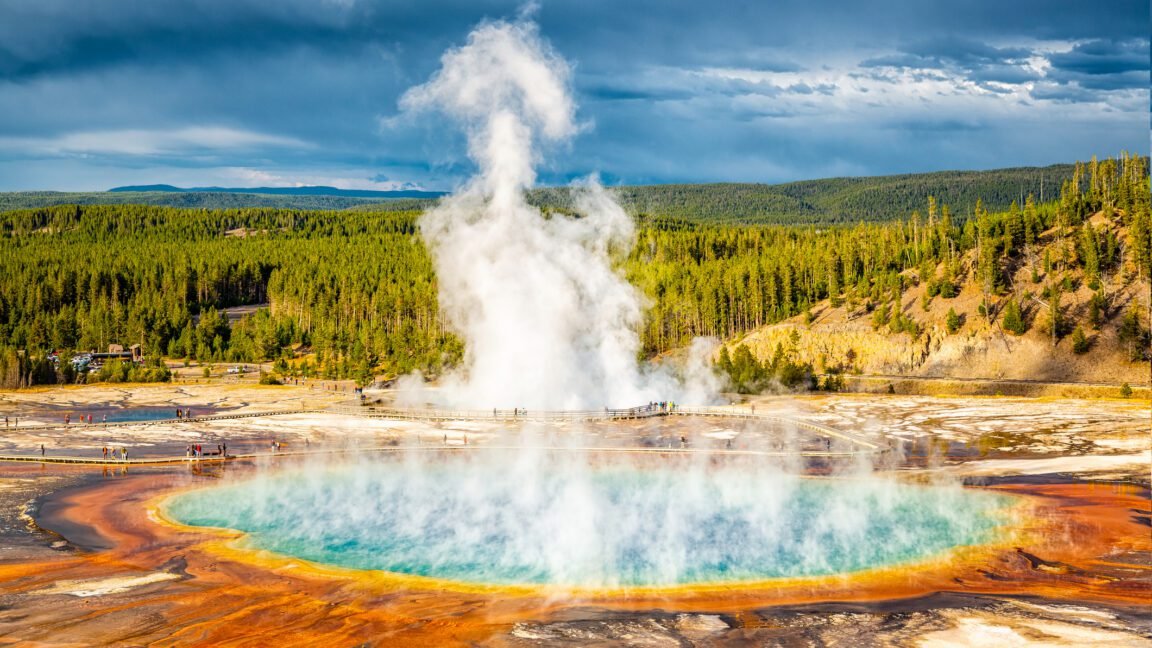
Now, a new paper suggests that the Farallon plate is still making its presence felt far from the coasts, powering one of North America’s most distinctive phenomena: the Yellowstone hotspot, which has periodically blanketed much of the continent with ash. The new proposal suggests that the plate’s vanishing act has created stresses that have opened paths for molten rock to reach the surface.
Hot spot or not?
Geologic hot spots exist around the globe; they’re areas where deep material from the Earth’s interior finds its way to the surface far from the edges of plates. In many cases, the heat that powers these hot spots is the product of what’s called a mantle plume: a blob of hot molten rock that convection drives to the surface of the mantle. In many cases, the plume appears to stay in place as the plates drift across it, creating a chain of progressively older islands as you move away from the hot spot.
Hotspots are generally associated with islands. The thinner oceanic crust makes it easier for molten material to find a path to the surface than it would if it had to work through the thick continental crust. But there are exceptions, most notably the Yellowstone hot spot. That appears to be behaving a bit like an oceanic hot spot, leaving a trail of massive eruptions across the Snake River Plain that terminates at the immense calderas beneath present-day Yellowstone.
That would seem to imply that Yellowstone is also powered by a mantle plume. But there are some oddities that don’t quite fit this model. For starters, the explosive, caldera-forming eruptions that created Yellowstone have a different chemistry from the massive floods of lava that created the Snake River Plain. And there’s an odd gap between the two where there’s little in the way of volcanic activity.
A paper published in yesterday’s issue of Science suggests an alternative explanation: The whole thing is enabled by stresses that are the product of the now-vanished Farallon plate.
Before the Pacific plate existed, North America ended roughly where the Rocky Mountains now stand. Offshore sat the Farallon plate, an enormous slab of oceanic crust. But as the Pacific plate formed and started spreading, it helped push the Farallon plate east, driving it under North America. This slammed a series of island chains into the continent’s west coast, progressively growing it to its present state.
In California and Mexico, the process has been completed, and North America now ends at the Pacific plate. But a fragment of the plate is still diving under areas to the north, powering the Cascade volcanoes; another does similar things in Central America.
Modeling the plumbing
The work done in the new paper involves building a geophysical model of what it refers to as the TLMPS: the translithospheric magma plumbing system. That’s the route by which molten and semi-molten material travels through the crust from the mantle below (technically, from the asthenosphere, or the upper-most part of the mantle). Various imaging studies have mapped the plumbing in some detail, suggesting that it’s fairly complex.
There appear to be two separate arms originating from the same general location at the crust-mantle boundary. One branch slopes northeast to feed the Yellowstone caldera, while a second branches off toward the Snake River Plain. The branches split in a way that the volcano-free zone between the two features results.
The researchers reasoned that, whatever else was going on to provide molten material, the paths to the surface were likely to be enabled by stresses in the crust. And that was going to depend on both the existing features in the crust (obtained largely through seismic data) as well as larger-scale processes going on in the mantle underneath. So, the model included both basic geological details, known physical processes, and a bit of history in the sense of what we know about how that section of the crust came to be.
And that’s where we come back to the Farallon plate. Its remains, having been driven beneath the North American plate, are continuing to sink and move through the mantle. That, the researchers surmise, is driving a general eastward flow of material through the viscous mantle. Just east of Yellowstone, however, that flow runs into the older border of the North American plate, where the crust is thicker and denser than the portion of the continent that was put in place by the Farallon plate.
New pathways
This thick crust causes the flow of the mantle to dip downward. And that change in flow causes a series of stresses in the crust, most notably a compressive force between the older and newer sections of the North American plate, as well as a downward drag on the older section. Adding to the local stresses is the fact that all the material that erupted to form the Snake River Plain is denser than much of the surrounding rock, which generates strain on nearby rocks as it tries to sink.
In the model, these two stresses appear to largely cancel each other out in the region just below the volcano-free gap between the Snake River Plain and Yellowstone. But on either side, the different forces create strains that could potentially open up conduits for mantle material to make its way toward the surface.
The model has some nice features. For one, it doesn’t need a mantle plume. No particular force is required to drive mantle material through the crust; instead, pathways are created by the stresses within the crust, and the mantle material simply fills them. It also explains why a single hotspot can produce two very different types of volcanism, given that the semi-molten mantle material takes different amounts of time interacting with different rocks on the two different pathways it takes.
But, while the model is driven by history in the form of the Farallon plate, it is a static picture of the present. The researchers don’t try to trace the history backward to see how these forces could have created the history of eruptions across the Snake River Plain. Nor do they explain why these features developed only at Yellowstone, when portions of the Farallon plate are sliding under most of western North America.
Overall, the work is a nice reminder that, regardless of the larger forces at play, the local details will have a big influence over how those forces play out. But it also has a lot of ideas that the community is likely to pick at and leaves a lot of space for more data to influence our picture of what’s going on under one of the most famous volcanic hot spots on Earth.
Science, 2026. DOI: 10.1126/science.ady2027 (About DOIs).