Neanderthals may have used birch tar as more than just glue; it could have helped them ward off infection and even insect bites.
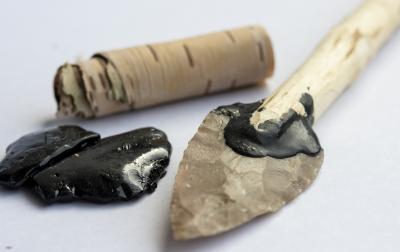
People from several modern Indigenous cultures, including the Mi’kmaq of eastern Canada, use tar from birch bark to treat skin infections and keep wounds from festering. We know from several archaeological sites that Neanderthals also knew how to extract birch tar and that they used it as an adhesive to haft weapons. A recent study tested distilled birch tar against the bacteria S. aureleus and E. coli and found that Neanderthals could easily have used the same material as medicine for their frequent injuries.
Medicine can be messy
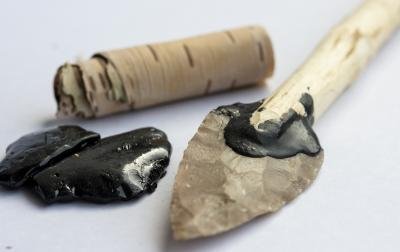
What we call “birch tar” in English has a lot of other names in multiple Indigenous languages, and it can range from an oily fluid to a brittle, almost solid tarry resin, depending on how long you heat it in the open air after extracting it from the bark. The Mi’kmaq of eastern Canada prefer the more fluid version, which they call maskwio’mi, for wound dressings and skin ointment.
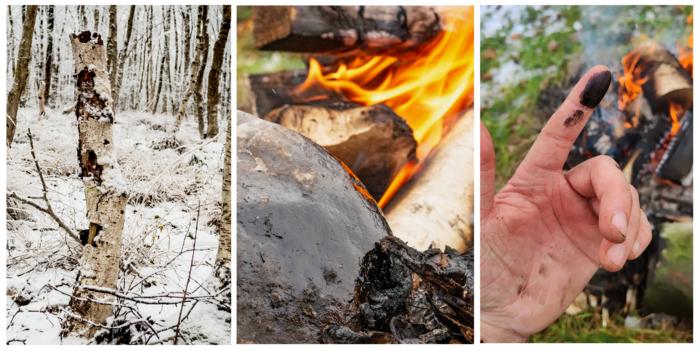
To test how well birch tar fends off common bacteria, the team gathered up rolls of bark from birch trees, choosing species that had been found at Neanderthal sites. They tested a few different methods to extract the sticky resin, or tar, from the bark. The simplest involved burning a roll of birch bark next to, or underneath, a flat rock, so the resin collects on the underside of the rock; the most efficient requires heating the roll of bark in a clay vessel buried inside a mound of dirt. Another method, popular with some modern Indigenous peoples, uses a tin can instead of a clay bowl.
A team led by archaeologist Tjaark Siemssen, of the University of Cologne and the University of Oxford, tested the resulting sticky mess against cultures of Staphylococcus aureus—best known for its role in skin infections and its evolution of the antibiotic-resistant MRSA strain—and the gut bacterium Escherichia coli, a frequent culprit in food poisoning.
Birch tar had no effect on the E. coli cultures, but it did stop, or at least slow down, the growth of S. aureus. Exactly how well depended on the species of birch and the concentration of the tar, probably because different birch species, and maybe even individual trees, produce tar with different combinations of chemical compounds. The most effective batch, taken from a silver birch (Betula pendula) tree, produced a “comparatively strong response.” Meanwhile, results from four other trees ranged from mild to moderate, and another had no effect.
The results, along with some earlier studies, confirm what Indigenous peoples like the Mi’kmaq, the Saami, and the Yakut would have known for at least several thousand years—or, more to the point, it explains in scientific terms why maskwio’mi works as an antiseptic.
“Our findings not only reinforce what past studies have reported, but they also echo traditional knowledge,” wrote Siemssen and colleagues. Their findings also hint that that traditional knowledge might be much, much older than even the Mi’kmaq oral histories record (or at least that it might have been discovered more than once in our evolutionary past).
How it works, for the chemistry nerds
So how does birch tar work against bacteria? One clue is that, like most other plant-based antimicrobial drugs, birch tar slowed the growth of Gram-positive S. aureus but not Gram-negative E. coli; that’s probably because Gram-negative bacteria like E. coli have an additional outer membrane that can keep the antimicrobial compounds out.
Those compounds are probably mostly ring-shaped molecules called phenolic derivatives; they’re mostly found in plant tissues, and they’re common ingredients in antiseptics and disinfectants (if you’ve ever used antiseptic mouthwash or a pre-surgery skin cleanser like Hibiclens, you’ve used the phenolic derivative chlorhexidine). Other chemicals may also play a role, including terpenes and terpenoids, which help protect plants against being munched on by insects or infected by fungi.
Siemssen and colleagues suggest that more detailed chemical studies could help unravel exactly which combination and proportions of all these chemicals are most effective, something that could be useful even for modern medicine.
“As today’s world is facing an antibiotic crisis, seeing increased antibiotic tolerance of bacterial strains, engagement with traditional remedies becomes ever more important,” write Siemssen and colleagues.
Unsurprisingly, the antibiotic Gentamicin proved much more effective against S. aureus than any of the birch tar samples. That’s because it is refined and concentrated, in contrast to whatever happens to be in birch tar. That’s, why, for instance, we take aspirin instead of just chewing on willow bark for headaches. (Seriously, if you have a skin infection, go to the doctor; please do not just start setting birch tar on fire in your backyard to treat yourself at home. We did not tell you to do that.)
The softer side of the Stone Age
Knowing that birch tar does work, at least against S. aureus, and that Neanderthals would have had ample opportunity to figure that out, we can start thinking more seriously about this kind of antiseptic as part of Neanderthal life.
“This study on birch tar’s affordances for wound care sits in the context of a surge of interest in Neanderthal life beyond stone tools,” wrote Siemssen and colleagues. Granted, it was stone tools that led archaeologists to discover that Neanderthals knew how to extract and use birch tar, but other recent finds have focused on the softer side of Neanderthal life: things like spun plant-fiber yarn and wooden foraging tools.
Neanderthals had started distilling birch tar by 200,000 years ago. It’s actually pretty simple to do: just prop a flat rock over a burning roll of birch bark, then scrape the resulting sticky gunk off the rock. However, doing it efficiently enough to be worthwhile is a much more complicated process, one that requires careful control of temperature and oxygen levels. Residue on a stone flake fished out of the North Sea in 2019 tells us that this complex process was already routine for Neanderthals by 50,000 years ago.
Of course, it probably took generations of experiments—and a lot of practice for each individual learning the craft—to refine the process into something routine and efficient. And (the argument goes) if Neanderthals spent that much time messing around with birch tar, they were bound to notice that it also worked for fighting skin infections and repelling mosquitos (that repulsion is probably thanks to the terpenoids). Similar arguments have been made about ocher, which seems to have been used for sunscreen and possibly even wound dressings, as well as for coloring things.
The argument isn’t much of a stretch, since we also know that Neanderthals were basically self-taught materials scientists. Neanderthals didn’t know about crystallography or atomic structures, but they had an intimate working knowledge of the properties of different types of stone, bone, and wood (and probably other materials that don’t survive in the archaeological record, like plant fibers, hides, and so on). Like us, they must have been keen observers, hardwired for figuring out how things worked and how to manipulate them.
That penchant seems to have extended to some basic herbal medicine; dental calculus from a Neanderthal unearthed at El Sidron in Spain still contains chemical traces of chamomile and yarrow, and yarrow also appears in a Neanderthal from Shanidar in Iraq. Both herbs contain compounds that make them useful as anti-inflammatories and may help with some digestive issues.
Neanderthals would probably have had opportunity to observe what happened when you put birch tar on an itchy red patch of skin or an open wound, because (as Siemssen and colleagues wryly observed) the stuff gets every-flipping-where.
“Given the low viscosity of birch tar produced in underground pits, and adhesive properties of birch tar, contamination of the skin during handling is nearly inevitable,” they wrote in their recent paper. In a press release, they added, “Every step of the production is a sensory experience in itself, and getting the tar off our hands after spending hours at the fire has been a challenge every time.” And it doesn’t take much: about 2 grams can cover up to 100 square centimeters of skin.
Studies like this one aren’t smoking guns, or even smoking birch tar extraction pits, but they help us understand what Neanderthals could feasibly have done. That in turn can help us search for more definitive evidence, because now we know what to look for—and that we should be looking.
PLOS ONE, 2026. DOI: 10.1371/journal.pone.0343618 (About DOIs).