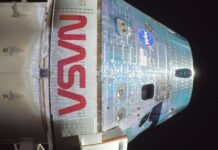
As we have been reporting on Ars, NASA’s Artemis II lunar mission has been going rather well so far. Of course, Orion’s big test is yet to come with the fiery reentry through Earth’s atmosphere on Friday. But so far, it’s looking like the rocket and spaceship needed for a lunar landing are getting there for NASA.
The biggest remaining piece of the architecture, therefore, is a lunar lander. Known in NASA parlance as the Human Landing System, or HLS, the space agency has contracted with SpaceX for its Starship vehicle and Blue Origin and its Blue Moon lander.
Last year NASA asked both companies for options to accelerate their lunar landers, and both replied that not having to dock with the Lunar Gateway in a highly elliptical orbit, known as near-rectilinear halo orbit, would help a lot. So the space agency has removed that requirement.
Beyond this, we don’t know much officially. NASA and the companies have not spoken publicly about their revised plans, but Ars reported a month ago that Blue Origin had a plan that did not involve orbital refueling, and SpaceX was looking at docking Starship with Orion in low-Earth orbit.
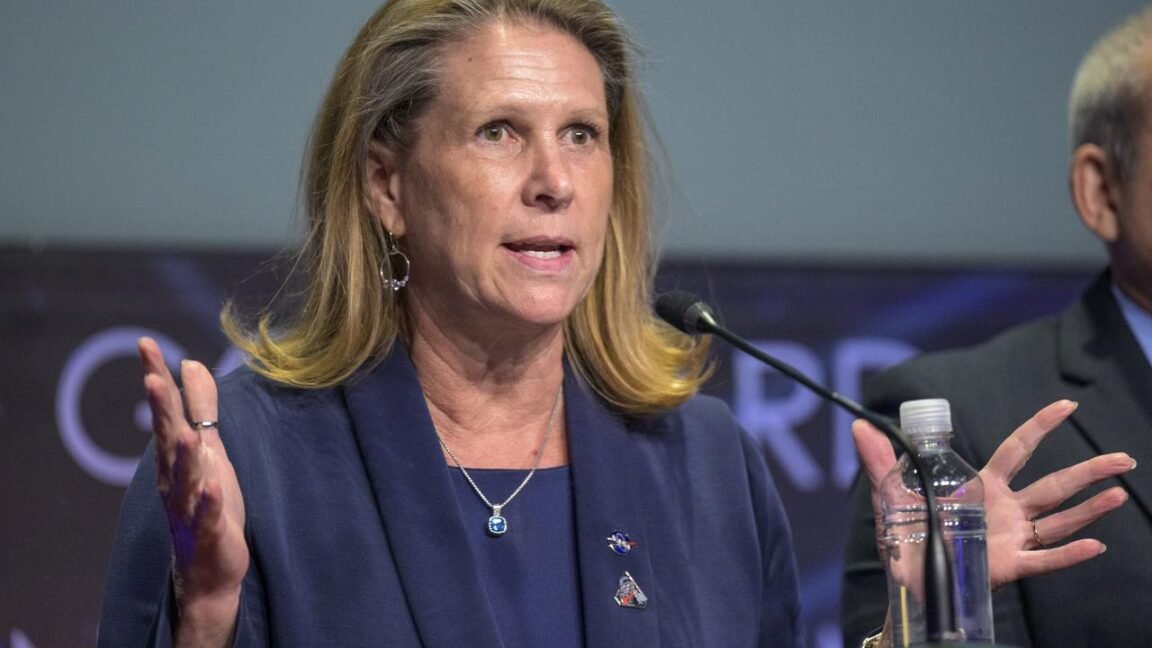
To get NASA’s official view on all of this, Ars recently interviewed Lori Glaze, who leads NASA’s deep space exploration program.
Ars: You guys haven’t talked much about the plans to publicly accelerate the Human Landing Systems. Is there going to be a time when you do that?
Lori Glaze: Yeah, I think there will be a time we do that. You know, we’ve got their proposals. They’ve each brought in some good proposals. They’ve taken this very seriously. They’ve brought proposals to us about simplifying requirements so that they can really pull things in and accelerate. The key thing that we have to complete is the analysis of the interactions with Orion, looking at power and thermal for the Orion system, and making sure that the whole case closes; that these changes we might make to the mission design aren’t going to break what we have with Orion. So we’ve got to all work together. And I think once we’ve completed that, which hopefully won’t take too much longer, we’ll be able to home in on some specific solutions for each.
Ars: You mentioned that getting out of a near-rectilinear halo orbit was a real benefit for each HLS provider in terms of delta-V. Could you maybe talk a little bit more about how finding a different orbit helps each of the companies?
Glaze: They both came up with kind of slightly different permutations on that. But they both came in and said going to NRHO requires a lot of extra fuel for them both to access the surface and then to get back to re-rendezvous with Orion. So they are looking for ways to reduce the amount of propellant that’s required. And you know, as I said in the talk, the lower they go the more it is a demand on Orion. So we’re looking to try and balance the demands on our systems to make sure that we have a solution that works for both. But there are a lot of benefits to some of the non-NRHO orbits.
Ars: I have a good sense of what some of those are. I don’t want to draw you out prematurely, but the space community is being asked to take a lot on faith here, right? Because you’re talking about a 2027 rendezvous with HLS in low-Earth orbit, and then at least one 2028 landing. We see what’s happening, or not, with Starship. That their next test flight has been pushed out to April or May, and they really had a lot of struggles last year. And Blue Moon Mk. 1 looks really cool, but it’s still in a vacuum chamber in Houston, about five minutes from where I live. What can you say to sort of give some comfort about the realism of these timelines?
Glaze: Yeah, I do recognize the challenges, and certainly as we’re thinking about trying to get to 2028 and the landing, a lot of the things we’re trying to do with the reduction in requirements is trying to make it less demanding on them so that they can have a lander that will work for 2028. The demo in Earth orbit, hopefully, really will drive down some of the requirements for those landers to let us test an earlier version of it that doesn’t require as much resources. I think the real confidence builder is that we’re closer to Earth. This is allowing us to do some of these things in a more benign environment here, closer to home.
Ars: When you say relaxing requirements, can you give me an example of what you mean?
Glaze: First and foremost, as we talked about, was the orbit, not requiring NRHO. But even on the surface, we have requirements for the communication systems between the crew and the lander itself, and the requirements on the types of additional utilization things that they need to bring with them. For example, how far the crew are going to get from the lander, and so what kind of other things do they need to bring with them if they’re going far out? All of that needs to be carried along. So there’s a variety of those kinds of things we’re looking at, how can we simplify and reduce the mass of things that need to be accommodated, and the integration of the various items that need to be accommodated. There’s a variety of those things, just the operations design. Are there ways we can simplify that helps them reduce their timeline?
Ars: I want to ask now about what milestones we should be looking for this year. I think with Starship it would be the in-flight refueling test. Is that still potentially going to happen this year? I mean, I’m checking my calendar and it’s already spring.
Glaze: I hope so. I believe that is still the plan. I think they’ve shifted their schedule around a little bit. This is something you probably need to go back and talk to SpaceX and what their schedule is right now.
Ars: They’re very forthcoming.
Glaze: Yeah, I know. But they have been making some adjustments to their schedule based on trying to make sure that they have a little more confidence in what they’re going to fly before they do the prop demo. So it’s worth having a conversation with them, or at least trying. But yes, the prop transfer, I believe, is still on schedule for this year, later this year, and it’s definitely one of the key milestones that we’re keeping an eye out for. And, of course, the uncrewed demo to the Moon.
Ars: Presumably that would not happen until after Artemis III?
Glaze: Yeah, agreed.
Ars: And with Blue Moon Mk. 1, that’s launching sometime this year. You know, presumably within a few months?
Glaze: I think it’ll launch this year.
Ars: I hope so. What should we be looking for on that flight as it pertains to HLS?
Glaze: I think some of their propulsion systems are going to feed forward into the guidance, navigation, and control. Their ability to land will be key. We all know that is not as easy as one might think. So that’ll be key, just seeing how all the systems perform in the lunar environment.
Ars: Have the companies shown a greater vigor toward executing on HLS in the last couple of months?
Glaze: Yeah, in fact, I’m glad you asked that. Because I think we really have seen them—they’re taking it very seriously. Our request to try and pull things in, to try and meet the mandate to land on the surface in 2028, I think we have seen real commitment to try and do that on both sides, from both Blue and from SpaceX, yeah, a real commitment to seeing what they can do to try and pull that in.
Ars: You mentioned the ICPS (Interim Cryogenic Propulsion Stage, currently used by the SLS rocket, of which NASA has one left), and that you’re sort of still trading on whether to fly that on Artemis III. If you could save it, why would you fly it on Artemis III?
Glaze: If we don’t need it on Artemis III, we won’t fly it because I think there’s value. I think we all recognize that there would be value in having it available for Artemis IV, giving a little bit more development time for the Centaur V replacement. However, we haven’t closed yet on what the Artemis III mission profile looks like, and whether or not we’re going to need an upper stage to get us to the right orbit.
Ars: How far can the SLS core stage push it?
Glaze: You know, that’s a really good question. I’ll have to get back with you. I don’t know that I have a specific answer for you on that. I know we’re looking at and considering a low-Earth orbit. But I don’t know exactly what it would be. Is that an ISS orbit? Is it a little higher than ISS? We’re still looking at that, and some trades in particular orbits, and then where can we get to without the upper stage.
Ars: OK, you’ve got a busy time ahead of you. Good luck.
Glaze: Oh, you’re not kidding.