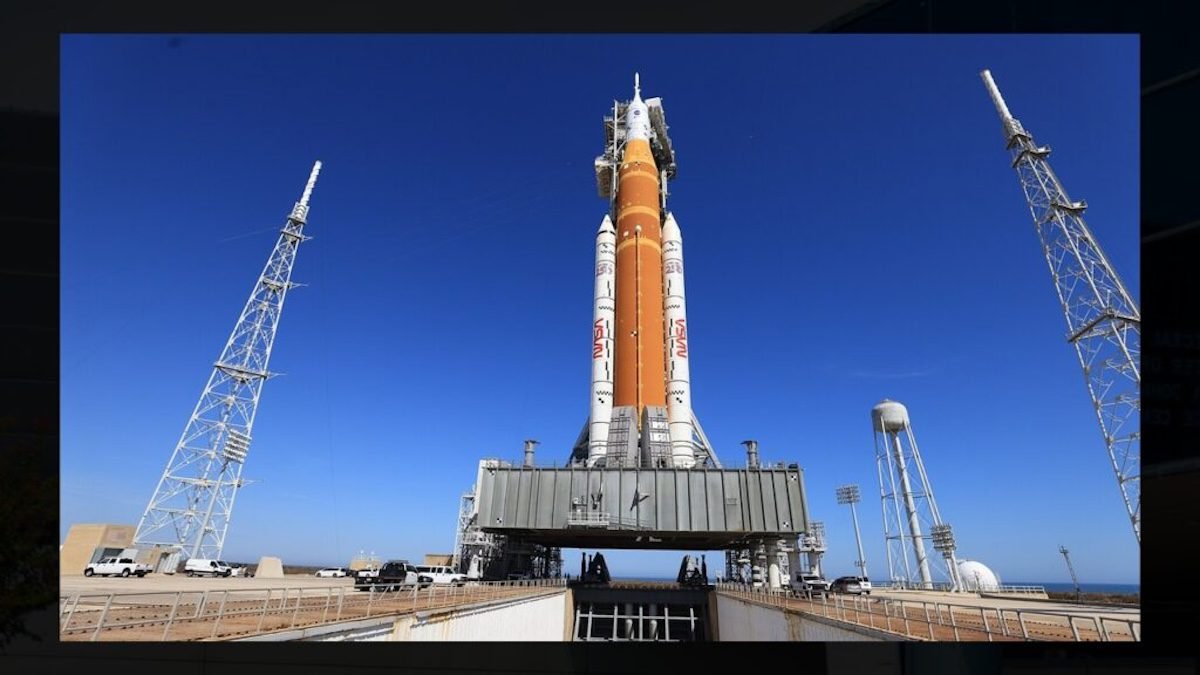
NASA is preparing for an imminent launch of Artemis II, a manned lunar flyby flight – the first in 50 years. While the launch is planned for April, and NASA announced on March 12th that the launch will go ahead, there remain serious problems with the spacecraft. NASA thinks the problems are resolved (not necessarily fixed), while others think the risk is too high for a manned flight.
Artemis is a moon launch program that got underway in 2017. By the end of 2025, the US had spent $93 billion. That number will continue to grow as the Artemis launch program gains momentum. Each launch by itself costs around $4.2 billion. The program is a follow on to the Apollo program that put the first humans on the moon in 1969. Apollo ended in 1972.
Apollo was in many ways a brilliant program, but it experienced a significant tragedy early on and a near failure later in the program. During a pre-launch test of Apollo 1 in 1967, a cabin fire killed astronauts Virgil “Gus” Grissom, Edward White and Roger Chaffee. This led to a complete redesign of the command module’s safety systems. In 1970 on Apollo 13, an oxygen tank explosion forced the crew to abort their lunar landing. Ground control and the crew worked together to bring the astronauts home safely.
Artemis is supposed to be able to demonstrate that astronauts can stay on the moon for a longer period of time so that the US can prepare for a more important manned mission to Mars in future.
The key question is whether the spacecraft is ready and safe enough to undertake a manned mission. A major issue is over the Orion capsule which is the manned part of the spacecraft. It is the Orion capsule that must safely return to earth.

The previous unmanned flight, Artemis I, was launched on November 16,, 2022 and returned to earth twenty five days later on December 11th. NASA called the flight “successful” but a subsequent Inspector General report (2024) found serious problems with the spacecraft.
The highest risk, according to the IG, was the heat shield of the Orion capsule. When the capsule returns to earth it must reenter the atmosphere at high speed, which generates severe stress on the capsule. The heat shield is designed to survive the extreme heat and insulate the capsule. The temperature of the heat shield reached nearly 5,000 degrees (F).
By way of comparison, Space X’s Crew reentry temperatures were lower as Dragon’s reentry speed was 40% slower than Artemis-I.

As Greg DeSantis, co-author of this piece, pointed out in a previous article in Weapons and Strategy, the Artemis I heat shield sustained significant damage. While the capsule survived, more than half of the heat shield AVCOAT tiles were cracked or broken. Also, as the heat shield partially disintegrated, an unexpected debris trail menaced the parachutes needed for the final portion of the spacecraft splashdown.
The 2024 IG reports said that “portions of the char layer [of the heat shield] wore away differently than NASA engineers predicted, cracking and breaking off the spacecraft in fragments that created a trail of debris rather than melting away as designed. The unexpected behavior of the AVCOAT [the material used for the tiles] creates a risk that the heat shield may not sufficiently protect the capsule’s systems and crew from the extreme heat of reentry on future missions.”
The Orion capsule is connected to its service module by four primary crew module/service module (CM/SM) separation bolts. These bolts are designed to be severed by pyrotechnics just before reentry, allowing the service module to discard while the Crew Module descends.
Post-flight inspections revealed unexpected melting and erosion on three of the four bolts. The IG warned that if this erosion had been more severe, it could have exceeded Orion’s structural design limits. In a worst-case scenario, this could lead to the breakup of the vehicle during reentry and the loss of the crew. NASA says it is adding thermal protective material to the bolts to better protect them, although the changes have not been tested.
NASA apparently believes that the heat shield problem can be mitigated by changing the angle at which the Orion capsule reenters the atmosphere. According to the 2024 IG report, “altering Orion’s reentry path can create more stressing conditions that exacerbate the char loss phenomenon or introduce new failures or unknowns into the system. Without understanding the residual effects of introducing design and operational changes, it will be difficult for the Agency to ensure that the mitigations or hardware changes adopted will effectively reduce the risks to astronaut safety.”
NASA scientists think the heat shield problem was caused by gas that was trapped in the heat shield tiles during reentry instead of the gas venting through the tiles. They believe that the gas build up can be mitigated by changing the amount of time the capsule “skips” as it enters the atmosphere, and that this can be done by a change in reentry trajectory.
NASA conducted ground “arc tests” of its theory. These tests, at a much higher temperature than the actual reentry, created a permeable char layer that allowed gases to escape, while the lower reentry temperatures did the reverse. It is hard to understand the relevance of the arc tests on actual reentry conditions.
Another issue is the impact of spacecraft vibration on launch. The IG reported “more than expected” damage to the ground systems following the Artemis-I launch in November 2022. While the flight was a success, the impact on mobile launcher 1 (ML-1) and related infrastructure was extensive. Blast pressure and debris caused significant damage to the launcher’s elevator system. While the Orion capsule is on the top end of the spacecraft, strong vibrations from launch potentially could have weakened or compromised the Orion capsule’s heat shield integrity during the launch phase.
One way to simulate the vibration issue is to mount the Orion heat shield on a shaker table and test it. There is no report this has been done.
There are other questions about the manufacture of the tiles for the Orion capsule and on quality control. NASA has this to say about future Artemis launches: “For Artemis III and later flights, heat shield modifications include better uniformity, controlled permeability … and changes to manufacturing methods for AVCOAT layers. Uniformity in shield material means fewer weak spots.” The obvious question is why Artemis II is flying without NASA’s proposed modifications and improved manufacturing methods.
NASA is right about its plans for heat shield improvements in future launches, but it is not clear why NASA wants to go ahead now with a launch of Artemis-II without major changes in the heat shield, including its manufacturing methods. The level of risk seems too high, and the urgency to have the launch far from compelling. NASA should reconsider.
Senior Asia Times correspondent Stephen Bryen is a former US deputy under secretary of defense. Gregory De Santis PhD holds four degrees in mathematics and aeronautical and mechanical engineering. As a NASA research engineer he worked on a number of life support and re-entry projects supporting Gemini, Apollo and Sky Lab. He also served as the US Army program manager for life support including ballistic, fire, chemical and biological protection.
This article was originally published on Stephen Bryen’s Substack newsletter Weapons and Strategy.