A landmark site in the peopling of the Americas is several thousand years younger than we thought. While that means very different things about the site itself, it doesn’t change the big picture as much as the researchers who generated the new date are claiming.
University of Wyoming archaeologist Todd Surovell and his colleagues recently took a second look at the age of a site called Monte Verde in southern Chile, and it turns out that people lived there 8,000 years ago—not 14,500, as the archaeologists who first described it claimed.
Monte Verde is about as far from the Bering Land Bridge as you can get without leaving the continents, so its age was the first piece of evidence that people were well-established in the Americas before the end of the last Ice Age. But it hasn’t been the last, so Surovell and his colleagues’ findings don’t actually change what we now know about the peopling of the Americas—and they definitely don’t put the “Clovis First” hypothesis back on the table.
It’s old, but exactly how old?
In 1997, a team of archaeologists sent shockwaves through the field by publishing radiocarbon dates for an ancient campsite in southern Chile, which they claimed was around 14,500 years old. The dates seemed impossible because at the time, most archaeologists agreed that there was no one in the Americas at all, let alone in southern Chile, until at least 13,000 years ago. But later studies matched the original radiocarbon dates.
Specifically (and this bit of detail will be important later), the dates showed that bits of wood and seaweed in the layer of sediment covering the archaeological site were around 14,500 years old. That seemed to suggest the sediment layer itself was 14,500 years old, which meant the site itself was at least that old.
It took nearly a decade for most archaeologists to come around to the idea, but Monte Verde rewrote the story we thought we knew about how (and when) people first moved into, and spread throughout, the Americas. For once in the history of science, that statement isn’t just a headline-grabbing exaggeration—it was really that big a deal.
However, Surovell and his colleagues recently re-evaluated those dates and realized the site can’t be more than 8,000 years old. So what does that mean for the story it had helped re-write? Surprisingly little, it turns out.
Digging into the details
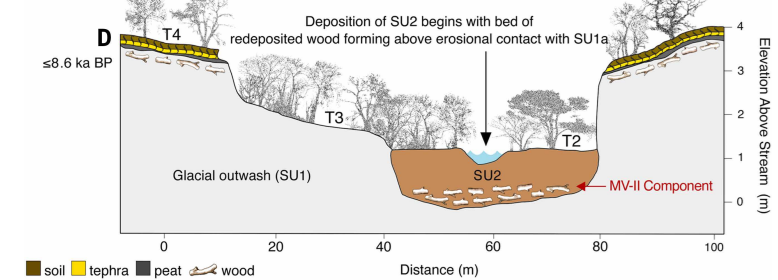
Surovell and his colleagues didn’t challenge the accuracy of the original radiocarbon dates. The bits of organic matter in the layer of sediment at the site are, they agree, around 14,500 years old. Instead, Surovell and his colleagues questioned whether that sediment layer actually covered the site 14,500 years ago or if it washed in later from a part of the riverbank laid down much earlier. In general, newer layers of sediment stack on top of older ones, but real-world geology is often messier than that, and that seems to be what happened at Monte Verde.
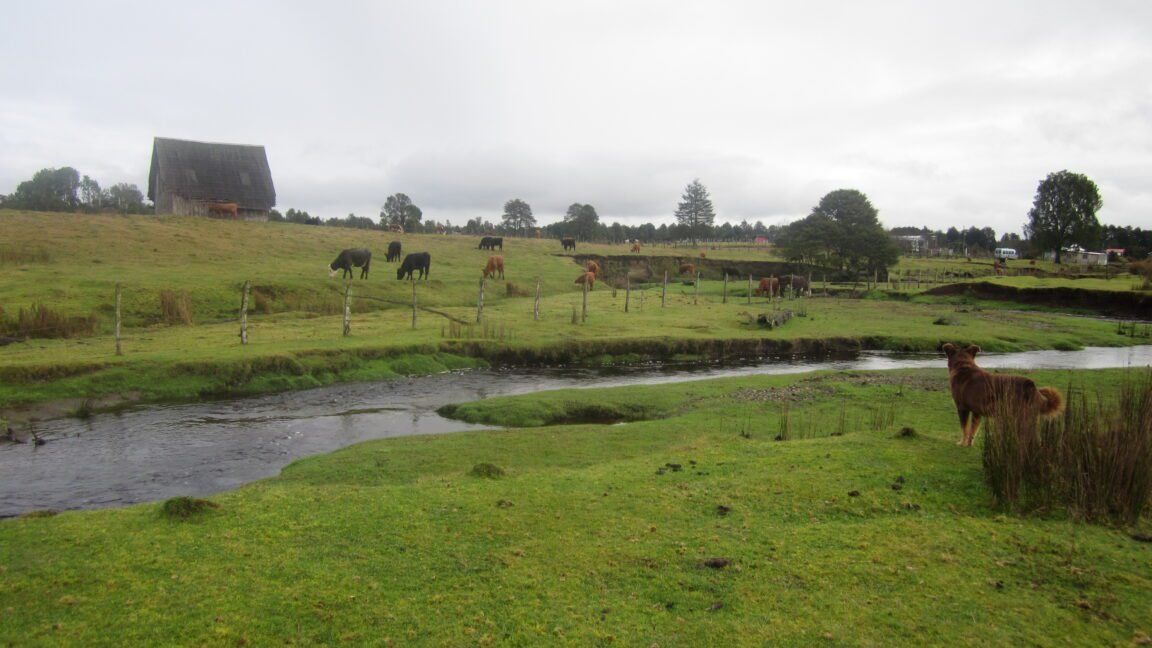
The archaeologists mapped the layers of sediment around the site: layers of sand and gravel left behind by glaciers 26,000 years ago, wood-laden silt from peaty marshes 15,000 to 13,000 years ago, a layer of volcanic debris that blanketed the whole region 11,000 years ago. And through it all, the channel cut by what’s now Chinchihuapi Creek, which carved its way through the volcanic layer and into the buried marshes beneath sometime between 11,700 and 7,600 years ago.
And that’s the complicated part, because the creek left older layers of sediment exposed on the hillsides along its banks. When it flooded, it scooped out some of that older sediment and deposited it on the floodplain, forming the ground where a group of around 20 or 30 ancient Chileans would eventually set up camp.
“The surface on which the [site] rests did not exist in the Late Pleistocene and is a product of Early Holocene erosion,” wrote Surovell and his colleagues in their recent paper (the Pleistocene ended, and the Holocene began, about 11,700 years ago). “Any inferences made about the peopling of the Americas based on a Late Pleistocene date for this site should be re-evaluated.”
The work itself is likely to spark some lively debate (and if heated arguments about sediment accumulation and erosion are your thing, you’re on the right website). But even if Surovell and his colleagues are spot-on in their analysis and Monte Verde really is only 8,000 years old, it doesn’t change the wider discussion about the peopling of the Americas as much as they imply it does.
“Although a pre-Clovis human presence in the Americas is accepted by many archaeologists, a Holocene age for Monte Verde leaves open the possibility of later initial colonization,” they wrote. But it really doesn’t. That possibility is firmly closed.
“Clovis First” is dead—let it rest
Until about a decade ago, students in nearly every Intro to Archaeology class learned that the first Americans made their way southward through a corridor that opened up in the middle of the ice sheets around 13,000 years ago. The oldest traces of humanity on either continent dated to around 13,000 years ago in the form of long projectile points with narrow notches (called flutes) at their bases, made to fit against a wooden shaft. Since the first of these fluted projectile points turned up near what’s now Clovis, New Mexico, archaeologists dubbed these early Americans the Clovis culture. The hypothesis that they were, in fact, the very first people to arrive in the Americas became known as “Clovis First.”
All of that is ancient history, both literally and figuratively. Over the last decade or so, archaeologists have unearthed much older artifacts and footprints at sites in Ohio, New Mexico, Florida, and Argentina. Monte Verde was the first site that looked old enough—and compelling enough—to challenge Clovis First. For a while, it was the linchpin of the whole debate, but that’s no longer the case.
A 14,500-year-old hunting site (the same age as the original dates for Monte Verde) now lies submerged in a Florida sinkhole, complete with stone tools and mastodon bones. Footprints in Argentina, and a single footprint in Chile, seem to be around that same age. At Cooper’s Ferry in western Idaho, archaeologists unearthed stone tools at least 16,000 years old. And someone left behind a pair of finely worked agate-scraping tools 18,000 years ago at Rimrock Draw rock shelter in southern Oregon.
All of those sites seem to point to the same broad story: sometime between 20,000 and 16,000 years ago, as the edges of the great ice sheets were beginning to melt and recede—thousands of years before the Laurentide and Cordilleran ice sheets pulled apart enough to create an ice-free corridor down the middle of the continent—people made their way south along the Pacific coast of Canada. When people finally reached the southern edge of the ice sheet, in what’s now the northwestern US, they scattered across the last unpeopled continents on Earth. (Sorry again, Antarctica.)
It’s still possible that some groups of humans migrated into the Americas through an ice-free corridor in the middle of the continent as the Cordilleran and Laurentide ice sheets were breaking apart. (Environmental models have painted a bleak picture of what the soggy, barren strip of ground between the ice sheets would have been like, and it’s not exactly the sort of place that a few generations of hunter-gatherers would want to raise a family.) But if they did, they probably arrived in a land where people had already been living for thousands of years.
That’s not surprising, as the broad story of hominins spreading around the world is that we tend to migrate in waves, pushed by changing climates in one place or pulled by open vistas in another. There wasn’t a single venture “out of Africa,” and there’s no reason to think there was just a single push across Beringia and into the Americas, either. That’s just not how people (of any hominin species, going back at least to Homo erectus) seem to move through the world.
New evidence and new debates arise
A couple of sites even hint that people may have gotten a foothold in the interior of North America before the ice sheets fused together and closed the path south from Beringia, which happened around 26,000 years ago.
Footprints at White Sands, in New Mexico, seem to be between 23,000 and 21,000 years old, based on radiocarbon dating of pollen and seeds from the ancient ground surface, along with optically stimulated luminescence dates (measuring how long ago quartz grains last saw sunlight). And stone tools from Chiquihuite Cave in north-central Mexico come from a sediment layer that seems to be more than 30,000 years old.
Archaeologists are still debating the age of the evidence from White Sands and Chiquihuite—a debate that underscores why it’s important to take a second, independent look at the data, as Surovell and his colleagues did with Monte Verde. Good science sometimes requires questioning and reexamining the evidence, and the recent study doesn’t need to relitigate Clovis First to have something relevant to say.
As Miami University archaeologist Jason Rech put it in a paper commenting on Surovell and his colleagues’ work, “Such sites that are scientific outliers must be critically examined, because the findings may be based on erroneous age control, or the evidence for human occupation may be equivocal.” The evidence for humans at the infamous Cerutti Mastodon Site in California, for instance, doesn’t pass even a cursory sniff test. “Conversely,” Rech adds, “scientists also should not reject outliers because they do not conform to a favored hypothesis.”
Fully resolving these debates and piecing together the story could take decades and, as always, a lot more evidence from a lot more sites.
Science, 2026. DOI: 10.1126/science.adw9217 (About DOIs).