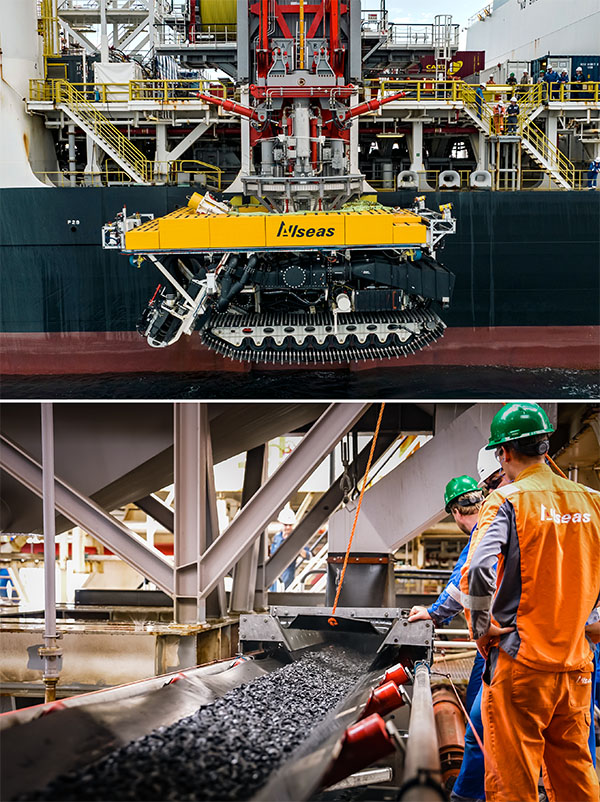
More than 13,000 feet below the surface of the Pacific Ocean, a more-than-70-ton machine trundled like a tank on its caterpillar tracks for a tenth of a mile—sucking up potato-sized nodules of rock packed with copper, manganese, cobalt, and nickel. It was 2022, and that pilot run of a subsea harvester by a Canadian business, The Metals Company, was pronounced a success.
The company is working to get a green light to deploy similar machines for commercial harvesting over an area of 65,000 square kilometers, to extract over 600 million metric tons of nodules.
There are riches on the ocean floor—round deposits made up of tightly packed layers of critical minerals that have long been out of reach. But not anymore. The pursuits of The Metals Company are among 31 initiatives by companies, governments and state-owned enterprises—including China, India, and the Republic of Nauru, a tiny island nation in the southwestern Pacific Ocean—to collect nodules for analysis and to test mining equipment.
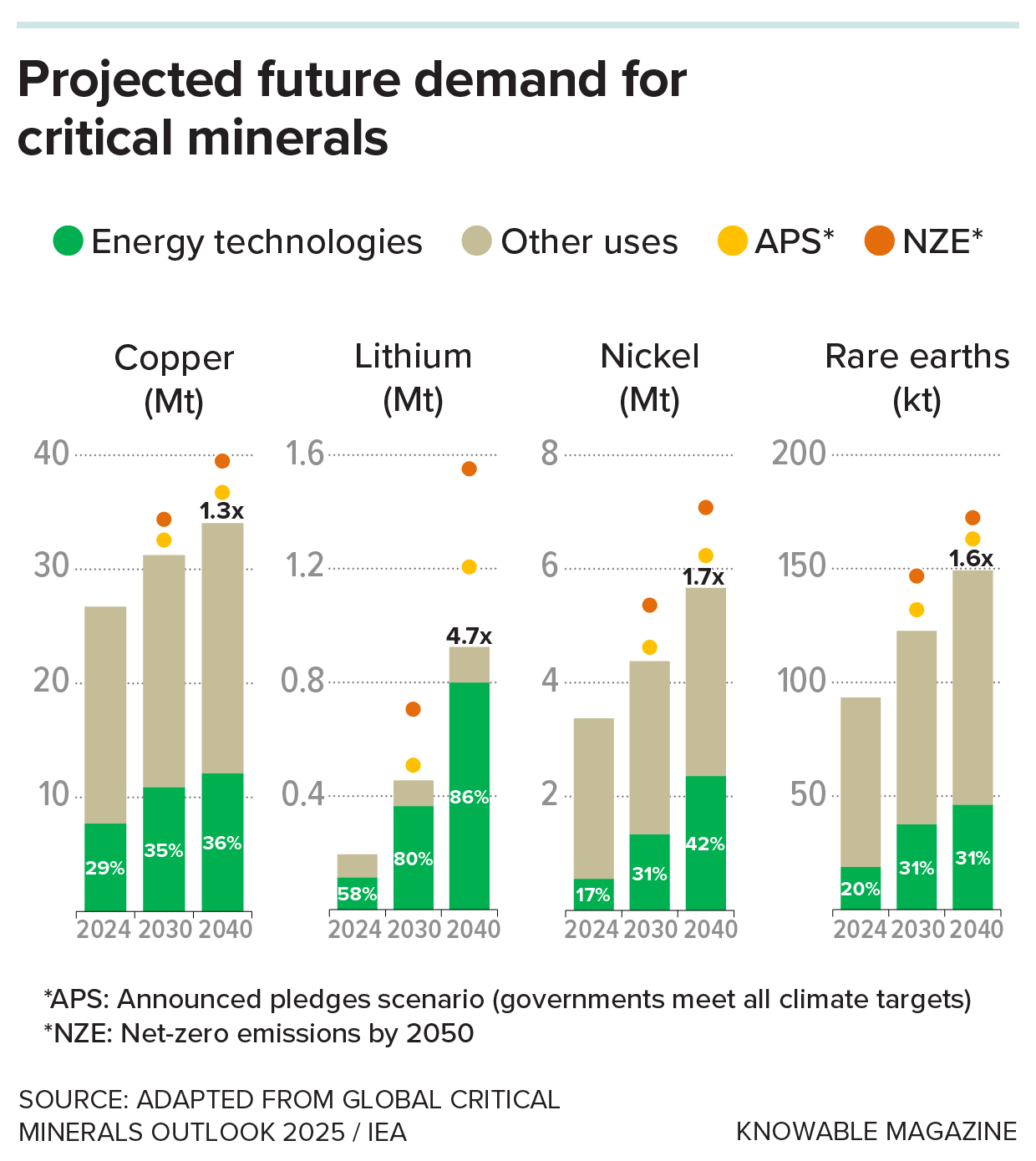
These untapped deposits, undisturbed over millions of years, are in the sights of these countries and companies as the world moves to operate sustainably in the face of climate change. A large-scale shift to clean energy could quadruple demand for critical metals and rare earth elements, according to the International Energy Agency (IEA), an organization in Paris that provides advice and analysis on energy policy. And there is sharp disagreement about where to obtain those extra resources.
Countries such as the United States, companies including The Metals Company and some scientists who study extractive industries argue that there aren’t enough easily accessible critical minerals on land to supply the growing demand. Rather than opening numerous new terrestrial mines, the nascent deep-sea mining industry could help fill the gap, they say.
Other researchers, conservation groups and some 40 countries, led by the archipelago nation of Palau in the Pacific Ocean, have called for an outright ban or moratorium on deep-sea mining activities until more is known about the potential ecological impacts and until regulations are adopted. Many argue that there are adequate remaining resources to be tapped on land.
For over a decade, the International Seabed Authority, which controls mining in areas beyond national jurisdictions, has been developing a mining code to govern extraction of seabed resources, but its member states have yet to agree on the rules. Talks ended in July 2025 with many unresolved issues, including how to measure and monitor ecological impacts. Negotiations recently resumed.
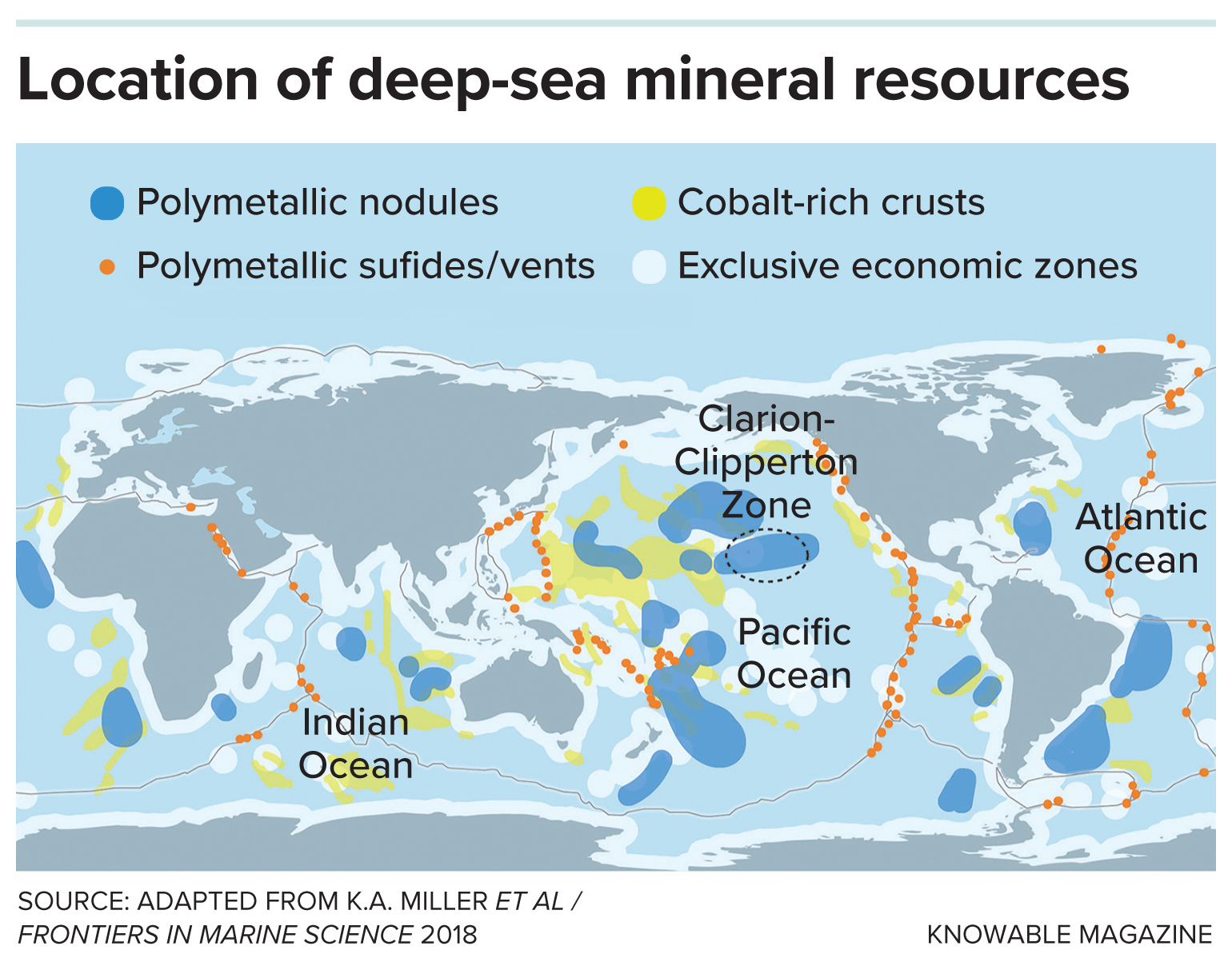
But time is short, because mining could get the go-ahead as soon as this year, before rules and safeguards are in place. Nauru is exploring a legal loophole that allows it and other nations to apply for a commercial permit before the mining code is agreed to. And in a unilateral initiative that skirts the mandate of the International Seabed Authority, The Metals Company has applied to the United States for permission to mine in the Clarion-Clipperton Zone, where most deep-sea mining ambitions are focused; that’s a 6-million-square-kilometer area (almost the size of Australia) under international waters between Hawaii and Mexico. The US has not signed the international treaty that gives the International Seabed Authority jurisdiction over such activities.
Pressed for time, researchers and analysts are working to answer key questions. Can we find the minerals we need on land, or must we venture beneath the waves for untapped resources? What would be the environmental consequences of each?
Looming green needs
There is little disagreement that the green transition will require a giant leap in the global supply of critical minerals. And mineral production from existing and planned mines could soon come up short, suggests the IEA in a 2025 assessment on mineral needs for the clean energy transition.
The analysts modeled three different scenarios of renewable energy use and climate change mitigation. They lined up these demand estimates against different types of supply estimates, including a less ambitious one that includes existing mines, ones under construction and projects yet to be launched that have permits or finances already secured, and a bolder case that also considered projects in which financing or permits are still being sought.
From this modeling, the analysts estimate that by 2040, global demand for lithium, a key component of electric vehicle batteries, could grow around 4.7 times from its 2024 levels, and demand for copper, crucial for wind and solar power, could grow 1.3-fold. They predict shortages of both metals as soon as 2035.
Future copper shortfalls may appear less severe than lithium, based on currently announced projects, but opening new copper mines or expanding existing ones is much more challenging, says Shobhan Dhir, a critical minerals analyst with the IEA. “In general, the rock with high copper content has really been mined already,” he says.
Will mines on land suffice?
Some analysts think that these needs can be met on land by opening new mines or digging deeper into existing ones.
Gavin Mudd, director of the Critical Minerals Intelligence Centre at the British Geological Survey in Nottingham, says that there is no shortage of mineral deposits on land. He notes that data from the United States Geological Survey show that reserves for many critical metals are growing (reserves refer to deposits that are economical and feasible to mine right now, while resources are a geological commodity that is known to exist in the ground). For example, the IEA estimates that by 2040 demand for lithium could reach as high as 1.5 million metric tons annually. But 2025 data from the USGS show global reserves on land of 30 million metric tons and resources of 115 million metric tons.
Reserves and resources, Mudd says, will probably continue to grow as new deposits are discovered. As demand for minerals grows, prices may rise, making it profitable to dig deeper into existing mines or to start new mines.
“There is no rational case to argue that we will be running out of lithium reserves any time soon,” he says.
Similar trends are seen for other minerals such as copper and cobalt. A 2022 global assessment of nickel mines by Mudd and Simon Jowitt, director of the Nevada Bureau of Mines and Geology, estimates that land-based reserves and resources can meet demand for over 100 years.
But to access these resources, new mines will need to open—more than 85 new lithium mines by 2050, by some estimates, and up to 40 new nickel mines by 2030, just to supply EV batteries, according to the IEA. The International Energy Forum, an intergovernmental group for discussing energy policies, estimates a need for at least 35 new copper mines by 2050 to supply the green transition.
It can take over a decade to get a mining project up and running. To avoid greater delays, Mudd says governments and companies must improve their planning of mining projects, or mineral shortages could hit even where resources exist.
Another resource: recycling
Recycling electric vehicle batteries and other materials from green technologies could help to lessen the need for new mines, says Paul Anderson, an inorganic chemist at the University of Birmingham in the United Kingdom who is leading a project to improve reuse and recycling of lithium-ion batteries used in electric vehicles.
Estimates vary on how much recycling could cut demand. The IEA estimates that by 2050, recycling can lower the need for new mining activity by 25 percent for lithium and nickel and by 40 percent for copper and cobalt. Other estimates suggest a much larger impact. One 2022 study by researchers at KU Leuven university in Belgium suggests that by 2050, recycling could provide 40 to 77 percent (depending on the metal) of Europe’s clean energy metal needs. And a 2025 report by researchers at the University of California, Davis, estimated that recycling could cut the number of new lithium mines needed from 85 to 15.
Governments would need to build recycling facilities in all regions of the world—not just in areas that manufacture EV batteries or that have the biggest EV markets, the UC Davis researchers concluded. And countries should adopt policies to encourage recycling, such as setting targets for manufacturers to collect used batteries, and for recycling plants to recover critical minerals from batteries.
Anderson says that recycling is often an afterthought in the design and production of batteries and other green technologies, making it less efficient and effective. “We’re obsessed with reducing carbon footprint by rolling out the technology… we’re not thinking about designing the end-of-life management into it,” he says.
But even with recycling, the global transition to a green economy could depend on ramping up terrestrial mining—among the dirtiest and most environmentally and socially destructive industries. Studies suggest that terrestrial mining is responsible for 9 percent of all Amazon forest lost between 2005 and 2015. It also uses large volumes of water, often in water-scarce regions, and can put vulnerable people at risk of human rights abuses. Spills of toxic mining waste pollute waterways and kill aquatic wildlife.
The extent of deep-sea damage
Supporters of deep-sea mining suggest that the industry could have fewer environmental and social problems.
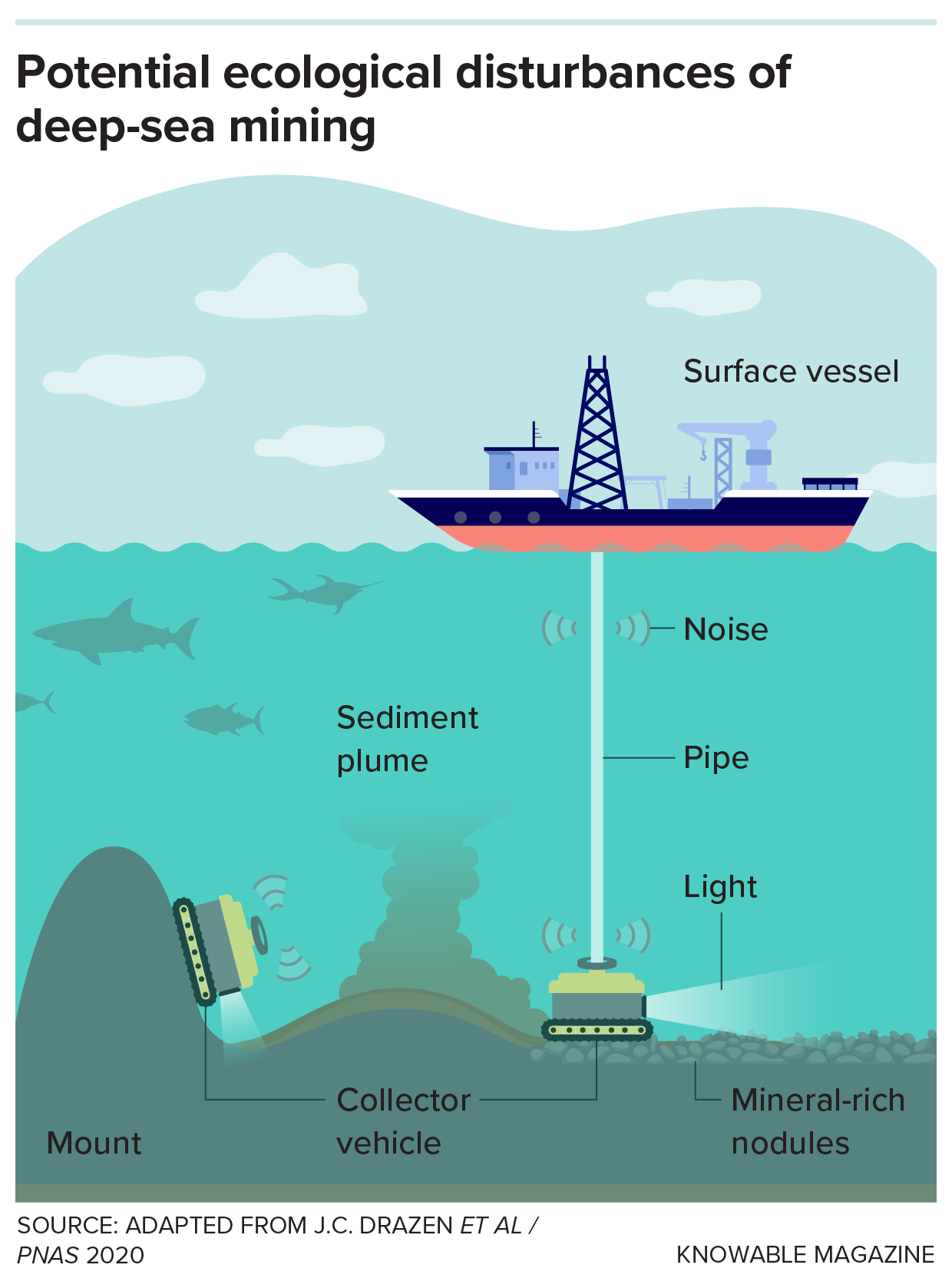
Impacts to the deep ocean might not be as long-lived as those of mining on land, The Metals Company says. It points to research suggesting that some deep-ocean fauna communities disturbed by mining could start to recover in number and diversity within one year. It says that deep-sea microbial communities could recover from the impacts of mining “within 50 years.” By contrast, the company says, “it can take hundreds or thousands of years to regenerate new soil and forests that can support previous levels of biodiversity” that are destroyed by terrestrial mining.
Saleem Ali, an environmental systems scientist at the University of Delaware who also provides research and advice on critical metals to the United Nations, says that deep-sea mining should be part of discussions on the green transition. He coauthored a 2022 analysis, funded by The Metals Company, that compared mining waste from terrestrial deposits to that of seabed resources. (Ali says he has never received direct funding from The Metals Company.) For example, the analysis looked at the impact of terrestrial mine tailings on water pollution and local biodiversity, and at the anticipated pollution from nodule mining, such as seabed sediment kicked into the water column by harvesting machines. It suggests that both types of mining will have effects on biodiversity, but deep-sea mining could result in less waste and fewer risks for communities than terrestrial mining. The study cautions, however, that its conclusions are limited by “substantial uncertainty” regarding impacts of sediment plumes.
Ali adds that the International Seabed Authority has been collecting data for at least 30 years, which should be sufficient to develop rules and regulations to govern seabed mining even if it’s unclear what the long-term impacts are, and whether the environmental impacts are likely to be better or worse than mining on land.
“I’m not saying that we should go ahead with it. I’m saying that it deserves to be considered in this broad context of very difficult choices we have to make,” he says.
But opponents calling for moratoriums or bans note that the same study that The Metals Company refers to as evidence of quick recovery eventually reached more pessimistic conclusions from its data as a whole. “The effects of polymetallic nodule mining are likely to be long term,” the authors wrote, and the analyses “show considerable negative biological effects of seafloor nodule mining, even at the small scale of test mining experiments.” Scientists are concerned that deep-sea organisms, which are adapted to living in a dark, quiet, and sparsely populated environment, will not cope well with the noise and light disturbances from mining. The organisms will also be exposed to toxic metals and plumes of sediment that can interfere with feeding and breathing. The Metals Company did not respond to several requests for comment.
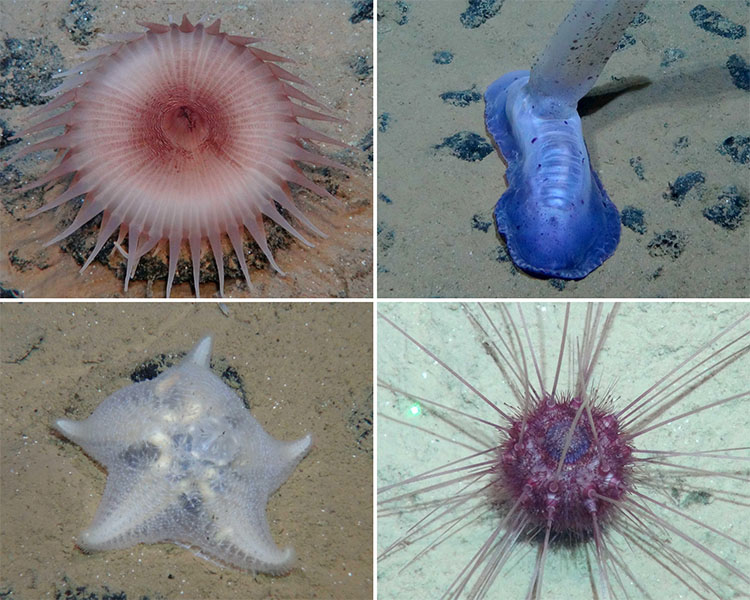
Because of these unknowns, the mining rules shouldn’t be rushed, says Anna Metaxas, a deep-sea ecologist at Dalhousie University in Canada who coauthored a 2025 overview of the potential impacts of mining on the deep-ocean ecosystem in the Annual Review of Environment and Resources. Metaxas participates in the Deep-Ocean Stewardship Initiative, a nonprofit international network of experts to inform deep-sea policy and governance. She says that she earlier led a project with experts in land and deep-sea mining to develop a framework for environmental comparisons of mining on land and the seabed. But in 2024, she and her coauthors concluded that data are at present too scarce to do so.
“Our knowledge gaps are really large,” agrees Matthias Haeckel, a marine biogeochemist at the GEOMAR Helmholtz Centre for Ocean Research in Kiel, Germany. He is part of a group of 30 researchers and technical experts tasked by the International Seabed Authority in 2024 to develop values needed for monitoring and assessing mining impacts. The group looked at toxicity, such as that from heavy metals, turbidity from sediment kicked up by harvesting machines, and underwater noise and light pollution. They are expected to submit a first draft of standards and guidelines at some point later this year.
Seeking answers—and soon
The International Seabed Authority Council—its executive body—convened in Jamaica in early March and will do so again in July to debate, and perhaps adopt, mining regulations. The Metals Company is still waiting for a nod from the United States to start commercial mining in the Clarion-Clipperton Zone. But it says it expects to have a permit by the end of this year and to start mining shortly after.
Meanwhile, scientists like Haeckel are scrambling to launch additional research cruises to provide critical data that will inform decisions about the future of seabed mining and the mining code. Haeckel is leading a European project called MiningImpact that will return later this year to research sites where, in 2021, it monitored part of the mining tests by Global Sea Mineral Resources, a subsidiary of the Belgian company DEME. The third phase of MiningImpact aims to see how the ecosystem has fared five years on, and to promote further understanding of the ecology of life in the abyssal depths.
“The Clarion-Clipperton Zone is a large area, and there are still many, many open questions,” Haeckel says. He wonders how mining in the area could be properly regulated when scientists hardly know yet what creatures live down there, or how they interact.