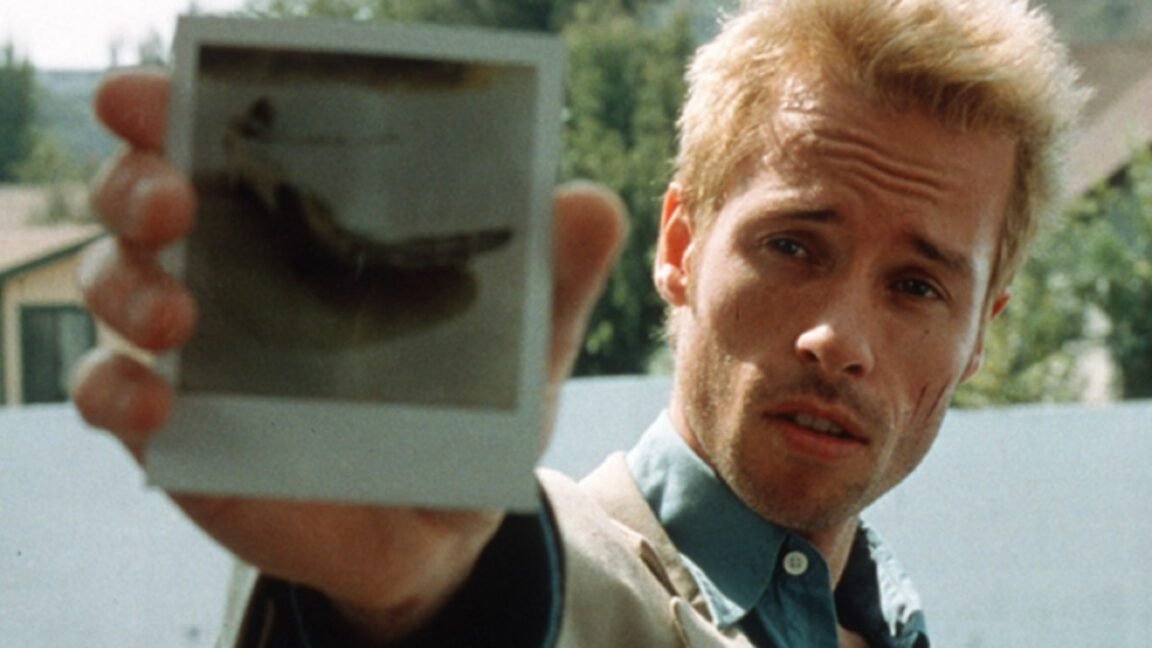
Christopher Nolan has cemented his status as one of our most consistently original and thought-provoking directors. Over the last 25 years, Nolan has delivered film after film that deftly balances mainstream appeal with eye-popping visuals, inventive narrative structures and special effects, and existential and/or philosophical themes. And it all started with his big breakthrough film: Memento, which marks the 25th anniversary this year of its US release.
(Spoilers below, but we’ll give you a heads up before the major reveals.)
The origins of Memento are now the stuff of Hollywood legend. Nolan’s brother, Jonathan, pitched him a story during a road trip about a man with anterograde amnesia who can’t form new lasting memories and yet is intent on tracking down and killing the man who raped and killed his wife. Nolan liked the idea, and Jonathan sent him a draft a few months later. (That draft would eventually become Jonathan’s short story, “Memento Mori,” published after the film’s release.)
Nolan decided it would be fitting, given the protagonist’s unique condition, to tell the story backwards and wrote his own version of the screenplay. He envisioned Memento as an inversion of the Jorge Luis Borges short story, “Funes the Memorious,” whose protagonist is a man who cannot forget anything, no matter how small the detail—a neurological condition known as hyperthymesia.
The two brothers exchanged various drafts for a year before the screenplay caught the attention of executives at Newmarket Films, who optioned the film and gave Nolan a $4.5 million budget. Brad Pitt was Nolan’s first choice for the lead, but when Pitt declined the offer, Nolan decided to skip the A-listers and cast Guy Pearce, best known at the time for his roles in The Adventures of Priscilla, Queen of the Desert (1994), and LA Confidential (1997). Nolan had been impressed by Carrie-Ann Moss’ performance as Trinity in 1999’s The Matrix and cast her as the female lead. It was Moss who suggested her Matrix co-star, Joe Pantoliano, for the third lead role.
Mnemonic devices
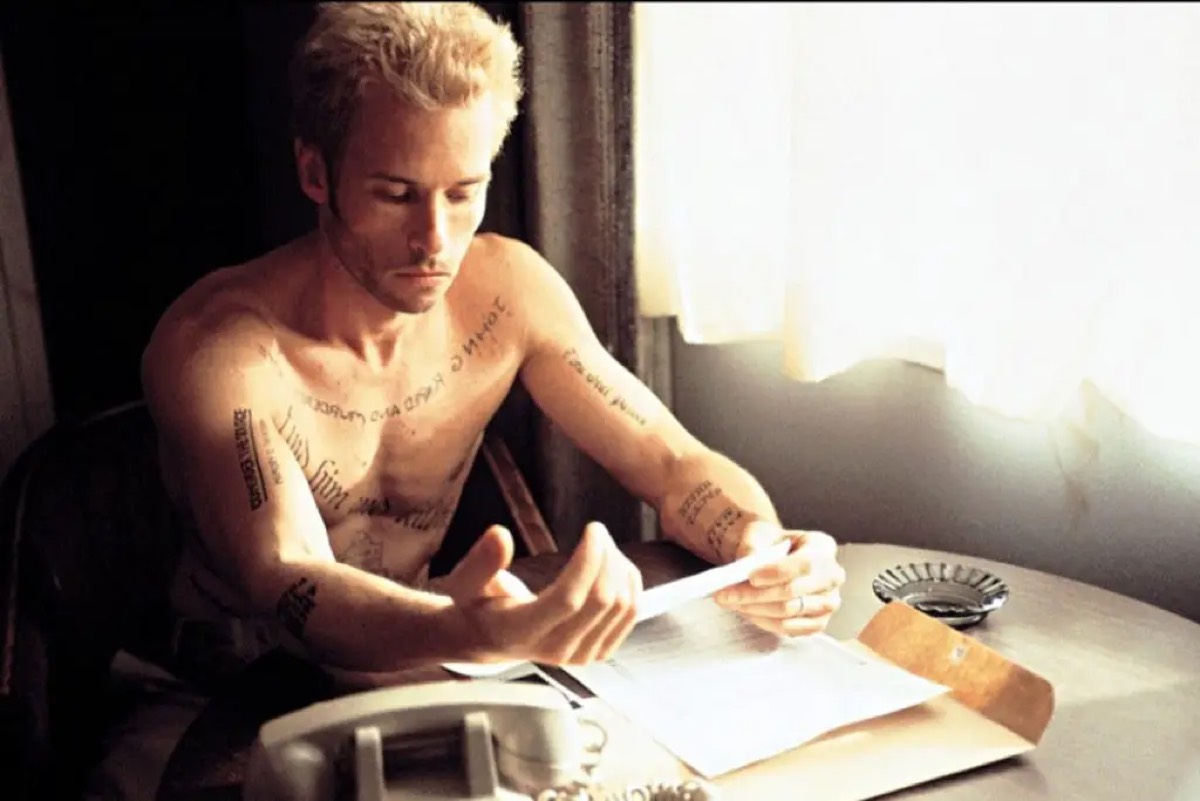
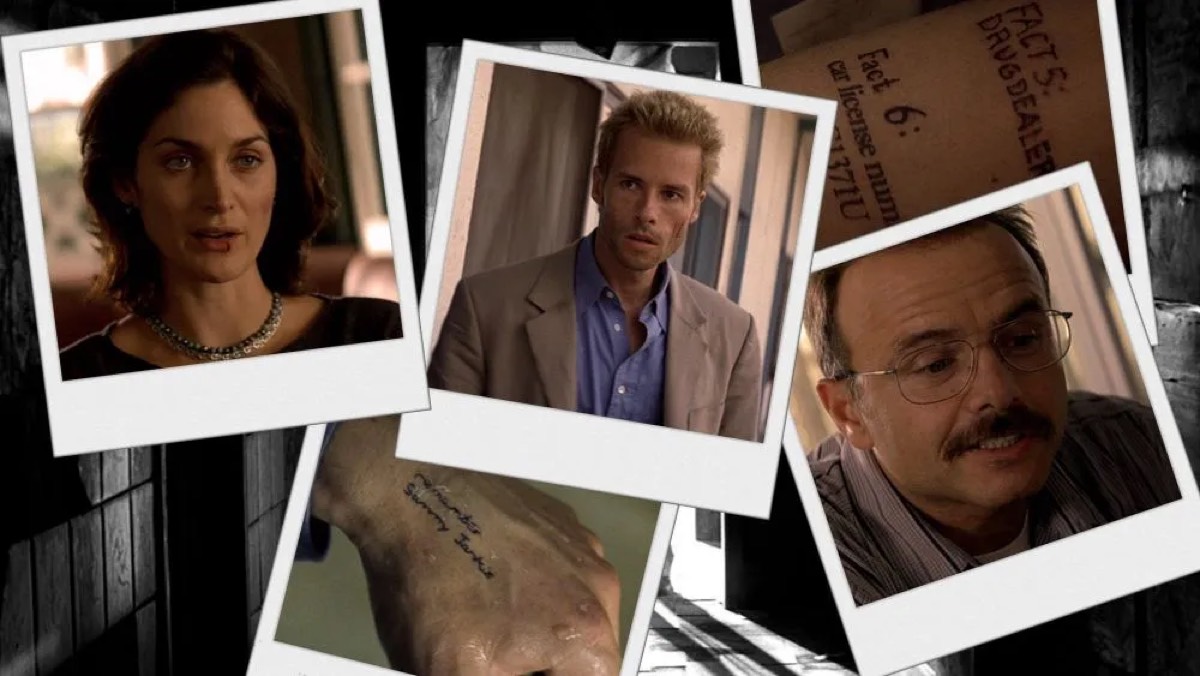
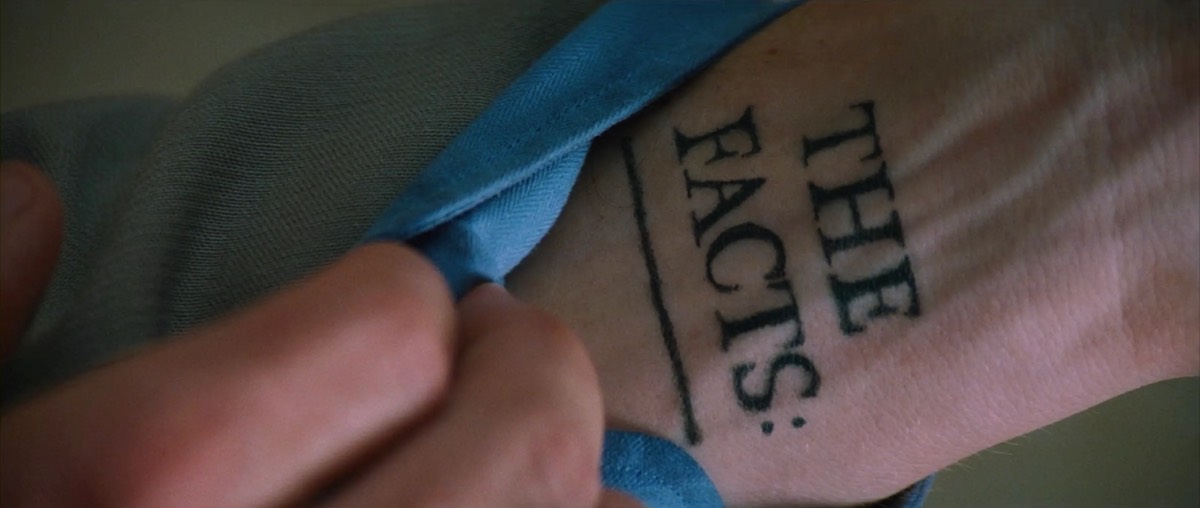
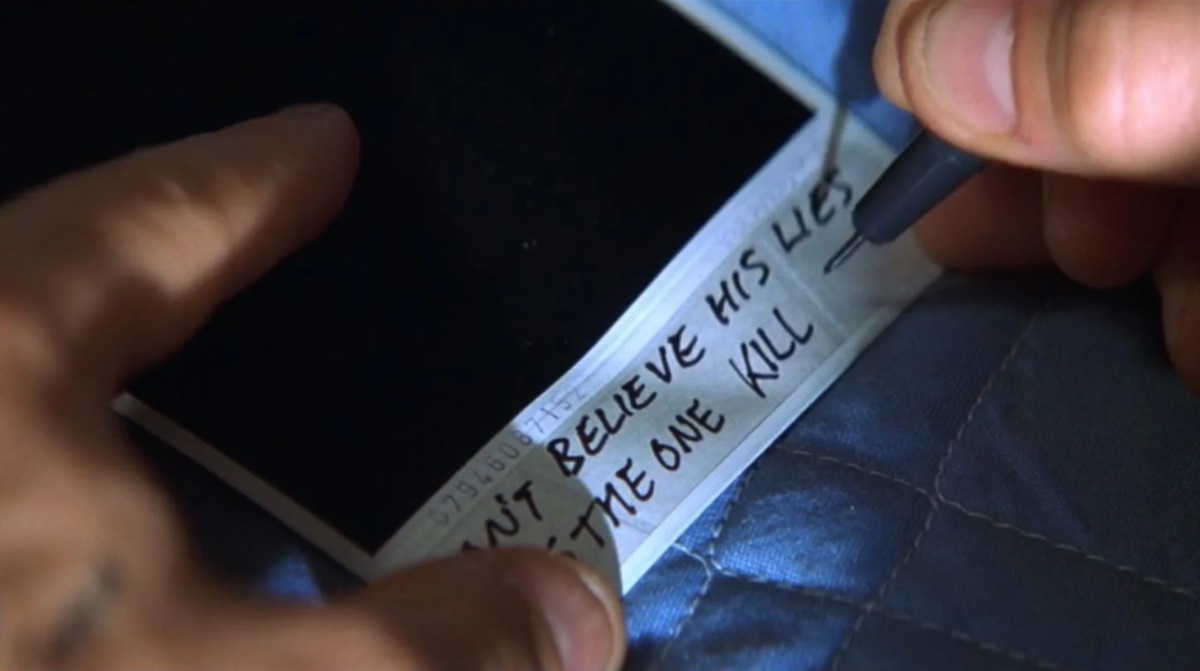
Leonard Shelby (Pearce) is a former insurance investigator who, we learn, lost his ability to form new memories after he and his wife Catherine (Jorja Fox) were brutally attacked. Catherine was raped and strangled, and Leonard’s mission in life is to hunt down her killer—a man he knows only as “John G.” or “James G.”—and exact revenge. He has developed ingenious methods for reminding himself of the facts he can’t retain: taking Polaroids and writing notes on them and tattooing the most vital clues on his body. He is helped on his quest by bartender Natalie (Moss) and a man named Teddy (Pantoliano)—but can Teddy be trusted? One of Leonard’s notes insists, “Don’t believe his lies.”
Memento‘s nonlinear narrative consists of two different sequences of events woven together with alternating scenes. One is filmed in black and white and shown chronologically, evoking classic noir. The other is filmed in color and shown in reverse order, and the two sequences finally merge at the end.
This sometimes left audience members bewildered about what had actually happened. But the clues are there, starting with the opening credits scene: a Polaroid of a dead man that gradually reverts to its undeveloped state and re-enters the camera as the scene “unwinds” to just before the man is fatally shot. Nolan has said that he wanted the audience to experience what life would be like for Leonard, unable to recall recent prior events that the audience also does not remember (since we haven’t seen them yet).
(WARNING: Major spoilers below the gallery. Stop reading now if you haven’t seen the film.)
Cruel twist of fate
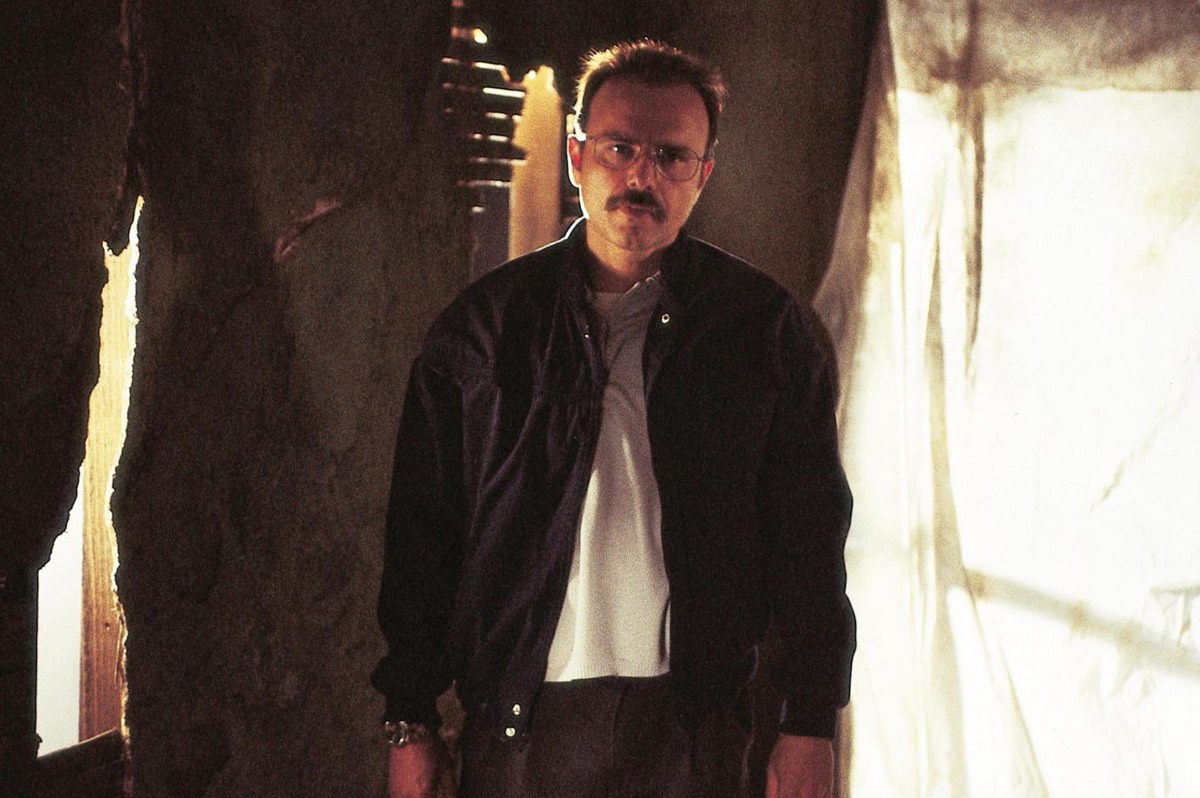
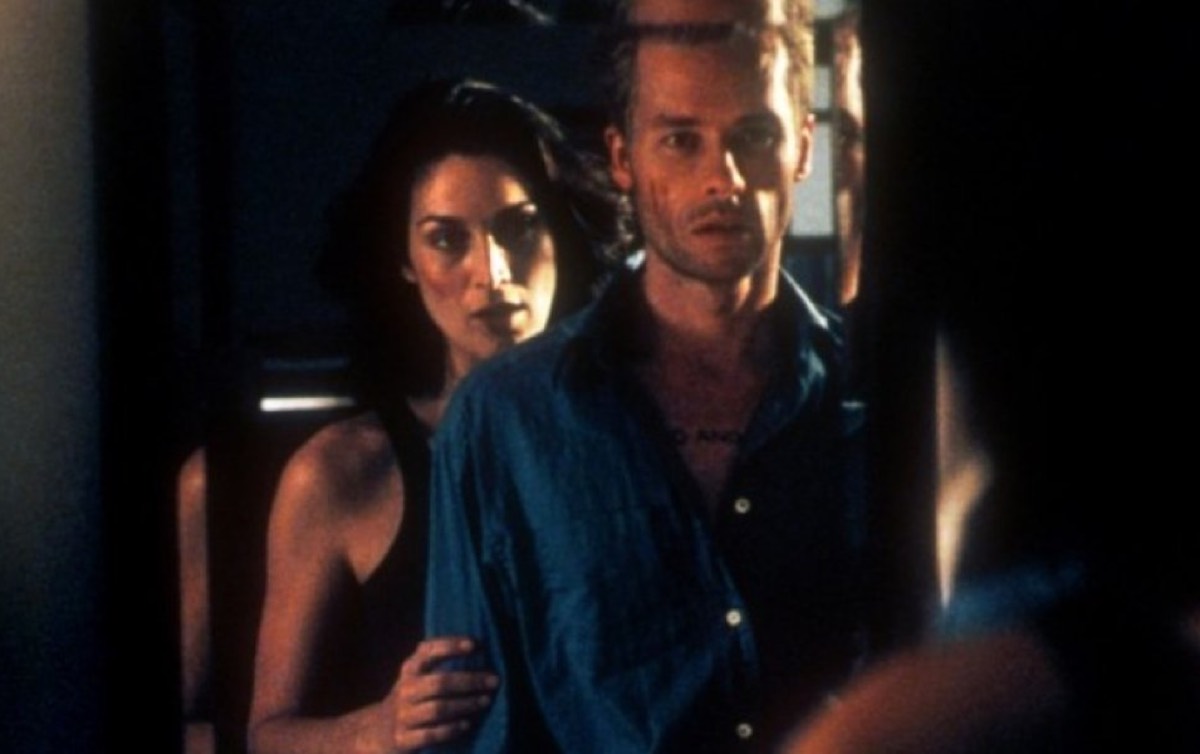
As the story unfolds, we learn the truth about Natalie and Teddy, both of whom have been exploiting Leonard’s amnesia for their own ends. Natalie manipulates Leonard into driving a man out of town by claiming that he beat her, although she does track down a license plate number for Leonard’s current suspect, one John Edward Gammel. We also learn Natalie’s boyfriend, Jimmy Grantz (Larry Holden), has gone missing—and somehow Leonard is driving Jimmy’s car and wearing Jimmy’s clothes.
The answer to that mystery lies with Teddy, who turns out to be a corrupt police officer. He initially helped Leonard find Catherine’s attacker a year before, but Leonard promptly forgot that he’d gotten his revenge—and Teddy saw an opportunity to use Leonard as his own personal assassin. After all, there are a lot of “John G.s” and “James G.s” out there, including the late Jimmy Grantz, killed by Leonard, who believed him to be his wife’s killer.
We also learn the truth about Leonard, who turns out to be an unreliable narrator. When Leonard realizes that Jimmy is the wrong guy, Teddy taunts him with the truth—not only about Jimmy, but also Leonard’s story of “Sammy Jankis,” another man with anterograde amnesia who accidentally killed his diabetic wife by giving her multiple insulin shots (forgetting each time he’d already done it). It was Leonard who had done this to Catherine, suppressing the painful memory to escape his own guilt. Teddy’s full name is John Edward Gammel. Leonard has taken his revenge by deliberately leaving clues to deceive himself, so that he would track down and kill Teddy in revenge for lying to him. Teddy is the dead man in the opening scene.
Some critics dismissed Nolan’s clever narrative structure and final twist as mere gimmicks. But in Memento, one can see the seeds of several themes revisited in later Nolan films, such as memory, personal identity, and self-deception (Inception) and the nature of time/time’s arrow (Tenet, Interstellar). Neuroscientists have even praised the film’s realistic and accurate depiction of anterograde amnesia and the basic neurobiology of memory. Memento has withstood the test of time, thanks to memorable performances, intricately layered storytelling, and what the film ultimately reveals about our all-too-human willingness to deceive ourselves in order to escape unpleasant truths.