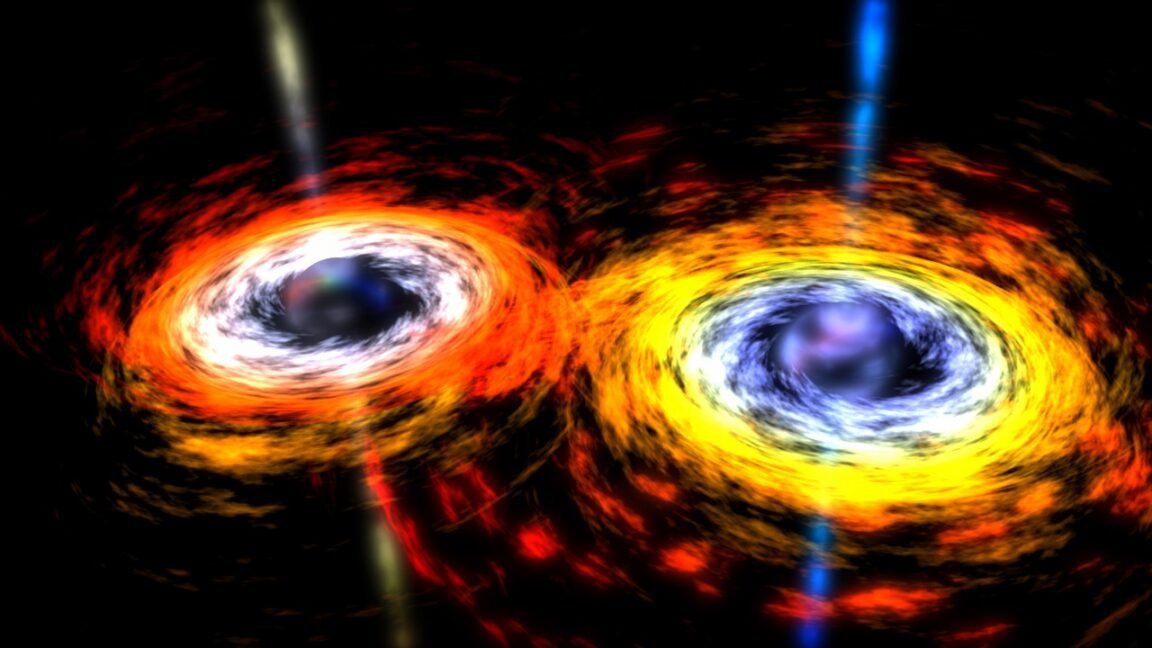
Many of the early exoplanet discoveries were exciting on their own, confirming that there really were strange new worlds out in the Universe. But over time, our focus has shifted more toward numbers, as we began using the frequency of objects like super-Earths and mini-Neptunes to learn more about how planets form. With four gravitational wave detectors now having generated years of data, we may be on the verge of seeing something similar happen with black hole mergers.
On Wednesday, researchers released an analysis suggesting that there’s a “mass gap” in the population of black holes that we’ve detected so far. And that gap supports the idea that some stars are so massive that they die in something called a pair-instability supernova, which is so violent that it leaves nothing but debris behind.
That’s not stable
Black holes result from the collapse of a star’s core during a supernova. While the outer layers of a star explode outward, the innermost layers plunge inward, funneling a fraction of the star’s mass into the black hole (or neutron star if the star’s mass is too small). We’re not sure what the upper limit on a star’s mass is, so you might naively think the distribution of black hole masses tails off gently.
But theoretical models have suggested there’s actually a sharp break. Above a certain mass, the density of photons in a star’s core can become so high that their energy is spontaneously converted into mass in the form of electron-positron pairs. Spontaneously forming a bunch of antimatter would seem to be a serious problem, but that’s actually not the worst of the star’s worries. Photons are the only things keeping the star’s core from contracting. Reducing their numbers by converting them to antimatter undercuts this force, causing a sudden compaction of the star.
If the star is sufficiently massive, this will cause the near-instantaneous onset of oxygen fusion, releasing a massive burst of energy. That energy is thought to be enough to completely destroy the star without leaving a remnant black hole behind. Alternatively, smaller bursts of oxygen fusion may blast away the star’s outer layers, leaving a much smaller star behind that will ultimately create a far less massive black hole.
While that’s pretty well established through modeling, it’s a very difficult process to confirm. There have been a number of proposed examples of potential pair-instability events, and we don’t have a clear picture of what observations would distinguish them from more run-of-the-mill stellar explosions. And while we’ve been able to estimate the mass of the black holes we’ve observed merging, that hasn’t been as helpful as we would like.
The problem is that several of the mergers we’ve seen involve black holes that seem to have merged previously. So they’re big enough to be above the cutoff where pair-instability should have blocked the formation of a black hole, but they might have gotten that hefty by swallowing another black hole.
Numbers to the rescue
The international team behind the new work considered what kinds of collisions we might see. One is two first-generation (G1) black holes merging, in which case both should be below the mass at which pair-instability destroys everything. Then there’s a G1 colliding with a second-generation (G2) that’s the product of a previous merger, with the G2 potentially being above the mass cutoff. Finally, there’s a G2-G2 merger, where both are above the cutoff.
Any black hole mergers are likely to take place within a structure filled with lots of high-mass stars, such as a globular cluster. But the merger itself tends to impart a lot of energy to the resulting black hole, which could potentially kick it out of the cluster. As a result, G2-G2 mergers would likely be far more rare than G1-G2 mergers; the team estimates that only about 1 percent of all mergers would be G2-G2.
At this relatively early stage of things, any mergers involving a G2 black hole would almost certainly be a G1-G2 merger. This means that the smaller of the two black holes involved in the merger had not previously undergone a merger and should therefore be subject to any mass limit imposed by pair-instability supernovae.
And that’s what the researchers seemed to see: There appears to be a mass limit in the smaller of the two black holes in collisions. The researchers estimate the cutoff at about 45 solar masses, not far from what theory had predicted (roughly 50 solar masses).
Adding further evidence that this is real, the spins of the more massive members of these mergers are high. That’s what you’d expect from a black hole that resulted from a merger, which will inherit some of the momentum of the orbits of the parent bodies. Doing an independent analysis based on spins also produced a limit right about in the same area: 45 solar masses. Earlier work had found a similar limit with a subset of the current data.
There is also an upper limit on the mass left behind by pair instabilities, which is a roughly 130 solar mass black hole. But our current data contains only a single example of a black hole this massive, so there’s not really anything we can say about the upper limit at the moment.
The error bars on these estimates are pretty large—literally five times the mass of the Sun. But each new year will bring more data, raising the prospect that we could narrow them down considerably with time. That should help validate whether this gap is really the product of pair-instabilities and maybe even help us understand the physical processes that create this limit.
Nature, 2026. DOI: 10.1038/s41586-026-10359-0 (About DOIs).