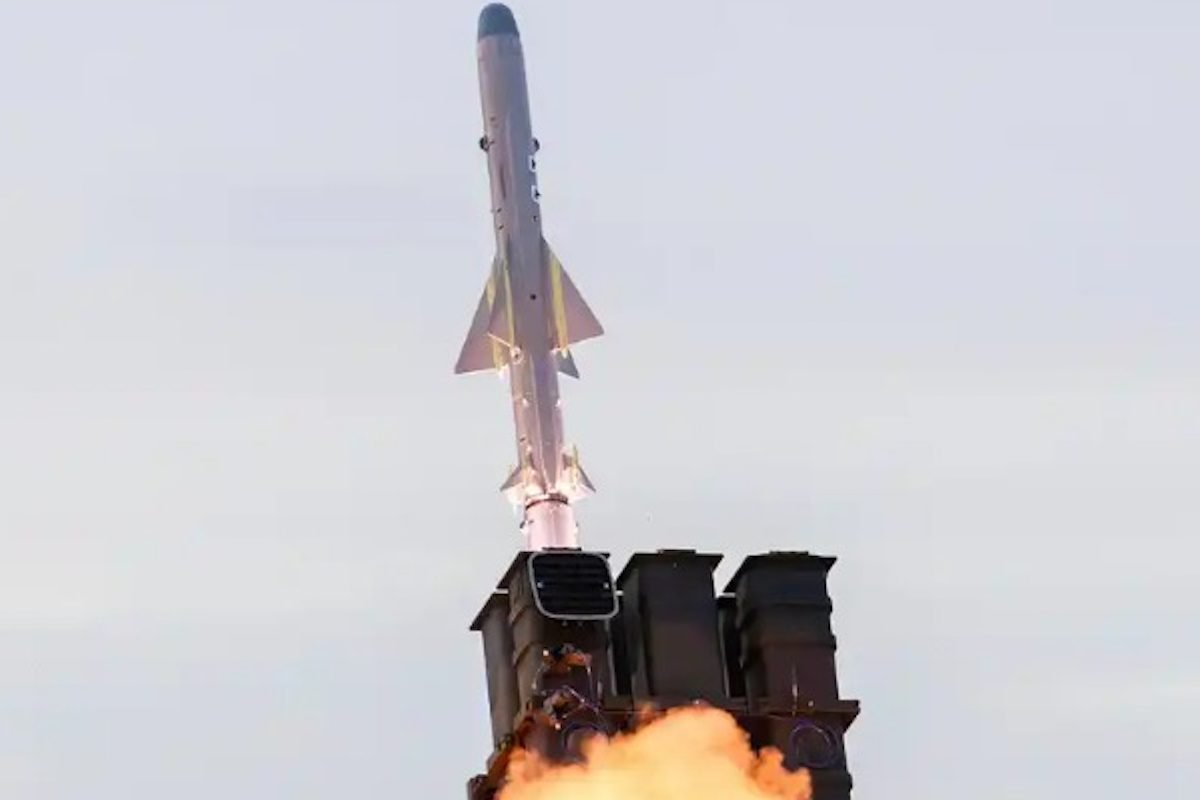
Japan’s quiet deployment of upgraded Type-12 missiles marks a decisive shift from defensive posturing to operational counterstrike capability, with implications for the balance of power in the East China Sea and around Taiwan.
This month, multiple media outlets reported that Japan will deploy its first domestically developed long-range missiles at the Japan Ground Self-Defense Force’s Camp Kengun in Kumamoto by the end of March, as part of efforts to field “counterstrike capabilities” amid rising tensions with China and North Korea.
Launchers and related equipment for the upgraded Type-12 surface-to-ship missiles—capable of striking targets up to 1,000 kilometers away, compared to about 200 kilometers for earlier versions—were transported from Camp Fuji to Kumamoto in a secretive overnight operation early this month, prompting protests from residents and criticism from local officials over a lack of transparency.
Developed by Mitsubishi Heavy Industries, the extended-range missiles can reach parts of mainland China and North Korea from southwestern Japan, significantly expanding their range and enabling stand-off strikes.
The deployment, which was moved forward by a year, reflects Japan’s response to what it sees as a deteriorating security environment, including China’s growing military activity around Taiwan and North Korea’s advancing missile programs.
At the tactical level, while Japan’s Ministry of Defense (MoD) explainer shows Camp Kengun and Camp Fuji in Japan’s main home islands as deployment sites for the upgraded Type 12, Rupert Schulenburg shows in an article this month for the International Institute for Strategic Studies (IISS) that from those locations, the upgraded Type 12 could place much of North Korea and parts of China’s eastern seaboard within range, and just some of the Ryukyu Islands.
Securing the Miyako Strait, which traverses the Ryukyu Islands, may be Japan’s top priority in deploying upgraded Type 12 missiles within its home islands.
The Miyako Strait is a critical maritime chokepoint that the People’s Liberation Army Navy (PLAN) must pass through to break out into the open waters of the Pacific. China has on multiple occasions sent its warships through the Miyako Strait, a maneuver that may be necessary to blockade Taiwan from the east and deter US and allied intervention.
A Chinese blockade of the Miyako Strait could complicate Japan’s response in the event of a US-China conflict over Taiwan. China’s control of the Miyako Strait could threaten the residents of the Ryukyu Islands by cutting off vital food and energy supplies – effectively holding them hostage. Such a move could force Japan to back down on supporting the US in a Taiwan contingency.
A blockade could also precede an amphibious move against the Ryukyus, securing China’s access to the Pacific while challenging US and allied efforts to contain it within the First Island Chain. However, such a move could trigger the 1952 US-Japan Mutual Defense Treaty (MDT), which makes such operations very risky.
Given these threats, deploying upgraded Type 12 missiles from Japan’s home islands could be part of a broader anti-access/area-denial (A2/AD) strategy and a counter to amphibious landings in the Ryukyus.
However, in a separate January 2025 IISS article, Schulenburg shows that the upgraded Type 12, when deployed on Japan’s Ryukyu Islands, puts all of North Korea, all of China’s eastern coastline, and all of Taiwan within range.
Such deployments could align with its emerging “counterstrike” capabilities in response to evolving missile threats from China and North Korea, as well as the limitations of current missile defense capabilities. As Japan’s 2022 National Security Strategy (NSS) notes, if Japan relies solely on existing missile defenses, it will become progressively more difficult to fully counter evolving missile threats.
In view of those developments, Japan’s 2022 NSS states that it needs counterstrike capabilities that, in the event of a missile attack by potential adversaries, enable effective counterstrikes against the enemy to prevent further attacks while protecting against incoming missiles through the missile defense network.
Japan’s emerging doctrine aligns with a “shooting the archer” approach, targeting enemy launchers before they fire.
Japan may now be able to strike farther—but it still cannot see far enough to do so independently. Veerle Nouwens and other authors note in a January 2024 IISS report that long-range strike capabilities in the Asia-Pacific depend on “connective tissue,” including space-based intelligence, surveillance, and reconnaissance (ISR) and integrated command systems.
They point out that while countries such as Japan are acquiring strike systems, such as the upgraded Type 12 missile, they remain reliant on the US to provide these enabling capabilities in the short term.
This reliance suggests that, despite growing offensive potential, such capabilities may not yet be fully autonomous.
Highlighting that capability gap, Schulenberg notes that as of this month, Japan has only 9 ISR satellites, which limits revisit rates and real-time targeting capabilities. However, he notes that beyond the US, Japan is partnering with Finland, Australia, and the UK to develop independent ISR capabilities.
China has responded strongly to Japan’s deployment of upgraded Type 12 missiles, with Chinese Defense Ministry spokesperson Jiang Bin saying that Japan has “completely stripped away its pretense” of an “exclusively defense-oriented” principle, “passive defense” strategy and “self-defense” policy, as quoted this month in Chinese state mouthpiece Global Times.
Bin also warned that “retreating to its belligerent and militarist past leads nowhere but self-destruction,” adding that any attempt by Japan to use force against China’s sovereignty and security would meet a “head-on blow” and “inevitable defeat.”
Militarily, China is likely to respond by expanding its missile forces, dispersing survivable launch systems, and targeting Japan’s bases, airfields, and ISR nodes early in a conflict, while increasing naval and air operations around the Senkaku and Ryukyu Islands.
Japan’s missiles may extend its reach, but until it can independently see and target at range, its counterstrike capability risks remaining more symbolic than decisive in a high-end conflict.