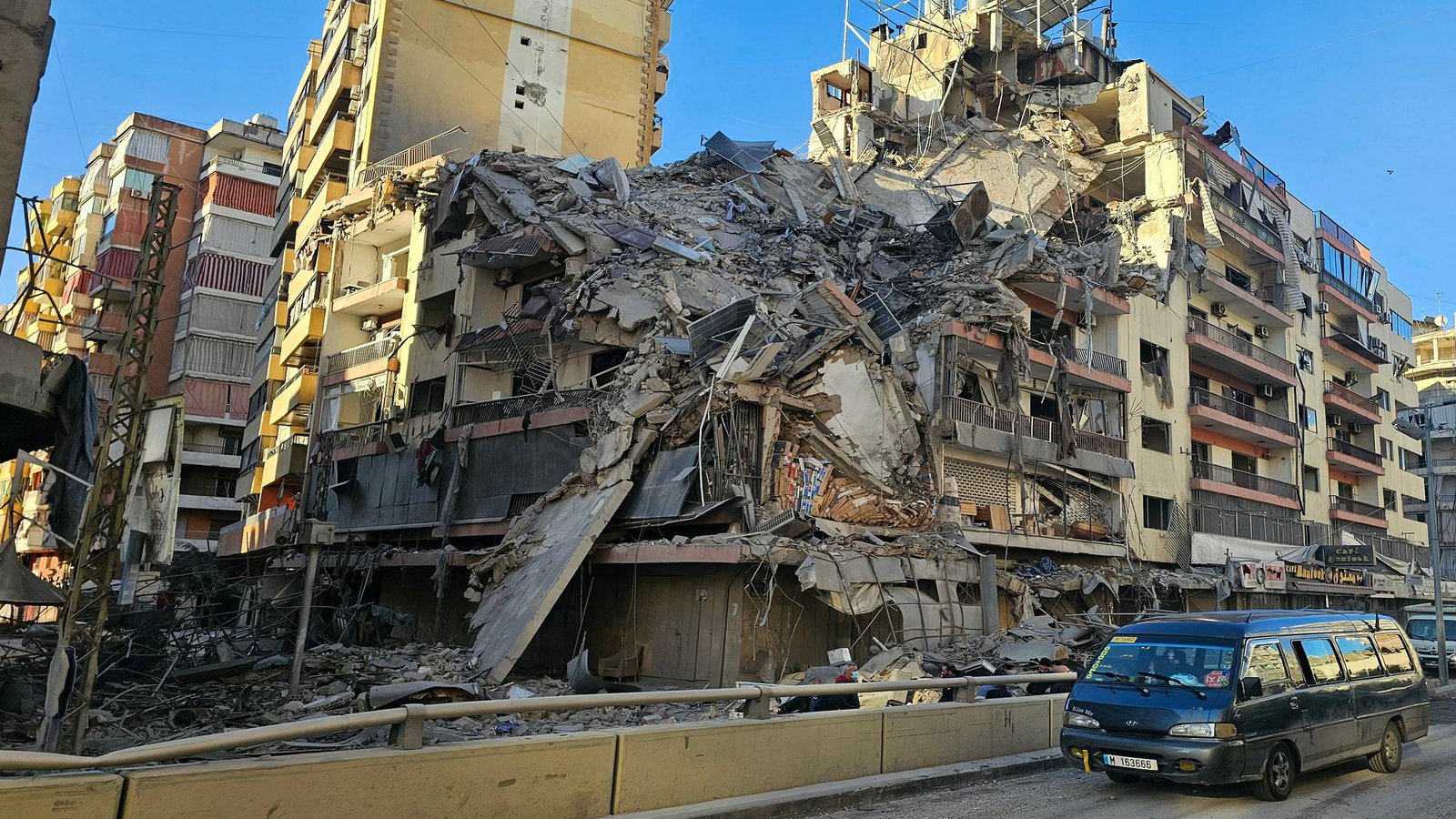
Residents scramble to escape Dahieh as Israeli warnings, heavy traffic, and limited shelter options trigger widespread displacement
In Dahieh, rifles are used to maintain order. A burst of gunfire sends a clear message to residents of Beirut’s southern suburbs: Flee! On Thursday, as the Israeli army issued an unprecedented evacuation order for the area, residents said ammunition ran out several times. More than 700,000 people were told to leave four suburban municipalities immediately. With each volley of shots, panic spread through a population familiar with displacement during past conflicts with Israel. Fear quickly spread across the capital, where roads became gridlocked, and many people continued on foot.
This is complete madness
“This is complete madness,” Ahmed said to himself as he tried to leave Dahieh. He drove against traffic, dodged motorcycles, accelerated, and swerved—anything to get out. Originally from southern Lebanon, he had lived in Beirut’s southern suburbs for 30 years. The previous war had already driven him from his longtime neighborhood for safety. But his parents were still there.
Just yesterday, these shots fired into the air saved my parents’ lives
“Just yesterday, these shots fired into the air saved my parents’ lives,” he told The Media Line with the calm of someone who knew what he was doing, a young man who knew these shortcuts by heart. “When Israel announced at seven in the morning that it would bomb a building on their street, the warning shots allowed them to evacuate, and they haven’t returned,” he acknowledged.
Ahmed’s destination was a hill not far from the threatened area, where he could watch events unfold. Alongside fellow journalists, the young man from Dahieh was both a witness to and a recorder of his town’s ordeal.
It looks like a real estate scheme
“What they’re doing is unspeakable,” said his friend Rifat, zooming in on the map shared by Israeli army spokesman Avichay Adraee on his X account to warn of the evacuations. “It looks like a real estate scheme,” he told The Media Line.
Elsewhere, fears of renewed Israeli military operations have revived old anxieties in Lebanon. In the south of the country, fighting between Israeli forces and Hezbollah has intensified over the past two days. Lebanese accounts say Israeli forces have taken control of five strategic points on the border, in violation of the ceasefire that took effect in November 2024.
Since the war began on Monday, the situation has changed by the minute. So far, 102 people have been killed and 638 injured. On Wednesday, Israeli military authorities ordered the evacuation of all towns and villages south of the Litani River in southern Lebanon. That order displaced about 250,000 people. Barely 24 hours later, residents across Beirut’s southern suburbs were told to leave by 2:30 p.m. local time on Thursday. That directive affected about 700,000 residents. In total, nearly one million people were forced to leave their homes at a moment’s notice.
Many of those who fled first sought refuge in the capital, but now even Beirut is no longer seen as safe from Israeli strikes. Not everyone chose to leave homes in the neighborhoods of Chiyah, Bourj el-Barajneh, Haret Hreik, and Hadath, all in the southern suburbs. With nowhere else to go, some defied the Israeli warnings. Many people who had tried since Monday to leave southern Lebanon, spending up to 14 hours on the road, later returned home after failing to find shelter.
Meanwhile, government-opened schools are full, and for many families, renting another home is unaffordable. Many others are sleeping in their cars. Residents and local reports say Israeli strikes have also hit buildings sheltering displaced people in areas outside Hezbollah’s control. The sense that nowhere is safe continues to grow. That is why many people say they would rather die in their homes. For some, that has become a form of resistance.
The Israeli army’s announcement appeared unprecedented in scope. Even during the fall 2024 war in Lebanon, there was no evacuation order of this scale covering entire neighborhoods. “Residents of the Bourj el-Barajneh and Hadath neighborhoods: please head east towards Mount Lebanon on the Beirut-Damascus highway,” Adraee wrote on X, along with a map showing the routes evacuees should take, something uncommon in this kind of order.
Very soon, Dahieh will resemble Khan Yunis
“Those from Hreik and Chiyah must head north towards Tripoli on the Beirut-Tripoli highway, and east towards Mount Lebanon on the Matn Expressway,” he added. “Any movement south could endanger their lives,” he stated, emphasizing that the Israeli army “will inform them of the appropriate time to return home.” “Very soon, Dahieh will resemble Khan Yunis,” Israeli Finance Minister Bezalel Smotrich said from the Israeli border.
From atop a hill in the town of Baabda overlooking Dahieh, Ahmed and Rifat condemned their government’s inaction. “This is also part of Lebanon, these threatened people are also Lebanese, so [political leaders] should do something,” Rifat declared, perched on a stool to film the impact of Israeli bombs with his camera. Lebanese President Joseph Aoun asked his French counterpart, President Emmanuel Macron, “to intervene to prevent attacks on the southern suburbs, following threats from the Israeli army,” the presidency said on X. “For Lebanon, we must act; we must do everything possible to prevent this country, so close to France, from being dragged back into war,” Macron said on “X”.
By nightfall, Beirut had filled with onlookers staring toward the horizon. Ahmed and Rifat stood among them, watching and waiting. “What else can we do?” they asked. A group of young people lit a bonfire while Dahieh remained dark. Few lights were visible in the southern suburbs of the Lebanese capital, although smoke still rose from the morning’s attacks, or perhaps from the day before. With cameras around their necks, young Lebanese people waited to document the scene before further destruction. Only when a national airline plane took off through the smoke did the sound of cameras clicking fill the air as they photographed the departure of fellow citizens.