As the US-Israel war against Iran is well into its second week, with no sign of ending, it is having ever wider global ripple effects. Beyond severe consequences for the world economy, the political and diplomatic fallout has also had a significant impact on Europe.
Europe is being forced to address the consequences of two wars of choice that are not of its making: the Trump-Netanyahu war against Iran and Vladimir Putin’s war on Ukraine. The European Union is increasingly straining to maintain unity as its institutions and member states struggle to align their interests confronted by such an unprecedented situation.
Divisions at the top of the EU institutions are increasingly playing out in the open. The EU is drawn between trying to maintain at least a minimum of transatlantic cohesion to keep the US on side in its confrontation with Russia, and its defence of an equally minimal pretence that international law still matters.
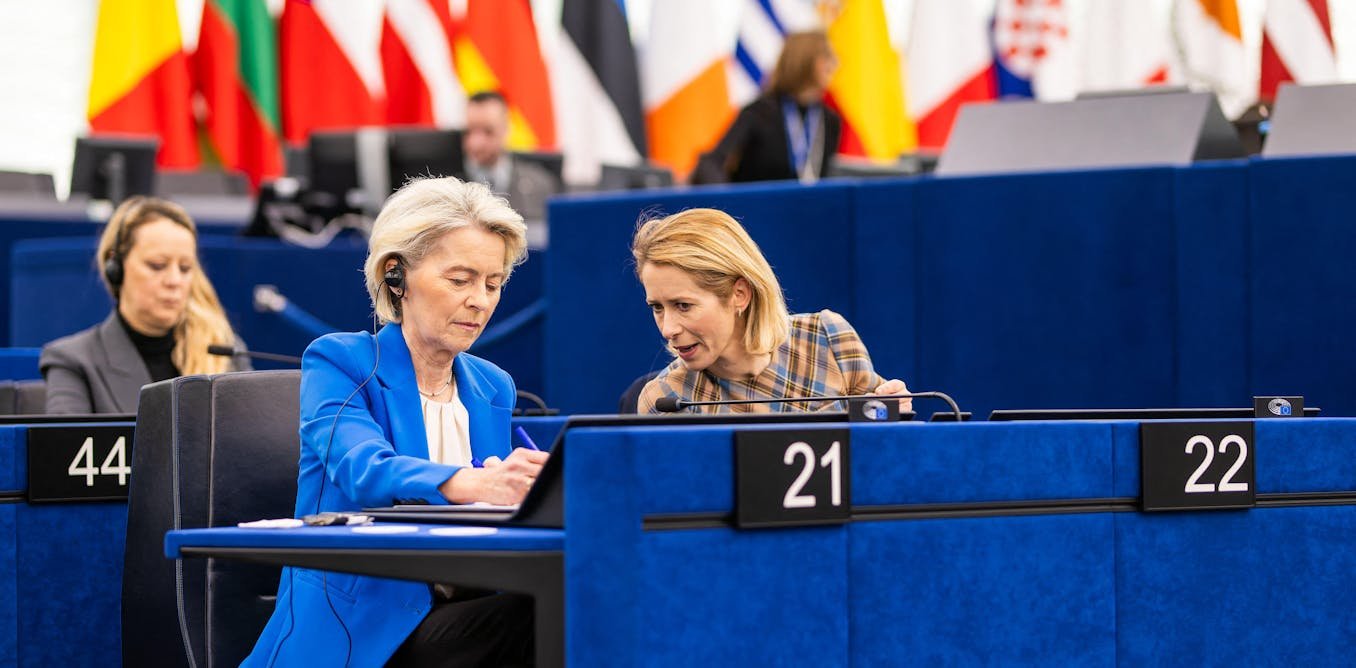
The result is mixed messaging on the US-Israeli war against Iran. Commission president Ursula von der Leyen was first clearly at odds with the EU’s foreign policy chief Kaja Kallas, before being contradicted by the commission’s executive vice-president Teresa Ribera and EU council president António Costa.
Such public spats between top EU officials are highly unusual. In fact, one of the least expected and most remarkable developments over the past four years since the beginning of Russia’s full-scale invasion of Ukraine in February 2022 has been the extent to which the European Union has changed and yet remained broadly united.
The EU’s response to Russia’s aggression was – uncharacteristically – one of breaking several taboos and at high speed. First, Brussels provided EU funds to non-member Ukraine for military equipment and training its armed forces. Over the past four years, the EU has risen to become Ukraine’s most important supporter. Second, and as significantly, the EU embarked on the process of making the development of Europe’s military capabilities a core future priority for Brussels. For a bloc whose core philosophy is focused peace through economic integration, this, too, was unheard of before Russia’s invasion of Ukraine.
These changes would not have been possible without the support of key member states, many of whom have abandoned longstanding and often highly cherished traditions as well.
Critically, this has been led by Germany and France, the EU’s two largest powers. In Germany, the then-chancellor Olaf Scholz’s Zeitenwende (turning point) speech just days after the war started triggered a fundamental rethink about the country’s relationship with Russia which had undeniably turned from a potential partner to an openly hostile adversary. This paved the way, among other things, for the sanctions imposed on Russia by the EU.
Scholz’s succcessor, Friedrich Merz, completed Germany’s geopolitical repositioning with his commitment to a European defence identity that will ultimately be independent from the US. This reflects an acknowledgement that the transatlantic pillar of US security for Europe has become too fragile under Donald Trump to continue to provide a dependable safety net for the continent.
The French embrace of European strategic autonomy may have been less surprising than in the German case. However, Paris recently announced concrete steps to expand its nuclear weapons arsenal and extend the French nuclear umbrella to eight European allies. This is a significant shift in doctrine. It will see nuclear-capable planes of the French air force stationed abroad for the first time.
Berlin’s participation in this scheme breaks another major taboo in Germany, while British participation is a clear indication that EU defence thinking has become more flexible. The idea of a “coalition of the willing” that includes members of both the EU and of Nato breaks with the traditional division of labour between them. It has the potential of providing a new anchor of European security that could overcome the rigidity of EU and Nato structures, including their dependence on consensus decisions.
All of these, and other, shifts in the EU’s geopolitical awakening have come at a cost, however.
European disunion
A longstanding row between Hungary and Slovakia, on the one hand, and Ukraine, on the other, over Russian oil deliveries via the Soviet-era Druzhba pipeline has significantly escalated. Budapest has vetoed the delivery of an agreed €90 billion (£77 billion) loan to Kyiv and threatened to block new sanctions against Russia.
There is now also an open debate in Brussels – principally between some member states and the European Commission – on at least the timing, if not the broader prospects, of Ukrainian accession to the EU.
None of these challenges will quickly disappear, nor are there easy answers to them. The idea of the heart of the European project – that economic integration and investment in a rules-based liberal international order would make the continent safe – turned out to be naive.
First, Moscow’s willingness to disrupt the international relations of Europe by force dealt a serious blow to the idea that the EU’s combined power could sufficiently constrain a revisionist and expansionist Russia. Second, and perhaps even more sobering, Washington’s willingness to stake a claim for the acquisition of Greenland, initially not ruling out the use of force, threatened the territory of Denmark, a European Nato ally and EU member. This at once cast the dependability of the transatlantic alliance into a whole new, and unwelcome, light.
The EU’s age of innocence is now over. Trump and Putin have delivered major shocks to the political psyche of European leaders. While this continues to be a painful process, Europe as a whole cannot afford a breakdown in the hard-won consensus over the need to support Ukraine and invest in its own defences. This would have serious negative consequences for the continent’s ability to survive in a world in which once-established rules of state conduct are rapidly dismantled.
After four years of war and more than a year of Trump 2.0, the EU has shaken off the conception of being a “civilian power”. But reshaping the current chaos into a new order that is once again conducive to the European project will require hard work for Europeans to be seen as being geopolitically relevant.