
Mathew Rodriguez is a Puerto Rican writer and author based in Brooklyn.
The night before we were set to fly out of John F. Kennedy International Airport in New York City, I approached my partner with a confession: For the first time that I can remember, I was afraid of flying with a Latino last name.
It was a new sort of affront I had to steel myself against. Air travel is filled with moments — buying basic economy tickets, being herded through winding security lines like cattle, squishing your limbs into a compact seat — that smoosh you until you feel subhuman, usually along class lines.
In the days leading up to our flight to Las Vegas, however, I saw the indignities of the airport mount as President Donald Trump deployed U.S. Immigration and Customs Enforcement agents into America’s terminals, turning an already-debasing necessity into something more chilling.
If one thing has been consistent in ICE’s ever expanding mission, it’s that the agency is being used by the administration to instill fear.
Certainly, that’s how I felt after my experience. At JFK, an ICE agent was taking the customary Transportation Security Administration role of checking IDs at security. Everything, though, seemed to be running as normal. When I handed over my passport, however, he asked me a question I hadn’t heard him ask anyone else in front of me — most of whom presented as white: “Do you have a second form of photo ID?”
I can’t be sure what motivated the agent to ask me, and apparently no one else near me, this question, but his request of me was difficult to separate from ICE’s role not only as brutal enforcers of Trump’s deportation regime, but also its use as his personal police force. If one thing has been consistent in ICE’s ever-expanding mission, it’s that the agency is being used by the administration to instill fear.
Later, it was impossible not to think about what my brief, eventually harmless encounter with the agent might portend. Shortly after Trump deployed ICE agents to airports, his former chief strategist Steve Bannon may have tipped the administration’s hand. Bannon speculated on his “War Room”podcast that the immigration force’s presence at TSA security checkpoints was a “test run” ahead of the November midterms.
Maybe, Bannon seemed to suggest, it was a rehearsal, meant to test how far the administration can stretch our tolerance for agents as part of the landscape of our daily lives without pushback.
If ICE’s invasion of American cities as part of Trump’s broad-based crackdown on immigration and dissent alike was a sledgehammer, what I experienced was more akin to a scalpel. It represents an agency that is understanding the criticisms against its methods and looking for new, more sophisticated ways to terrorize people.
If we can accept the reality that Trump’s personal army is requiring more documentation from us just to board an Airbus, how long until we are forced to tolerate them in our voting booths and beyond?
Training Us to Terror
It was hard not to feel that surgical instillation of terror during my airport visit.
The heightened scrutiny of airport security already makes me feel like a criminal, one who doesn’t even know he committed a crime. In the days leading up to my flight, I prepared for that same kind of interaction, amplified by the presence of someone with a gun and near-unlimited state power. I knew I’d have to get much closer to an ICE agent than I ever had before.
Instagram videos of JFK suggested lines might be long, but when we arrived on Thursday morning, the terminal was mostly empty and the estimated wait time in my reserve line was only about 15 minutes.
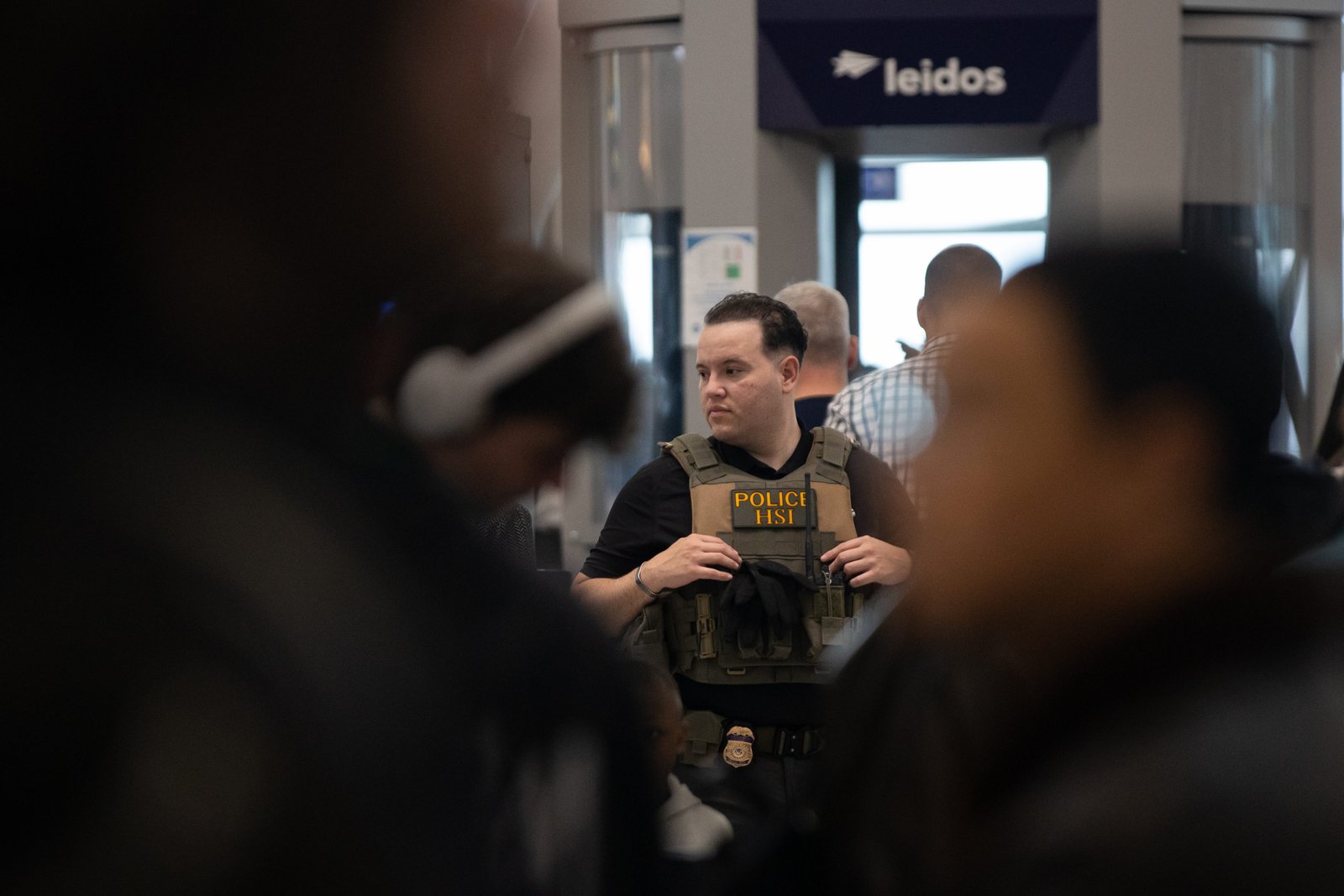
It ended up taking twice as long. As we got closer to the security checkpoint, I realized what the holdup was: A TSA agent was standing behind two ICE agents, training them on how to do her job. As she stood there — working without getting paid, unlike the heavily armed agent sitting in front of her — she walked them through the steps.
I got a closer look at one of the ICE agents. He was white and bald, wearing military fatigues and a tactical vest that announced his employment with ICE.
People in front of me walked through without incident, performing the usual routine: passport, boarding pass, then on to remove their belts and unsheathe their laptops.
When I stepped up to the podium, I wondered if I was about to interact with someone who would be suspicious of me merely for my name and skin color.
I let out an involuntary smile — perhaps as a subconscious signal that I am friendly and low-risk. The ICE agent asked for my passport, which I handed over, as usual, and waited while a machine took my picture. I anticipated moving on quickly.
That’s when he asked me for another form of ID. At that moment, I started to feel my face turn hot, as if I were being accused of something. A U.S. passport is considered one of the most powerful forms of identification in the world. Why did he need a second document?
Though I had already started to grab the wallet in my coat pocket, he followed up with, “You know, like a driver’s license?” I handed over the plastic driver’s license — not a REAL ID, which is why I brought my passport — and waited for his verdict.
He looked back and forth between my documents and the monitor and then OKed me to walk forward.
My partner, who is white, walked through behind me without incident.
People with weapons will now ask more of me just to do the same thing I had done a few weeks before.
Later, as I was sitting in my seat toward the plane’s rear, I began to gain a greater perspective on what I had just undergone. That interaction — the kind that I had worried about for a few hours before waking up and schlepping to the airport — was designed to happen to people like me. It represented a moment of friction, designed to jolt me at first, but then get me used to the fact that people with weapons will now ask more of me just to do the same thing I had done a few weeks before, when I flew to Puerto Rico without any ICE agents at the TSA checkpoint.
Free passage would be harder, the stakes of any interaction would be higher. The fear that I was feeling in that moment had been designed, as if in a lab, to train me to accept a violent overreach that would’ve seemed absurd mere weeks ago.
It’s easy to see how this creep might affect people — Latinos and other immigrants who have citizenship — at their polling places. It will bring a little terror. And then instill a little normalcy.