When Soviet president and Communist party secretary Mikhail Gorbachev introduced the policies of perestroika (reconstruction) and glasnost (openness) in the mid-1980s, it marked the beginning of cautious reforms of the Soviet Union. Georgia, or the Georgian Soviet Socialist Republic, to give it its full name at the time, was on the periphery of the union.
Far from Moscow, it lay hidden on the other side of the Caucasus mountain range on the edge of the Black Sea. As a doctoral candidate in linguistics on a research grant to Tbilisi University, I spent one year living there, between 1987 and 1988. I was conducting research on the Georgian language.
Travel at the time was very difficult, and could only happen via Moscow. I did not return to Sweden for the duration of my stay. In the recent publication, We Witnessed the Soviet Break-Up: Five Scandinavian Researchers on the Final Years of the USSR, Seen From the Caucasus, I detail how this gave me a front-row seat from which to observe the speed at which society was shifting – and how language was key to that transformation. I also observed how old cultural traditions had endured despite decades of Communist propaganda and harsh Sovietisation.
Rapid transformation
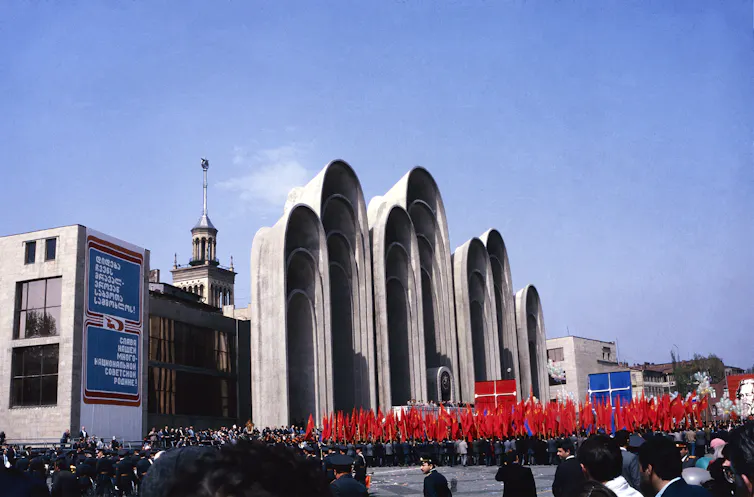
The May Day parade was long one of the key moments in the Soviet calender. I witnessed the last time it was held in central Tbilisi, in 1987. People were carrying red flags. Banners declaiming “Glory to the Communist party” and “Glory to our multinational Soviet Fatherland” were draped on the main buildings.
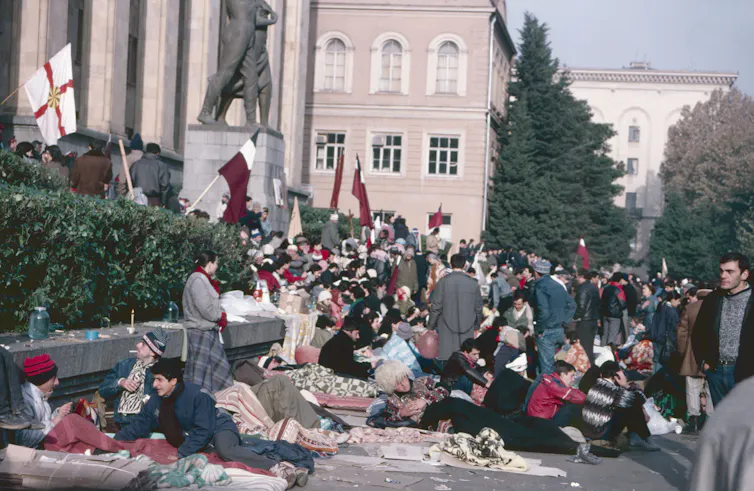
Next year, however, the national movement across the republic was pushing for a free Georgia. In November 1988, many took part in a hunger strike in front of the Georgian parliament against changes in the constitution that would reduce the rights of the Georgian republic. Protesters wanted what they termed the “Russification of Georgia” to come to an end.
Georgian society was multiethnic and multilingual, counting Russians and Georgians alongside Armenians, Azerbaijanis, Abkhaz, Ossetians, Greeks and many others. Georgian was the main language within the Georgian education system as well as in broadcasting and the press and, technically, according to Article 6 of the Constitution of Soviet Georgia recognised as the republic’s official language. However, during the Soviet period, Russian speakers could easily live and work in Georgia without knowing Georgian: Russian was the lingua franca for inter-ethnic communication within the republic and the Soviet Union at large.
As a non-Indo-European language, Georgian boasts its own script and a written history that dates back to the 5th century AD. It is a cornerstone of the Georgian identity. Within the wider push for greater political freedom, Georgians now fought for the implementation of the constitutional status of Georgian. This included increased demands for knowledge of Georgian in workplaces and administration, while also investing in teaching Georgian as a second language.
Efforts were made to develop Georgian terminology in technology, science and other fields where Russian had been dominant. Citizens who had little or no knowledge of Georgian were under pressure to learn.
Enduring traditions
Despite decades of Sovietization, social and family life remained underpinned by old patriarchal traditions.
During my time in the country, I was welcomed with more openness and engagement, and less suspicion, than during the three years I had spent in Moscow. I experienced the extent to which hospitality was an ancient Georgian virtue. “A guest is a gift from God,” local people would say.
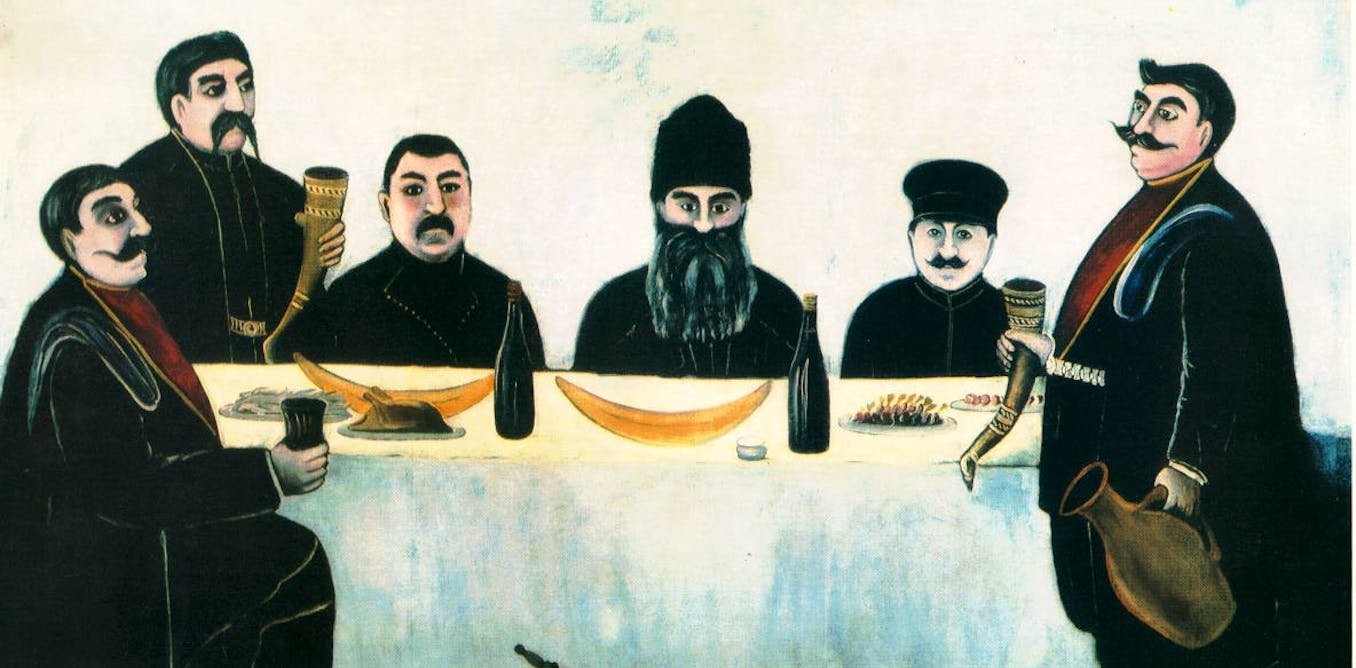
Georgians were proud of their cuisine and ancient wine production. When a guest entered a home, the dinner table would quickly transform into a feast, what is know as a “supra”. This came with its own specific structure and rules. The man of the house would assume the role of toastmaster (tamada), and the wife and female members of the family would prepare and serve the food. They would be called in from the kitchen for a toast in honour of the women. In some traditional families, the men would sit at one end of the table, and the women and children at the other.
These traditions were discernible across the different cultural communities within Georgia. Tensions at the time were growing between Tbilisi and the central Soviet authorities in Moscow, and within Georgia itself, with minorities in the autonomous entities of Abkhazia and South Ossetia.
In the summer of 1989, the first violent Abkhaz-Georgian clashes took place. I was on a day trip, travelling from Sokhumi, the capital of the Autonomous Republic of Abkhazia, to a wedding in a small town called Zugdidi in the Megrelia region when violence broke out. Unable to return to Sokhumi as planned, I ended up spending one week with a family on the outskirts of the town.
Being there was like stepping back in time. The household was run by a young woman called Tsira, who, as a widow, dressed all in black. According to tradition, she would remain in black for the rest of her life. Her eldest son, who was 12-13 years old at the time, appeared to be seen as the man of the house.
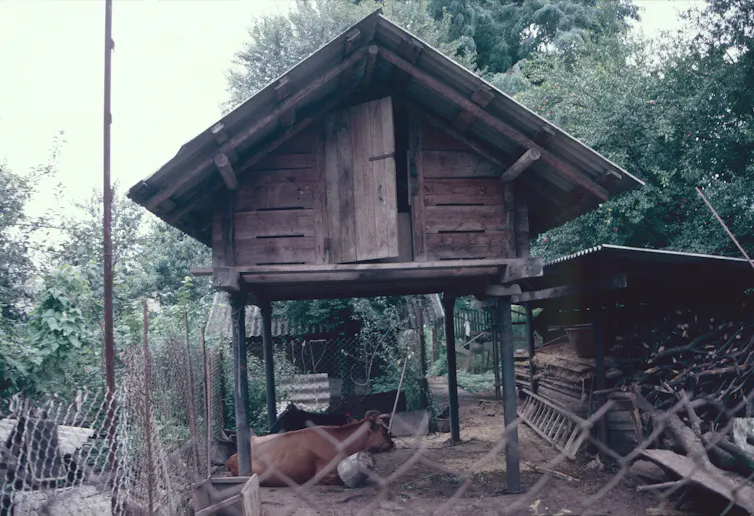
Tsira’s neighbours came round and my friends from Sokhumi sat with them, discussing the conflict in Megrelian, the local language. Tsira prepared food, chicken and maize porridge over an open fire in a small wooden hut in the yard. Smoked cheese hung from the ceiling.
At one point, we visited the cemetery. Tsira sat on a stone bench by a black marble bust of her husband while relatives and guests sat around the grave. The women brought out Soviet champagne and food. I observed how toasting and eating bread dipped in wine were important in a ritual of honour and remembrance.
These religious practices showed how, within the official atheism of Soviet society, Georgian Orthodox traditions persisted – as they still do today. Another such religious practice common in Georgia during Soviet times was to hold a commemorative supra 40 days after a person had passed away. During this period, the men were not supposed to shave. The 40 days are considered the time it takes for the soul to reach heaven and God.
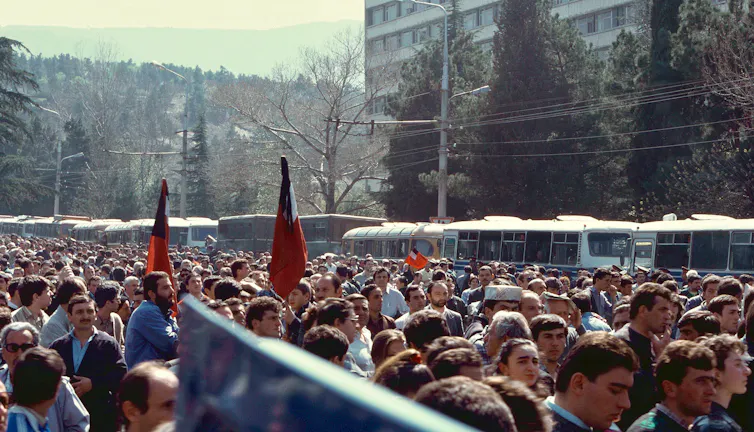
In 1990, I heard the crowd shouting “occupiers, occupiers” in front of the general staff of the Caucasian Military District in Tbilisi. The newly adopted Soviet law, dubbed the “law of non-secession” made the idea that the Soviet Union might break up feel a utopian dream. And yet it did, merely a year later. Georgia declared independence from the Soviet Union on April 9 1991 and the split was finalised on December 26 with the dissolution of the USSR.
In the intervening decades, the ethnopolitical conflicts that were fomenting during this early post-Soviet period have only deepened, not least following the Russo-Georgian war of 2008. Today, they remain largely unresolved and the situation in Georgia, highly volatile.
The Georgian language, however, has reclaimed the media, education and the streets. Russian has been replaced by English among the young generation of Georgians who do not carry this Soviet heritage.