When the United States and Israel struck Tehran in late February, Jakarta’s response was conspicuously muted, echoing the unusually quiet corridors of diplomacy in Pejambon, typically alive with sovereignty-laden rhetoric. As “Operation Epic Fury” unfolded on February 28, 2026, unleashing precision-guided missiles and reportedly eliminating Iran’s Supreme Leader, Ayatollah Ali Khamenei, the world expected a forceful reaction from Indonesia, home to the largest Muslim population globally. Instead, what emerged was a tepid expression of “deep regret,” devoid of direct condemnation of Washington or Tel Aviv, and notably absent of any immediate official condolence from the presidential palace.
The contrast sharpened as domestic political dynamics took center stage. Former president Megawati Soekarnoputri stepped into the vacuum left by the state’s restrained posture. She issued condolences for Khamenei’s death and, shortly thereafter, extended congratulations to Mojtaba Khamenei following his succession through the Assembly of Experts on March 10, 2026. This was no mere personal gesture. It amounted to a form of “shadow diplomacy,” evoking the legacy of the 1955 Bandung Conference at a moment when the central government appeared strategically hesitant.
For Jakarta, this was nothing short of an existential threat. Labour-intensive sectors such as textiles, footwear, and rubber, employing between four and five million workers, are heavily reliant on the US market.
Why did Indonesia appear so constrained, almost paralyzed, in responding to the Iran crisis? The most candid answer lies in the evolving geo-economic and geopolitical architecture shaped by Donald Trump, into which Indonesia had just been drawn days before the strikes began. On February 19, 2026, Jakarta signed the Agreement on Reciprocal Trade (ART) in Washington, marketed as a “Golden Era” pact, yet in practice functioning as a gilded cage for Indonesia’s foreign policy autonomy.
Economic pragmatism appears to have pushed the long-standing “free and active” doctrine to a precarious low point. By aligning with the Board of Peace (BoP), a Trump-backed alternative to the United Nations launched in Davos in January 2026, Indonesia has entered a system that prioritizes market stability and energy security, even at the cost of shielding key allies from accountability. Jakarta is no longer a bystander, but a participant in an order where geopolitical alignment carries tangible economic consequences. The result is a delicate balancing act between dollar dependence and the erosion of Indonesia’s ideological identity.
Geo-economic Shackles
Indonesia’s restraint toward Washington is best understood as a direct consequence of mounting economic pressure since early 2025. At that time, Trump threatened unilateral tariffs of up to 32 percent on Indonesian exports to reduce a U.S. trade deficit that had reached $23.7 billion. For Jakarta, this was nothing short of an existential threat. Labor-intensive sectors such as textiles, footwear, and rubber, employing between four and five million workers, are heavily reliant on the U.S. market.
Indonesia’s accession to the Board of Peace marks a seismic shift from UN-based multilateralism toward a more transactional, influence-driven order.
To avert economic disruption, Indonesia agreed to the ART deal, eliminating tariffs on more than 99 percent of U.S. goods. The most binding clause, however, requires Indonesia to import $15 billion worth of U.S. energy annually, including LPG, crude oil, and refined fuels. This represents a twelvefold increase from previous levels, effectively shifting Indonesia’s energy dependence from the Middle East to the Gulf of Mexico, at a time when the Strait of Hormuz has been paralyzed by conflict.
This structural dependence has created a deterrent effect: open criticism of U.S. military actions in Iran risks triggering Section 232 of the Trade Expansion Act, which could revoke Indonesia’s preferential trade status on national security grounds. In practical terms, Indonesia’s moral voice on the global stage now carries a measurable economic cost. Each word of condemnation could jeopardize the trade surplus needed to stabilize the rupiah.
Compounding this dynamic is the role of strategic investment. Freeport-McMoRan’s expansion in the Grasberg mine, in partnership with Indonesia’s Ministry of Investment, is projected to generate $10 billion annually. At the same time, Indonesia’s ambition to dominate the global nickel downstream industry, and by extension, the electric vehicle battery supply chain, remains contingent on Western technology and market access. Foreign policy, in this context, increasingly resembles a balance sheet calculation rather than a pure expression of constitutional principles.
The Board of Peace and the “Free and Active” Dilemma
Indonesia’s accession to the Board of Peace marks a seismic shift from UN-based multilateralism toward a more transactional, influence-driven order. The BoP is not merely a forum for dialogue; it is a body where Donald Trump wields unilateral veto power, and permanent members are required to contribute $1 billion in membership fees. By joining, Indonesia has implicitly acknowledged Washington’s primacy in shaping narratives of peace and stability in conflict zones.
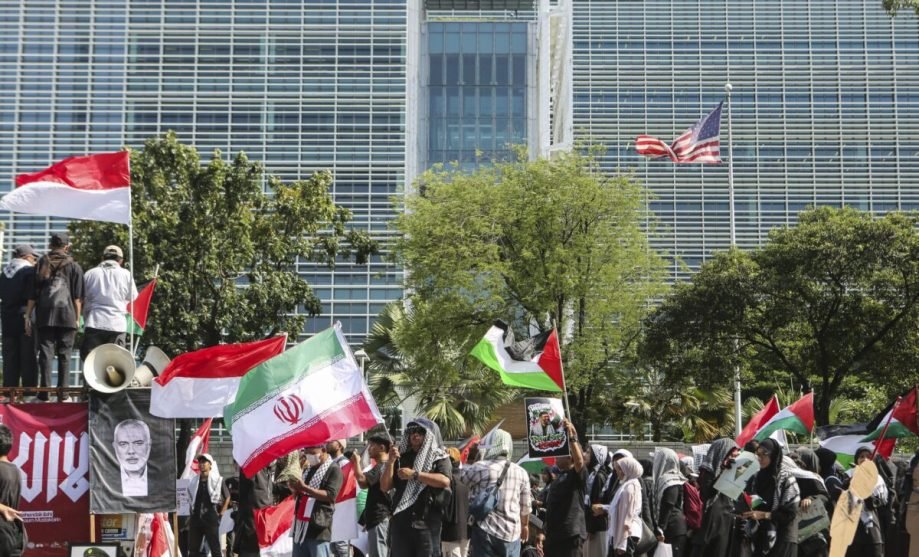
Domestically, tensions have intensified. Major civil society organisations such as Nahdlatul Ulama have condemned the strikes as a violation of international norms, warning that global silence could fuel a resurgence of radical movements.
The timing is striking. The Tehran strikes occurred just one week after the BoP’s inaugural meeting in Washington on February 19, 2026. This has drawn sharp criticism from the Indonesian Ulema Council (MUI), which argues that the BoP has already lost legitimacy, serving instead as a mechanism for granting impunity to U.S. and Israeli military actions. Yet Indonesia now finds itself deeply entangled. As a BoP member, it has committed to deploying thousands of troops to the International Stabilization Force (ISF) tasked with securing post-conflict Gaza.
This places Indonesia’s military in a profound ethical bind. On one hand, it fulfills a peacekeeping mandate; on the other, it enforces an order shaped by actors directly involved in the Iran strikes. For President Prabowo Subianto, the constraints of realpolitik appear to have overridden ideological consistency. His administration has opted for what it describes as a “rational, calm, and non-emotional” approach, delaying further discussions on BoP commitments without withdrawing altogether.
Domestically, tensions have intensified. Major civil society organizations such as Nahdlatul Ulama have condemned the strikes as a violation of international norms, warning that global silence could fuel a resurgence of radical movements. It was this internal pressure that ultimately prompted Indonesia’s Ministry of Foreign Affairs to issue a stronger statement on March 9, 2026, explicitly calling on the U.S. and Israel to halt their attacks, albeit still framed in cautious diplomatic language.
Dual-Track Diplomacy
Against this backdrop, Megawati Soekarnoputri’s vocal stance on Iran can be interpreted as a deliberate dual-track diplomacy. While President Prabowo maintains formal economic ties with Washington to safeguard investment flows, Megawati, through the Indonesian Democratic Party of Struggle (PDI-P), preserves Indonesia’s historical and ideological links with Tehran. Her correspondence, invoking the principles of “Trisakti” and Iran’s self-reliance, serves as a pressure valve to prevent a lasting rupture in bilateral relations.
This approach also reassures domestic audiences that Indonesia has not entirely abandoned its moral compass. Megawati’s explicit praise for Iran’s resilience, framed within the legacy of the Bandung Conference, resonates strongly with Muslim constituencies at home. The division of roles allows Indonesia to retain economic access to the United States while symbolically sustaining its standing in the Islamic world.
Indonesia’s banking sector is increasingly exposed to the threat of secondary sanctions from the US Treasury’s Office of Foreign Assets Control (OFAC), which has intensified its scrutiny of entities linked to Iran.
However, this strategy carries tangible financial risks. Indonesia’s banking sector is increasingly exposed to the threat of secondary sanctions from the U.S. Treasury’s Office of Foreign Assets Control (OFAC), which has intensified its scrutiny of entities linked to Iran. The collapse of the Iranian rial, now trading at roughly 88 rial per rupiah, and the reimposition of multilateral UN sanctions have effectively severed Tehran’s shadow banking networks. Indonesia’s Financial Services Authority (OJK) and Bank Indonesia must now work overtime to ensure that domestic institutions avoid entanglement with blacklisted Iranian entities.
Looking ahead, Indonesia faces a critical imperative: to convert its geo-economic strengths—particularly its dominance in critical minerals, into more assertive political leverage. The cancellation of plans to acquire Boeing’s F-15EX fighter jets, in favor of Dassault Rafale aircraft and the KF-21 program, signals an emerging effort to diversify defense partnerships and reduce overreliance on a single supplier. Strategic silence may offer short-term stability, but over time it risks eroding Indonesia’s credibility as a regional leader.
The views expressed in this article belong to the author and do not necessarily reflect the editorial policy of Middle East Monitor.