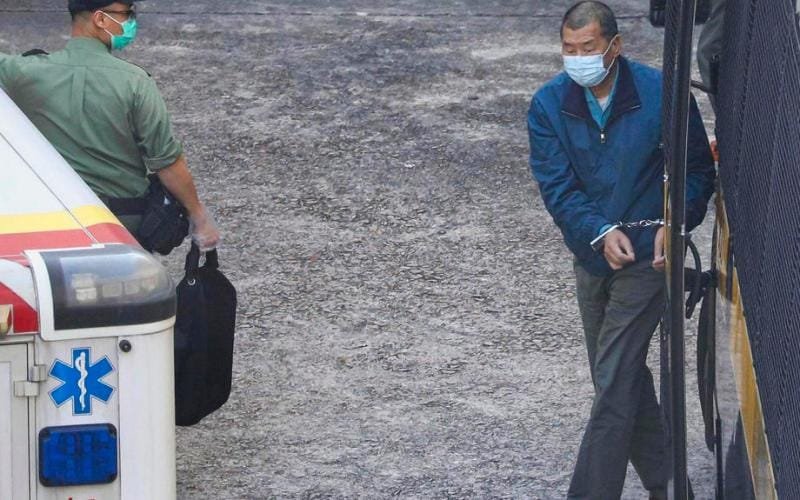
Former Hong Kong media tycoon Jimmy Lai has been given a 20-year prison sentence. This concludes a legal saga that symbolizes Beijing’s broad clampdown on civil liberties in the city. The 78-year-old billionaire is known for his outspoken criticism of the authorities. He is the most prominent figure to face prosecution. This has occurred since China’s national security law was introduced in Hong Kong in 2020.
Lai’s sentence, the longest imposed under the controversial law, ensures he will not be eligible for parole until his late nineties. The verdict is expected to intensify international advocacy for his release, with global leaders – including former US President Donald Trump – closely monitoring the trial and urging action.
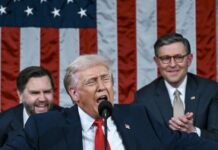
Trump is anticipated to visit China in the coming months, and Lai’s supporters are planning to lobby him to raise the imprisoned media magnate’s plight during talks with President Xi Jinping.
The severity of the sentence has prompted strong reactions from Lai’s family. His son Sebastien described the punishment as “draconian” and potentially “life-threatening,” while his daughter Claire called it “heartbreakingly cruel.” She expressed grave concern over her father’s deteriorating health in prison and warned that, if carried out, the sentence could lead to Lai dying behind bars as a martyr.
Jimmy Lai’s activism for Hong Kong’s freedoms, including direct engagement with senior US officials, and his role in founding the pro-democracy Apple Daily newspaper, have long made him a target for Beijing. The paper, now defunct, was known for its uncompromising stance in favour of democratic principles.
Both Beijing and the Hong Kong government have dismissed international criticism, insisting that Lai’s prosecution is not politically motivated and does not infringe upon press freedom. Officials maintain that Lai has been provided with adequate medical care during his incarceration.
Steve Li, chief superintendent of the national security department, stated: “The court has affirmed the gravity of his crime, showing that he’s the mastermind and leader behind the scene.”
Lai was convicted in December of two national security charges and one count of sedition after a protracted legal battle. His sentencing follows the jailing of six former Apple Daily colleagues, who received prison terms ranging from nearly seven to ten years. The publication and its affiliates were fined six million Hong Kong dollars.
Beijing’s national security law has dramatically altered Hong Kong’s landscape, leading to the imprisonment of dozens of dissidents, the dissolution of civil society groups and independent media outlets, and the suppression of the city’s previously vibrant political arena. Authorities claim the law restored stability after the 2019 anti-government protests.
Supporters queued for days outside the West Kowloon court to witness Lai’s sentencing, with heightened police security in place. Judges presiding over the case, appointed by the government, asserted that Lai harboured “resentment and hatred of the PRC,” describing him as the “mastermind of the conspiracies.” They highlighted his lobbying of US politicians as evidence of sedition and collusion with foreign forces, and noted that his actions were “well planned and premeditated” to reach audiences both locally and abroad.
The court determined that Lai’s offence represented the “most serious category” of sedition, citing the number of articles involved and the length of the alleged offence. Prosecutors claimed Apple Daily published up to 161 seditious articles.
While Lai is entitled to appeal his conviction and sentence, the process is notoriously lengthy and rarely succeeds. To date, only one in nearly one hundred individuals charged under the national security law has been fully acquitted.