A Europol high-value target has been arrested and key members of his criminal network targeted during a coordinated action on 23 March across Spain, Bulgaria and Greece.
The network is suspected of trafficking firearms from the Western Balkans and Türkiye into the European Union, exchanging them for cannabis and fuelling organised crime across multiple Member States.
The main suspect, a Turkish national holding a Greek residence permit, is believed to have coordinated the sourcing and transport of firearms into Spain, while overseeing the purchase and onward distribution of drugs to countries including Greece and Bulgaria.
Flow of illicit firearms into the EU
The investigation began in March 2025, when the Spanish Mossos d’Esquadra detected the illegal introduction of firearms from Türkiye and their distribution to criminal groups in Catalonia, against a backdrop of rising armed violence.
This led to the identification of a criminal organisation specialising in the importation, storage and distribution of firearms.
Investigators uncovered a structured supply chain: firearms were sourced in the Western Balkans and Türkiye, concealed in vehicles and lorries equipped with hidden compartments, and transported into the EU. Once inside Europe, they were circulated within criminal networks and used as a bargaining tool in drug deals.
This steady flow of weapons significantly increased the firepower of organised crime groups and contributed to violence across Europe.
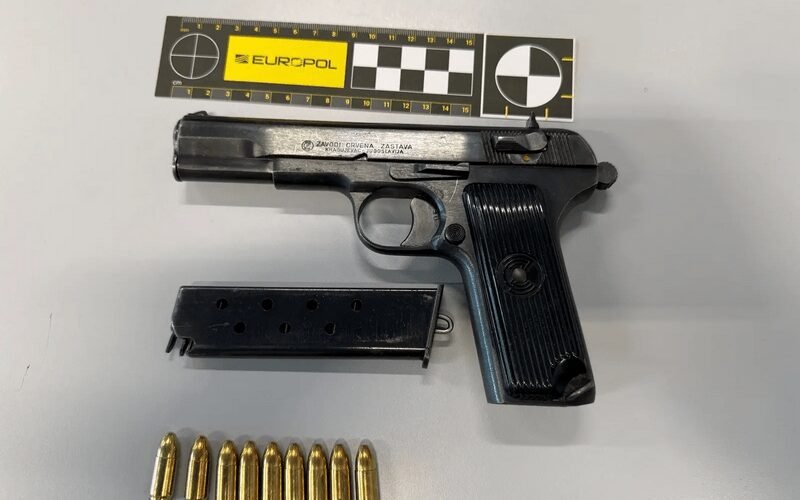
The network trafficked so-called “Frankenstein” weapons – hybrid firearms combining original components with handmade metal parts. These low-cost but fully functional weapons are particularly difficult to trace and facilitate illicit distribution across Europe.
Firearms traded for cannabis
In parallel, the network was heavily involved in large-scale cannabis trafficking.
Investigators found that the group had established infrastructure to source significant quantities of marijuana in Catalonia and export it via land and maritime routes across Europe to Türkiye and Greece, where its value increased substantially.
The network is estimated to have had the capacity to transport up to 1.5 tonnes of marijuana per month. During the investigation, around 550 kilograms of marijuana were seized, alongside firearms and ammunition.
Action day: coordinated arrests across Europe
Authorities acted as the network prepared further criminal deals involving both firearms and drugs.
On 23 March:
- Spain arrested 18 suspects across Teià, Barcelona, Mataró, Sabadell, Tordera, Lloret de Mar and Málaga;
- Bulgaria arrested the leader of the organisation in Sofia, along with two other suspects;
- Greece supported the investigation through its participation in the operational activities.
In total, 21 suspects were arrested.
Seizures throughout the investigation included seven semi-automatic pistols and one war-grade weapon, Silencers and sound suppressors and 587 kg of marijuana and 76 kg of hashish, with an estimated illicit market value of EUR 4.4 million.
Europol support
Europol supported the investigation throughout by facilitating intelligence exchange and operational coordination between the countries involved.
The Agency:
- Enabled cross-checks across its databases, generating key intelligence hits;
- Supported the identification of firearms trafficking routes and sourcing patterns;
- Hosted operational meetings to align actions between Spain, Greece and Bulgaria;
- Assisted in mapping the network’s structure, movements and criminal activities across borders.
Information shared via Europol’s secure communication channels played a central role in connecting national investigations and building a comprehensive intelligence picture.
Authorities involved:
- Bulgaria: General Directorate Combating Organised Crime
- Greece: Subdirectorate Against Organised Crime of Northern Greece
- Spain: National Police and Mossos d’Esquadra