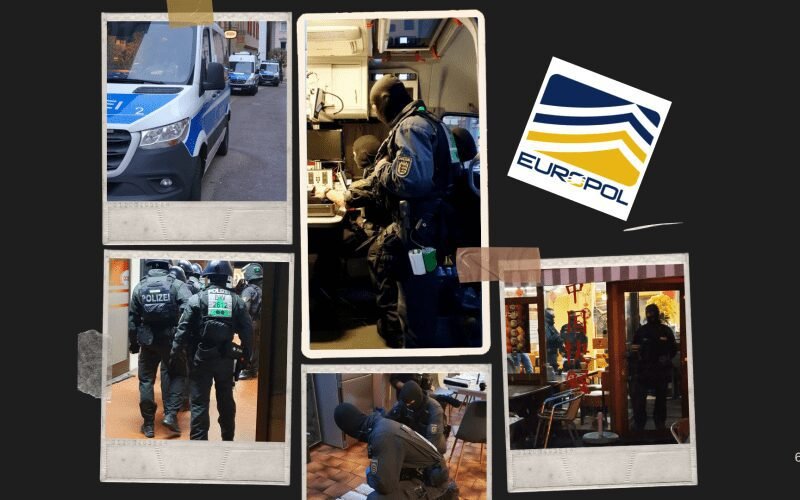
On 30 March 2026, a coordinated international French-led operation, which was supported by Europol and involved law enforcement and judicial authorities from Germany and Hungary, led to the dismantling of a Vietnamese migrant smuggling network. The criminal organisation operated across several European countries, with the United Kingdom as the final destination of the migrants. Such migrant smuggling networks link facilitators in countries of origin, transit hubs, and destination countries, while generating significant illicit profits.
The well-structured criminal network advertised its services via social media, targeting Vietnamese nationals seeking to reach the United Kingdom. With a growing criminal market for migrant smuggling, networks make use of widely available online services to coordinate operations and conceal illicit profits. Digitalisation enhances every stage of the activity, allowing these networks to operate with greater speed, efficiency, and resilience while remaining challenging for law enforcement and judicial authorities to detect and disrupt.
Migrants, smuggled by this network entered the Schengen Area using Hungarian-issued short-stay visas or residence permits before traveling onward by air to France. Once there, they were placed in accommodations in the Paris region and later transported to northern France. From there, the migrants crossed to the United Kingdom aboard small inflatable boats. The final crossing to the UK was organised by a connected Kurdish-Iraqi migrant smuggling network active in the North of France.
The operational actions resulted in:
- 8 individuals arrested, including key facilitators and organisers (6 in France, 1 in Germany and 1 in Hungary)
- 7 house searches in France
- 1 network leader arrested in Germany under a European Arrest Warrant
- 1 high-level organiser arrested in Hungary prior to the action day
- Seizures including around 20 passports, 3 vehicles, electronic devices, and EUR 10 000 in cash.
Up to EUR 3 million in criminal profits
The members of this migrant smuggling network organised the entire journey, including logistics, accommodation, and transport, relying on complicit drivers and facilitators. An underground banking system enabled the movement of funds between Europe and Vietnam. This system ensured the availability of liquidity for operations as well as the repatriation of the criminal gains.
The networks transported at least 15 migrants per month, charging them up to EUR 22 000 for the full journey. This suggests that the criminal syndicate has generated up to EUR 3 million in revenue over the past years.
Joint operational response
To piece together the intelligence in this case, Europol facilitated information exchange and provided operational coordination as well as analytical support. To support field operations with real-time information sharing and analysis, Europol deployed an expert to France on the action day. Such deployments allow Europol experts to cross-check operational data against its databases and generate leads for investigators on the ground.
Digitalisation driving migrant smuggling
Criminal networks operate online and across borders and jurisdictions. Investing in advanced analytics, digital tools, and real-time intelligence sharing is crucial. Responding to this shift has become increasingly important. In April 2024, Europol convened its first thematic meeting on tackling migrant smuggling in the digital domain, laying the groundwork for the creation of a dedicated platform to support online investigations.