Slamming into the atmosphere at more than 30 times the speed of sound, NASA’s Orion spacecraft blazed a trail over the Pacific Ocean on Friday, returning home with four astronauts and safely capping humanity’s first voyage to the Moon in nearly 54 years.
Temperatures outside the capsule builtup to some 5,000 degrees Fahrenheit as a sheath of plasma enveloped the Orion spacecraft, named Integrity, and its four long-distance travelers, temporarily blocking radio signals the Moon ship and Mission Control in Houston. Flying southwest to northeast, the spacecraft steered toward a splashdown zone off the coast of San Diego, where a US Navy recovery ship held position to await the crew’s homecoming. Ground teams regained communications with Orion commander Reid Wiseman after a six-minute blackout.
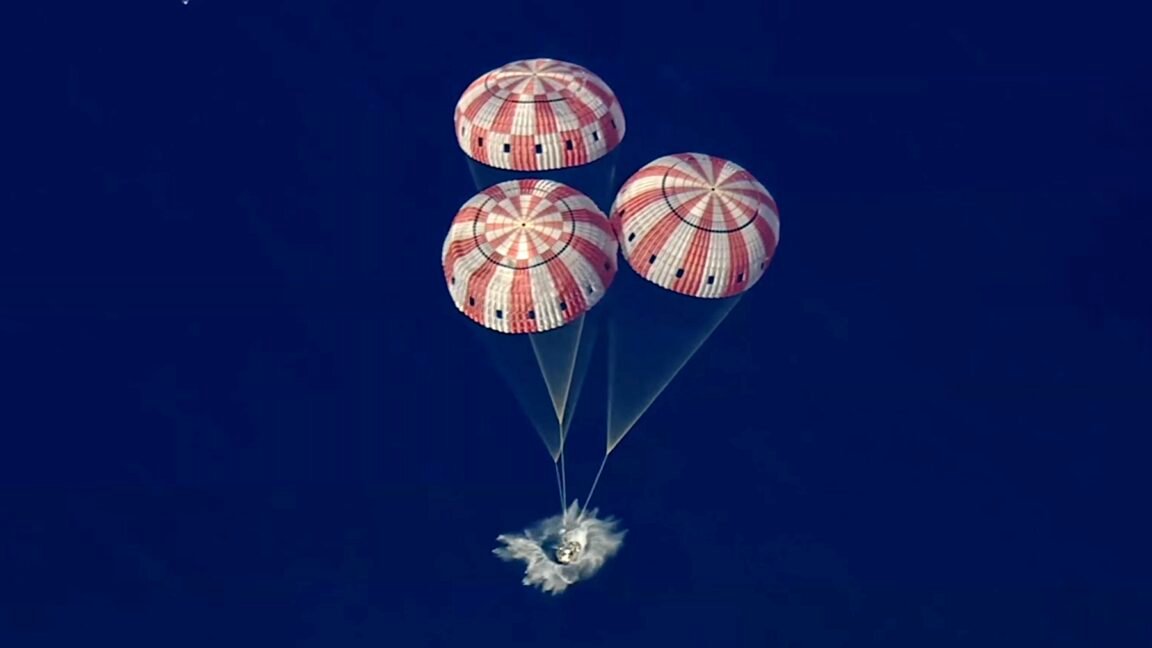
Airborne tracking planes beamed live video of Orion’s descent back to Mission Control, showing the capsule jettison its parachute cover and deploy a series of chutes to stabilize its plunge toward the Pacific. Then, three larger main chutes, each with an area of 10,500 square feet, opened to slow Orion for splashdown at 8:07 pm EDT Friday (00:07 UTC Saturday).
In just 14 minutes, Orion bled off nearly 25,000 mph of velocity, subjecting the crew strapped into their seats to two brief periods of about 3.9 Gs.
The USS John P. Murtha amphibious transport dock ship dispatched helicopters and small boats to begin extracting Wiseman and his crewmates: Victor Glover, Christina Koch, and Jeremy Hansen. Wiseman reported “four green crew members” inside the cockpit of the Orion spacecraft, confirming good health and high spirits after splashdown.
History made
NASA Administrator Jared Isaacman watched the splashdown from the deck of the Navy’s recovery vessel.
“I think about our crew members that we’ve all had an opportunity to observe over the last 10 days, absolutely professional astronauts and wonderful communicators, almost poets,” Isaacman said in remarks broadcast on NASA’s live video feed from the recovery zone. “These were the ambassadors from humanity to the stars. I can’t imagine a better crew that just completed a perfect mission right now.”
Friday’s reentry came nine days after the mission launched from Kennedy Space Center in Florida. The Artemis II astronauts made history in several ways. They became the first people to fly to space on NASA’s Space Launch System rocket and Orion spacecraft, following an unpiloted test flight more than three years ago. A day into the mission, Orion set a course toward the Moon. Artemis II was the first human spaceflight mission to encounter Earth’s cosmic companion since the last Apollo crew returned from the Moon in December 1972.
Artemis II reached its farthest point from Earth and closest approach to the Moon on Monday. At 252,756 miles from Earth, Wiseman, Glover, Koch, and Hansen became the most distant travelers in human history, returning remarkable imagery of the Moon’s tortured terrain and a crescent Earth suspended over the lunar horizon.
Almost as soon as they arrived at the Moon, gravity started pulling the astronauts back home. The four-day homebound cruise ended with an on-target reentry, with the Orion capsule reaching a top speed of some 24,661 mph, just shy of the all-time human speed record set on the Apollo 10 mission returning from the Moon in 1969.
Reentry was one of the riskiest segments of the mission. For the crew to get home safely, the heat shield on the bottom side of the capsule had to withstand scorching temperatures—hotter than a return from the International Space Station—as Orion turned into a pressure-sealed fireball over the Pacific. The thermal barrier is designed to ablate, or erode, during reentry, but the shield cracked and chipped away in an unexpected manner on the Artemis I mission in 2022. Despite this problem, the Orion spacecraft was still able to safely splash down on Artemis I.
NASA adjusted the reentry angle for Artemis II. Orion entered the atmosphere on a steeper trajectory, shortening the heat shield’s exposure time to extreme heating. It will take several hours to several days for engineers to complete their initial inspections of the Orion spacecraft, but the successful return to Earth on Friday proved the heat shield did its job.