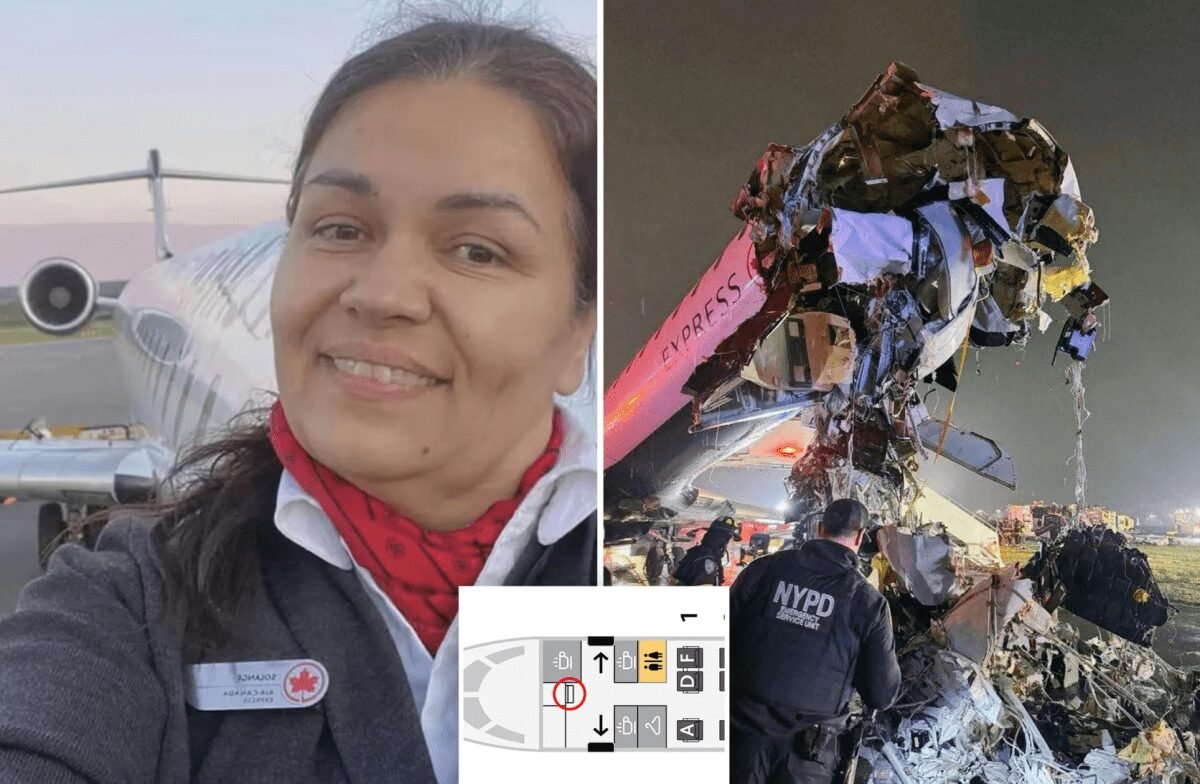
A devastating runway collision at New York’s LaGuardia Airport turned into a story of both tragedy and sheer survival — after one flight attendant was violently ejected from the aircraft and somehow lived to tell the tale.
Authorities say Air Canada Flight 8646 slammed into a Port Authority fire truck late Sunday night, triggering chaos on the runway and leaving two pilots dead. But amid the wreckage, one detail has left even seasoned investigators shaken: a flight attendant was thrown more than 300 feet from the aircraft — and survived.
That woman, identified as Solange Tremblay, had been strapped into her jump seat at the moment of impact — a detail experts now say likely saved her life.
According to former federal crash investigator Jeff Guzzetti, those jump seats are built very differently from passenger seats. They’re mounted directly to the aircraft’s structure and equipped with reinforced harness systems designed to withstand violent forces during emergencies.
“It’s a very robust seat,” Guzzetti explained. “It’s specifically designed so flight attendants can survive a crash and still assist passengers afterward.”
That design may have made all the difference.
Tremblay’s daughter described the moment in emotional terms, calling her mother’s survival nothing short of a miracle. She revealed that when first responders found Tremblay, she was still strapped into the seat — despite having been hurled the length of a football field away from the wreckage.
“At the moment of impact, her seat was ejected over 300 feet,” she said. “And she was still in it.”
Astonishingly, Tremblay escaped with a fractured leg — a minor injury considering the scale of the crash.
Behind her survival, however, lies a far darker scene.
The aircraft’s cockpit was obliterated in the collision, instantly killing Captain Antoine Forest and First Officer Mackenzie Gunther. Harrowing footage from the scene shows the plane plowing directly into the emergency vehicle, tearing apart the front of the jet and scattering debris across the runway.
In total, 41 of the 76 people on board were hospitalized, though most injuries were reported as minor.
The fire truck had reportedly been cleared to cross the runway while responding to a separate emergency involving another aircraft. In the moments after the crash, an air traffic controller was overheard admitting he “messed up,” raising immediate questions about how such a catastrophic failure occurred.
Now, investigators with the National Transportation Safety Board are digging into what went wrong — and early indications suggest it wasn’t just one mistake.
NTSB Chair Jennifer Homendy warned that the crash likely involved “multiple failures,” emphasizing that aviation disasters are rarely caused by a single error.
“It’s too early to draw conclusions,” she said. “But these tragedies are almost always the result of a chain of breakdowns.”
As the investigation continues, the crash has already reignited concerns about runway safety protocols and communication breakdowns at some of the nation’s busiest airports.
But for now, one image stands out above all others: a battered jump seat lying far from the wreckage — and the woman still strapped inside it, alive against all odds.
A miracle in the middle of devastation.