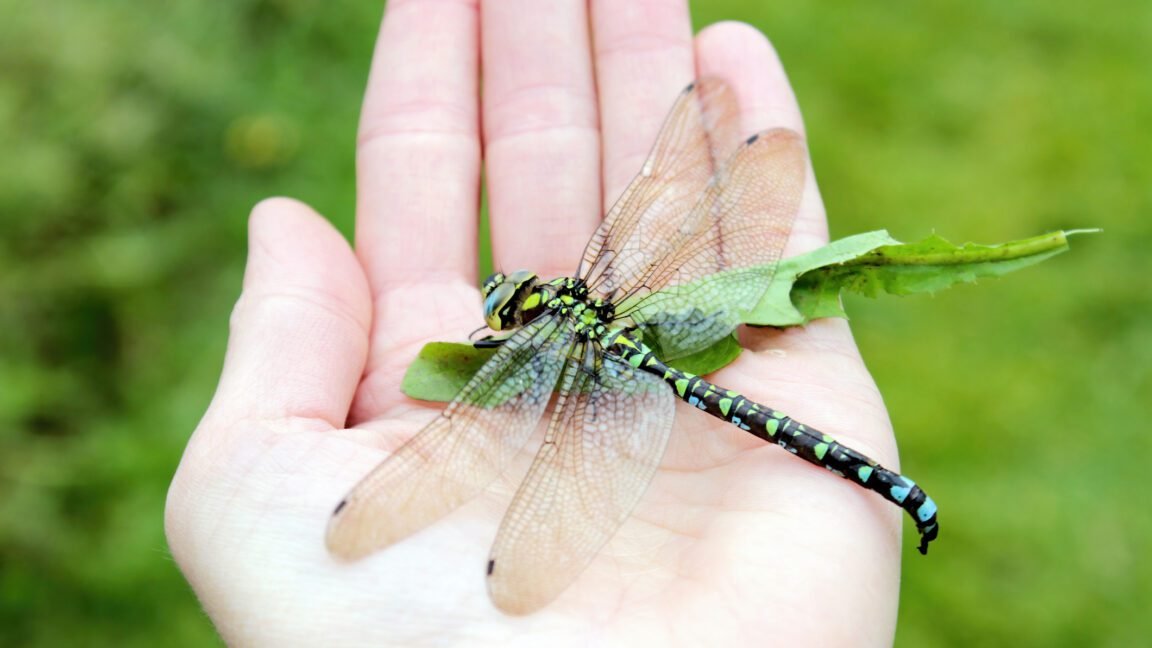
Three-hundred million years ago, the skies of the late Palaeozoic era were buzzing with giant insects. Meganeuropsis permiana, a predatory insect resembling a modern-day dragonfly, had a wingspan of over 70 centimeters and weighed 100 grams. Biologists looked at these ancient behemoths and asked why bugs aren’t this big anymore. Thirty years ago, they came up with an answer known as the “oxygen constrain hypothesis.”
For decades, we thought that any dragonflies the size of hawks needed highly oxygenated air to survive because insect breathing systems are less efficient than those of mammals, birds, or reptiles. As atmospheric oxygen levels dropped, there wasn’t enough to support giant bugs anymore. “It’s a simple, elegant explanation,” said Edward Snelling, a professor of veterinary science at the University of Pretoria. “But it’s wrong.”
Insect breathing
Unlike mammals, insects don’t have a centralized pair of lungs and a closed circulatory system that delivers oxygen-rich blood to their tissues. “They breathe through internalized tubing called the tracheal system,” Snelling explained.
Air enters the insect’s body through specialized portholes on their exoskeleton called spiracles. From there, it travels down larger tubes, the tracheae, which gradually branch into microscopically thin, blind-ending tubes known as tracheoles. These tracheoles are embedded deep within the insect’s tissues, and mitochondria in neighboring cells cluster next to them.
Insects can actively pump air in and out of the larger tracheae by flexing their bodies, but this active pumping stops at the very end of the line, in the tiny tracheoles. Here, oxygen delivery relies on passive diffusion to cross the final barrier into the tissue.
The problem with diffusion is that it’s notoriously slow. The oxygen constraint hypothesis argued that the larger the insect grows, the further the oxygen must travel to reach the deepest tissues.
“As the insects get bigger and bigger, the challenge of diffusion becomes greater,” Snelling said.
To prevent the muscles from suffocating, a bigger insect would need significantly wider or far more numerous tracheoles to maintain the supply of oxygen, which implied there had to be a structural tipping point. If an insect gets too big, the volume of breathing tubes required to supply its muscles with oxygen would take up too much physical space. The tracheoles would crowd the very muscle fibers they were trying to fuel, leaving the insect with severely impaired flight performance.
The late Palaeozoic was a time of hyperoxia, with atmospheric oxygen levels peaking around 30 percent, compared to the 21 percent we breathe today. Hyperoxia was supposed to let insects bypass the limitations of their breathing system and grow larger.
But recently, Snelling led a team of researchers that tested this idea, as they describe in a recent Nature study. It just didn’t hold up.
Tubing inspection
Snelling and his colleagues gathered 44 species of insects across ten distinct orders, representing nearly the entire body mass range of modern flying bugs. On the tiny end of the spectrum was the Trioza erytreae, weighing only 0.334 milligrams. On the heavy end was Goliathus albosignatus, the famous Goliath beetle that weighs 7.74 grams. “We were able to look at insects varying 10,000-fold in body size,” Snelling says.
Using transmission electron microscopes, the team took 1,320 high-resolution images of the insects’ flight muscles. They wanted to measure exactly what percentage of the muscle volume was being taken up by tracheoles, a metric known as tracheolar volume density. If the oxygen-constraint hypothesis was correct, the tracheolar volume density should have dramatically increased as the insects got larger, creeping close to a theoretical limit that would compromise the muscle’s mechanical power. “In our mind, it stands to reason that if very large insects are really challenged, then there should be evidence of this in the tracheoles,” Snelling said.
But his team found no such evidence.
It turned out that in the 0.5 milligram insects, tracheoles took up 0.47 percent of the flight muscle space. In the 5-gram insects, that number rose only to 0.83 percent. Over a 10,000-fold jump in body mass, the relative space occupied by these breathing tubes increased by a factor of just 1.8.
To put that into perspective, the blood-filled capillaries that serve the same oxygen-delivery function in the aerobic flight and cardiac muscles of birds and mammals typically take up around 10 percent of the tissue volume. Insect breathing tubes, by contrast, typically stay at 1 percent or less.
Next, the team extrapolated these findings to estimate the tracheolar volume density in the ancient giants, starting with Meganeuropsis permiana.
Supporting the giant
Assuming a mass of 100 grams, Snalling’s newly conceived scaling equations predict that Meganeuropsis permiana’s tracheoles would have still occupied only about 1 percent of its flight muscle volume. The absolute upper statistical limit places it no higher than 3 percent. So it apparently had plenty of room to spare.
Furthermore, the team ran a sensitivity analysis using a standard 1-gram locust as a physiological model to see what would happen if an insect drastically increased its tracheal plumbing. Doing calculations based on the known locust physiology, the researchers found that tripling the tracheolar volume density from 0.6 percent to 1.8 percent would increase the system’s oxygen-diffusing capacity by over four times. This, Snelling’s analysis shows, would make oxygen delivery quite efficient without much impact on the muscle’s maximum mechanical work rate and peak metabolic rate.
To put it simply, if a giant insect needed more oxygen, evolving a denser network of tracheoles would be a cheap and effective physiological upgrade. There was likely no anatomical roadblock stopping them from doing so, and they probably wouldn’t have to sacrifice flying power to achieve it.
But if the lack of oxygen didn’t kill the giant bugs, we’re still faced with an outstanding question: What’s stopping our present bugs from evolving to the size of a pigeon?
“There are a few hypotheses that are out there,” Snelling said.
Flying snacks
Snelling’s team suggests that to understand the limiting factors in insect size, we need to look beyond the molecular diffusion of oxygen and consider the broader ecology, physical mechanics, and other aspects of whole-body physiology.
One hypothesis is the rise of aerial vertebrate predators. The fossil record shows a decoupling between maximum insect wing length and atmospheric oxygen levels starting at around 135 million years ago, which roughly coincides with the evolution of birds and, later, bats. “This predatory pressure didn’t exist 300 million years ago,” Snelling said.
Giant, meaty insects were likely slow to accelerate, which made them excellent, high-calorie targets for more agile avian predators. So perhaps being huge simply became a bad evolutionary strategy once the skies became more competitive.
Another reason could lie in the physiological hurdles insects face. Flying generates a significant amount of heat. Because surface area-to-volume ratios decrease as animals get larger, a hawk-sized insect might simply cook itself from the inside out with the heat of its own flapping wings, as it wouldn’t have enough surface area to cool down efficiently. In this scenario, the key to the ancient giants was not the oxygen level but a higher density of the atmosphere that enabled the insects to dissipate heat better.
Then there’s an issue of growing XL-sized exoskeletons. Insects must molt to grow. When they shed their hard outer shells, they are temporarily soft and squishy until the new exoskeleton hardens. Surface tension and basic structural mechanics can hold this soft body together in a tiny beetle, but they might struggle to do so if the bug is much larger.
Finally, the insect cardiovascular system might also play a role. Bugs rely on an open circulation system, which might be too inefficient to power flapping flight in extremely large bodies.
But the insect breathing mechanics may still hold one mystery we haven’t solved yet. “While we looked at tracheoles, we didn’t look upstream,” Snelling said. And upstream, in the parts of the internal tubing that are closer to the atmosphere, insects often have large air sacs that act as bellows to ventilate the lateral regions of the tracheal system. Doing the same kind of comparative study on the size of the air sacs is the next step for his team.
“I imagine in the next decade or so, the synchrotron X-ray technology will become so sophisticated that it will be possible,” he said.
For now, though, Snelling doesn’t expect air sacs to suddenly cause a miraculous comeback of the oxygen-constraint hypothesis. “Any limitation upstream can be compensated by the investment in the tracheoles—there’s so much space down there,” Snelling said. “But it would be interesting to see how the air sacs’ dimensions change as a function of body size.”
Nature, 2026. DOI: 10.1038/s41586-026-10291-3