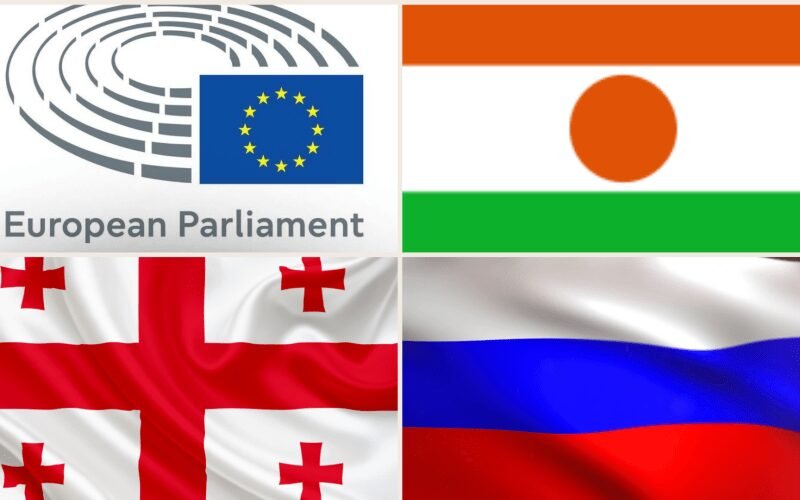
The European Parliament on Thursday adopted three resolutions addressing human rights concerns in Russia, Niger and Georgia, calling for sanctions, political accountability and the restoration of democratic norms.
While such resolutions are not legally binding, they reflect the political position of EU lawmakers and often shape future diplomatic or sanctions policy.
Resolution on Russia: recruitment of foreign nationals for the Ukraine war
Ukraine
In its first resolution, the Parliament condemned what it described as coercive or deceptive recruitment of foreign nationals to support Russia’s war against Ukraine.
MEPs said individuals from African countries, Cuba and parts of South and Central Asia have allegedly been lured with offers of employment or education circulated online. Some were later forced into military roles or defence-related work, including the assembly of drones.
Lawmakers argued that such practices could amount to human trafficking and potentially war crimes or crimes against humanity. They urged the EU and its member states to impose targeted sanctions on individuals and entities involved in recruitment networks linked to Russia’s war effort.
The resolution also calls on social media companies to cooperate with authorities to identify and remove deceptive recruitment content.
MEPs specifically referred to the case of Francis Ndung’u Ndarua, a Kenyan national reported missing after travelling to Russia, and urged Moscow to disclose his whereabouts and allow his repatriation.
Vote: 479 in favour, 17 against, 43 abstentions.
Resolution on Niger: detention of President Mohamed Bazoum
Mohamed Bazoum
In a second resolution, the Parliament condemned the continued detention of Niger’s democratically elected president, Mohamed Bazoum, who was removed from power during a military coup in July 2023.
MEPs said the junta has since cracked down on political opponents, journalists and civil society, while the country’s security and humanitarian situation has deteriorated.
Lawmakers pointed to rising human trafficking, arms smuggling and irregular migration flows across the Sahel, and expressed concern about Niger’s announced intention to withdraw from the International Criminal Court.
The resolution calls for:
- the immediate release of Bazoum and other detainees,
- the restoration of democratic institutions,
- the legalisation of political parties, and
- the organisation of free and fair elections.
MEPs also stressed the need to ensure uninterrupted humanitarian aid to populations affected by conflict in Niger.
Vote: 524 in favour, 2 against, 29 abstentions.
Resolution on Georgia: political repression and detained opposition figures
Georgian Dream
Elene Khoshtaria
Mikheil Saakashvili
The third resolution focused on the political situation in Georgia, where MEPs accused the ruling Georgian Dream party of systematic persecution of opposition figures and journalists.
Parliament condemned the detention of opposition politician Elene Khoshtaria, arrested in September, and called for her immediate release, citing reports of degrading treatment during detention.
MEPs also demanded an independent investigation into alleged abuses by security forces, including credible reports that chemical agents were used against protesters.
The resolution further highlights concern over the continued imprisonment and deteriorating health of former president Mikheil Saakashvili, who lawmakers say has effectively been held as a political hostage for more than four years.
MEPs called on the EU to impose targeted sanctions and EU-wide visa bans on officials responsible for political repression.
They also warned that the presence of political prisoners is incompatible with Georgia’s commitments under the EU-Georgia Association Agreement.
Vote: 438 in favour, 37 against, 81 abstentions.