According to a recent New York Times report, the company is pouring in a quarter trillion dollars to build 10 chip production plants that could “provide a winning formula for American reindustrialization.”
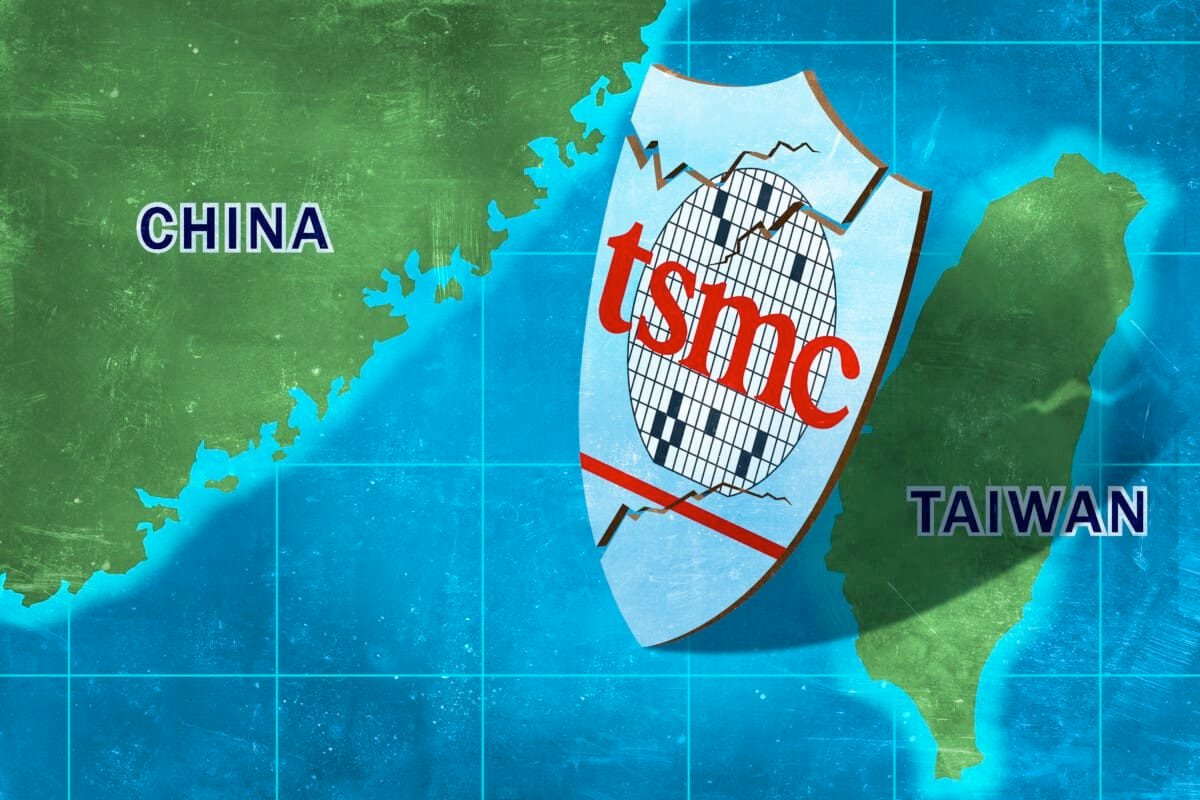
Though this is good news worth celebrating, there is also a dangerous side to this US-Taiwan technology partnership. The massive TSMC investment could help drag the US into the middle of Asia’s biggest powder keg.
The risk is that with its new TSMC presence, America could gain a sizable economic interest in protecting Taiwan from China. But guarding TSMC production facilities in Taiwan cannot constitute a rationale for US military intervention in a China-Taiwan conflict.
In theory, building a semiconductor plant in the US should enhance American national security by making it less dependent in a crisis on foreign supply networks.
However, in reality, the Taiwan investment may come to seem like a large bribe intended to solidify Taiwan’s so-called “silicon shield,” the effort to make Taiwanese chips so indispensable that Washington has no choice but to try to safeguard the island with its military forces.
Officials in Taipei are even trying a direct approach by appealing to US foreign policy elites with the idea that “Taiwan is indispensable” for US economic and national security.
In a recent Foreign Affairs article couched in sweeping ideological rhetoric, the Taiwan’s Foreign Minister Lin Chia-lung asked: “whether it will be democracies or autocracies that set the standards and values of the new digital age.”
He goes on to argue that “Taiwan is a force multiplier for the United States in artificial intelligence: it has the capability, reliability, and values necessary to support the United States’ technological ambitions.”
What the foreign minister’s appeal does not explain is the massive military risk Americans will run by further integrating with Taiwan. In any military contingency, China will benefit from proximity, preparedness and national will, placing Washington at a serious and dangerous disadvantage. America should not risk war with a highly motivated nuclear superpower in its own backyard over interests ancillary to most Americans.
To understand these risks, consider that the former director of naval intelligence, Adm. Mike Studeman (USN-ret), said recently that China “could potentially defeat big portions of America’s traditional naval force….”
That comment is not surprising to those following the naval balance closely, since the Chinese Navy now deploys many types of hypersonic anti-ship missiles, while the US Navy still lacks this capability.
Nor can the nuclear risks of a Taiwan scenario be put aside either. Indeed, it has become increasingly common for Washington strategists to discuss nuclear scenarios related to Taiwan and this trend is extremely disturbing.
No rational American leader would run such risks, and certainly not for the sake of some advanced semiconductors. In fact, the importance of semiconductor production in Taiwan has been significantly overstated. As it turns out, semiconductors are also made in Japan, Malaysia, Singapore, and South Korea.
These are advanced technology powerhouse countries and could pick up the slack in any emergency. Moreover, much of the relevant technology still comes from the US and Europe, and could thus be replicated in a reasonable time period while avoiding a disastrous war.
Most of the advanced chips made in Taiwan are being used for high-performance computing (relevant to AI and data centers) and ever faster and lighter phones and laptops. These are nice to have but a temporary disruption in the latest consumer product models would not constitute a good reason to risk war between two nuclear-armed powers.
Additionally, many armaments can rely on simpler chips. Hence, Chris Miller in his book “Chip War” mistakenly concludes that Russian missile production faltered for lack of advanced semiconductors. But that has not proven true, since Moscow is wielding large numbers of ever more effective precision-guided munitions, including missiles.
Even if Beijing decided to assault Taiwan, China would still likely want to keep selling semiconductors to America and other countries, since it is such an immensely profitable business.
Markets are rather nimble at adjusting to such shocks, and even if TSMC was knocked offline in a conflict, regrettable as that might be, other sources of supply would emerge. That is the simple, crisp law of supply and demand.
Americans are thankful, of course, for Taipei’s assistance in putting their economic house in order. However, that does not mean tens of thousands of American lives should be put at risk.
The US should not be dragged into the long-frozen Chinese Civil War, with all the enormous military and, yes, nuclear risks and costs this would entail. And especially not to protect the profitable business of TSMC.
Lyle Goldstein is director of the China Initiative at Brown University’s Watson School and concurrently serves as director of the Asia Program at the think-tank Defense Priorities.

Source: Iwpost.com