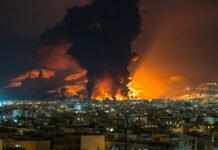
Civilians fleeing villages near the border are moving north into Sidon as fears rise that the river could become the next major military line
[SIDON, Lebanon] Sidon, the largest city in southern Lebanon, is filling with civilians displaced from villages south of the Litani River after new Israeli evacuation orders pushed residents north, raising fears that the river could again become the main military line in the Israel-Lebanon conflict. Many of those arriving have nowhere to go, and the humanitarian strain is already visible in the city’s streets and along its seafront.
It breaks my heart to see all the people sleeping on the Corniche
“It breaks my heart to see all the people sleeping on the Corniche,” Malik, a Sidon native who owns a trucking company, told The Media Line while standing in front of one of the bombed buildings in the city.
Only one wall of the building remains standing. The shelling has left it twisted and unstable, with pieces of the staircase scattered from the upper floors. Malik, 59, has his trucks parked next to this Muslim Brotherhood building and said he left three minutes before the first shell hit.
“They hit it twice,” he said.
Luckily, this time he saved all his trucks.
“Each one is worth $100,000, and during the Beirut port explosion [in 2020], I already lost two,” he said.
This will be the last war; Hezbollah will keep fighting until the end, they won’t give up, but we can’t take it anymore. We’re tired.
“This will be the last war; Hezbollah will keep fighting until the end, they won’t give up, but we can’t take it anymore. We’re tired,” says Malik, his hands blackened from removing debris that landed on his vehicles.
Not everyone in Sidon sees the war ending soon.
“This won’t be the last war, because Israel can’t achieve its goal,” the 21-year-old Palestinian-Lebanese student from Sidon tells The Media Line.
According to Sara, Israel’s objective is not only to disarm Hezbollah but also to seize a large part of Lebanese territory.
“It’s a very, very important geographical position; that’s why Lebanon has suffered so many wars,” she said.
The Litani River has long been central to the conflict between Israel and Lebanon, both as a geographic marker and a strategic military line. Known in classical sources as the Leontes and believed to derive from an older Semitic name, the river lies about 30 kilometers north of the border between the two countries and runs 140 kilometers from its source in the Bekaa Valley to its outlet in the Mediterranean Sea north of Tyre.
Southern Lebanon, including areas around the Litani River, is home to large Shia communities, while Sunni populations are concentrated in coastal cities such as Sidon. Christian villages are scattered across the country, particularly along the coast north of Beirut, while the Druze minority lives in the Lebanese mountains. The river cuts through one of Lebanon’s most densely populated and politically sensitive regions.
Israel’s first major operation in Lebanon in 1978, aimed at pushing Palestinian fighters away from the border during the Lebanese Civil War, was called Operation Litani. In 1982, Israel launched a second invasion to push Palestinian forces 40 kilometers farther north. That year, which also saw the Sabra and Shatila massacre, Israeli forces crossed the Litani River, advanced to Beirut, and eventually expelled Palestinian fighters from Lebanon by sea.
Although Israel later withdrew from Beirut, it maintained control over much of the territory south of the river until 2000. In 2006, after Hezbollah captured three Israeli soldiers, Israel launched another military campaign that lasted 33 days. The war ended with a ceasefire under UN Security Council Resolution 1701, which called for “the establishment between the Blue Line and the Litani River of a zone free of armed personnel, property and weapons, except those of the Government of Lebanon and the United Nations Interim Force in Lebanon.”
During Israel’s military offensive in the fall of 2024, Israeli troops advanced six kilometers into southern Lebanon. That operation was not as extensive as the 2006 war, when Israeli forces again reached the Litani River and tens of thousands of Lebanese fled north. Since then, Hezbollah has remained a dominant armed presence in southern Lebanon. The 2024 ceasefire, framed around the terms of Resolution 1701, called for armed forces to withdraw from the area, but neither side fully complied.
Now, after two days of renewed military operations, the Israeli army has ordered the evacuation of the entire population south of the Litani River, raising fears of a deeper Israeli ground advance.
“We could find ourselves maneuvering in that area [south of the Litani River] one way or another, and we don’t want any civilians there,” a senior military officer told the BBC last week, on condition of anonymity.
We have plans to go as deep as necessary, even to the Litani River and beyond, if ordered
“We have plans to go as deep as necessary, even to the Litani River and beyond, if ordered,” he stated, adding that forces were on site and ready to move immediately if ordered.
The idea of a deeper buffer zone is also being voiced in Israeli politics.
Israeli Opposition Leader Yair Lapid has publicly advocated creating “a barren zone without Lebanese villages,” arguing on a local television channel that Israel “would have no choice.”
“Perhaps it’s unsightly, or unpleasant, to eliminate two or three Lebanese villages, but they brought it on themselves,” he declared.
A permanent Israeli-controlled zone extending to the Litani River would amount to roughly 8% of Lebanese territory.
The Litani River is also a vital water source. It irrigates the Bekaa Valley and supplies much of southern Lebanon, especially Tyre, the country’s third-most-populous city. Before the 2024 offensive, the river irrigated about 6,000 hectares of farmland in southern Lebanon.
Legal and humanitarian concerns are mounting alongside the military escalation.
“Calling on everyone who lives south of the Litani to evacuate immediately raises serious legal and humanitarian red flags and fears for the safety of civilians,” said Ramzi Kaiss, Lebanon researcher at Human Rights Watch, who is monitoring the situation and alleged violations of human rights and the laws of war.
More than 100 villages in southern and eastern Lebanon were ordered to evacuate in just two days, according to the UN. This week’s Israeli evacuation orders have affected 300,000 people.
Sara put it bluntly: “The Litani River belongs to the Lebanese, just as southern Lebanon belongs to us.”