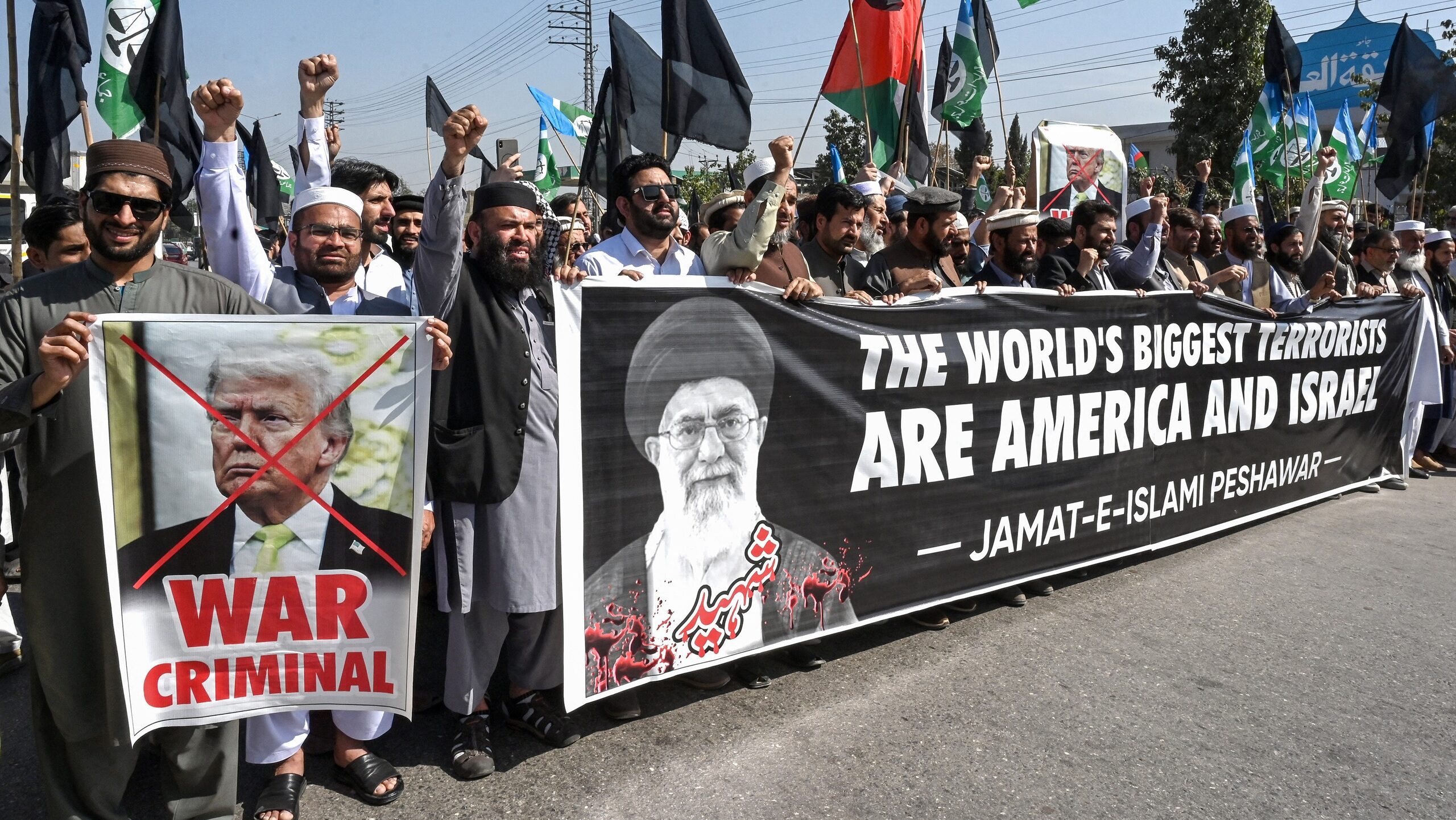
[ISLAMABAD] At least 23 people across Pakistan have been killed in protests triggered by US and Israeli strikes on Iran that killed Supreme Leader Ayatollah Ali Khamenei. The deadliest violence was concentrated in Karachi and Gilgit-Baltistan.
Demonstrations spread across major cities, including Karachi, Islamabad, Lahore, Peshawar, and Pakistan-administered Kashmir, as anger over the strikes and Khamenei’s killing spilled into the streets.
In Karachi, clashes outside the US Consulate left at least 10 people dead and dozens injured after hundreds of protesters breached outer security barriers, vandalized parts of the compound, and attempted to set portions of the building on fire.
Conflicting accounts circulated about how the shooting began. Some reports attributed the deaths to gunfire from US troops stationed at the consulate, while others said both US personnel and local police fired on protesters.
The Sindh government expressed sorrow over the fatalities and announced a high-level Joint Investigation Team (JIT) to conduct what officials described as an impartial inquiry. A provincial statement said the JIT would determine how the incident unfolded, what triggered it, and who was responsible, while emphasizing citizens’ constitutional right to protest.
Unrest intensified in Gilgit-Baltistan, where authorities deployed military forces to restore order following confirmation of Khamenei’s death. Protesters set fire to United Nations offices in Gilgit and Skardu, and a curfew was imposed in parts of Skardu.
Dr. Asif Raza, medical superintendent of Skardu Regional Hospital, confirmed that five bodies were brought in and that about 50 injured people received treatment. Two of the injured remained in critical condition. Four of the dead were civilians, and one was affiliated with a security agency.
Video circulating on social media showed protesters forcing their way through the Karachi consulate gate and smashing glass panels in reception and security areas before Karachi Police’s East Zone said officers regained control. Crowds later gathered near the Tower area and attempted to move toward the building, prompting police to use tear gas and rubber bullets after demonstrators rejected an alternative protest site. Police, special units, and paramilitary forces, including the Pakistan Rangers, were deployed around the compound as protesters demanded the American flag be removed and urged the prime minister and interior minister to intervene.
In Islamabad, authorities closed routes to the Red Zone as demonstrators at Aabpara Chowk attempted to march toward the US Embassy, prompting police action. Crowds on Constitution Avenue continued chanting slogans against the US and Israel, and a private news channel’s DSNG vehicle was attacked and its crew reportedly assaulted. Security officials established three layers of protection along routes to Serena Chowk, the Red Zone, and the Diplomatic Enclave. Federal Interior Minister Mohsin Naqvi visited the Red Zone and Diplomatic Enclave and said that while protest is a legal right, no one is allowed to take the law into their own hands.
The US Embassy in Pakistan said it is monitoring demonstrations at the US consulates in Karachi and Lahore, as well as calls for protests in Islamabad and Peshawar, and advised US citizens to avoid crowds and take personal security precautions.
Pakistan’s Shia community announced three days of mourning nationwide to protest Khamenei’s killing in a US-Israeli airstrike. At a press conference in Karachi late Sunday, Shia Alliance President Allama Shahenshah Hussain Naqvi, accompanied by other prominent Shia leaders, condemned violent acts committed during what he described as peaceful nationwide protest rallies. The leaders demanded action against those responsible for the killings of protesters, called for a formal case to be registered against the US consul general, and demanded the immediate closure of US diplomatic missions in Pakistan and the expulsion of the US ambassador.
Pakistan’s Shia community makes up roughly 15% to 20% of the population and has historically faced periods of sectarian violence and discrimination. In anticipation of further protests, authorities tightened security around American diplomatic facilities in Islamabad, Peshawar, Lahore, and Karachi, deploying reinforced forces alongside regular police.