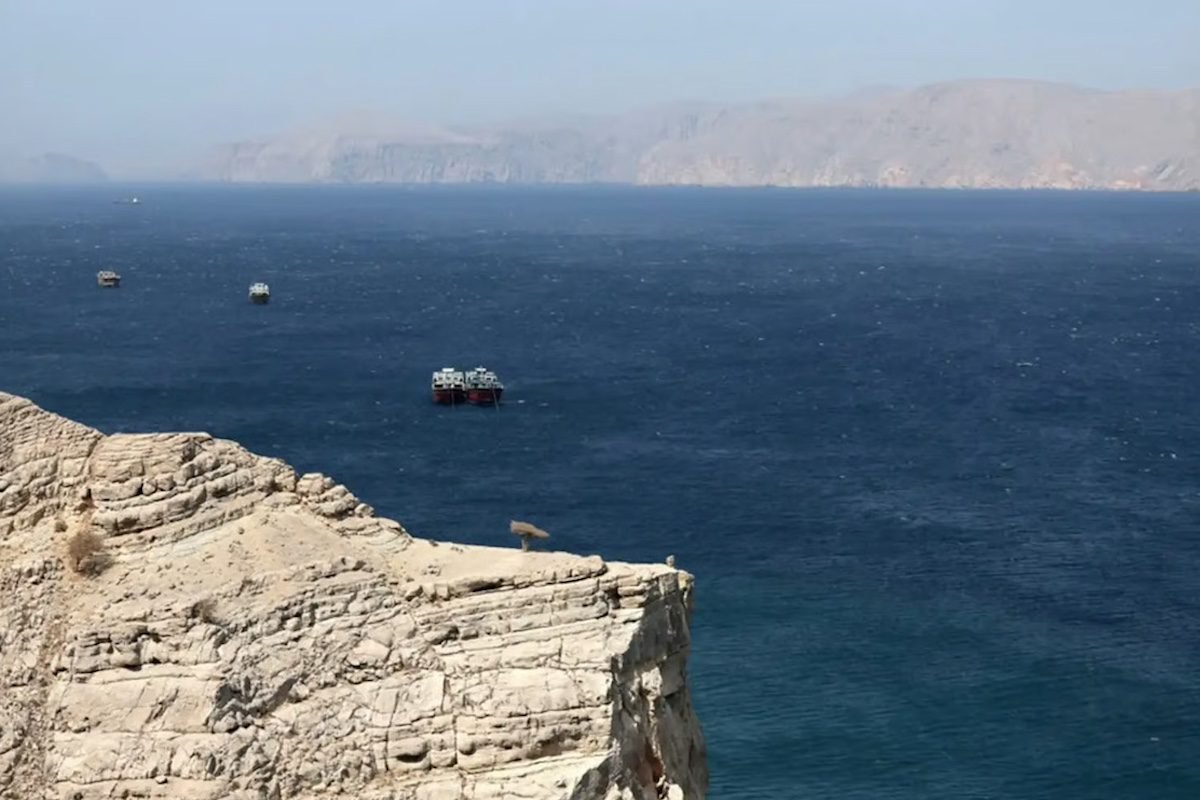

US President Donald Trump’s remarks on Tuesday questioning why China, Japan and South Korea have not taken a more active military role in safeguarding key energy transport routes, namely the Strait of Hormuz, draw attention to a deeper shift already underway.
Asia’s largest energy importers’ inaction signals a structural shift underway, one that’s already reshaping capital flows, supply chains, and geopolitical alignments across the region.
For decades, the security of global energy transit has rested heavily on US naval dominance. Asian economies, despite being the world’s most significant buyers of oil and gas, operated within this framework.
Strategic dependence was tolerated because it worked. Energy arrived, costs remained predictable and risk was largely externalized. But, it appears that a new reality is emerging with the US and Israel’s war on Iran.
China, Japan and South Korea are no longer behaving as passive beneficiaries of a US-led system. Their restraint in moments of tension reflects a calculated repositioning.
Their military non-intervention does not indicate complacency; it reflects a deliberate pivot toward insulating their economies from precisely the kind of disruption such intervention would entail.
That is, the region’s energy security is being redefined in real time. Instead of protecting routes, Asia is reducing reliance on them. Emerging investment patterns already confirm this transition.
Liquefied natural gas (LNG) infrastructure is quickly expanding across the region. Import terminals, storage facilities and regasification capacity are being scaled not as incremental upgrades but as foundational shifts. LNG offers more flexibility, as cargoes can be redirected, suppliers diversified and exposure diluted.
Renewables are accelerating in parallel, not as environmental gestures but as strategic imperatives. Solar, wind and grid-scale battery storage are receiving sustained investment across China, Japan and South Korea. Domestic generation reduces vulnerability to external shocks. Political risk falls as energy sovereignty rises.
Nuclear is also returning to the conversation with new urgency. Japan’s reactor restarts and South Korea’s continued commitment to nuclear expansion underscore a shared recognition: baseload power must be secure, stable and domestically controlled. And nuclear capacity provides exactly that.
Bilateral and regional energy agreements are expanding quietly but meaningfully. Long-term supply contracts with Middle Eastern producers, increased pipeline cooperation, and deeper ties with Southeast Asian energy exporters all point to the same objective: diversification away from chokepoints and concentration risk.
As we’re seeing in real-time, capital markets aren’t waiting for confirmation. They’re already pricing in this shift. Infrastructure funds, sovereign wealth vehicles and institutional investors are increasing allocations to Asian energy assets that support resilience rather than just efficiency.
Ports designed for LNG throughput, renewable energy projects tied to domestic grids and nuclear supply chains are attracting sustained interest. Investment committees are placing less emphasis on marginal cost advantages and more on continuity of supply.
Such repositioning carries long-term implications for global energy pricing and trade flows. Reduced reliance on singular transit routes diminishes the leverage of disruptions in those corridors. Price volatility linked to geopolitical flashpoints are going to become less acute over time as diversification takes hold.
US influence in energy security, while still significant, faces gradual dilution. Asian autonomy is increasing through the accumulation of capability rather than confrontation in the Strait of Hormuz.
Currency dynamics may also shift as regional energy trade becomes more diversified. Bilateral agreements increasingly explore settlement in local currencies, reducing exposure to dollar volatility in energy transactions. Incremental moves in this direction could have a cumulative impact on global financial architecture over time.
Corporate strategy across Asia reflects the same logic. Energy-intensive industries are investing directly in supply security, from captive renewable generation to long-term LNG procurement. Vertical integration is gaining traction as firms seek greater control over input costs and continuity.
Energy security risk is being redistributed rather than eliminated. Greater domestic production and diversified imports entail their own capital intensity and execution challenges. Renewable intermittency, nuclear regulatory hurdles and infrastructure bottlenecks remain real constraints. Even so, the direction of travel is clear.
Markets are now acutely focused on action, such as troop deployments, naval movements and political declarations. But the greater insight arguably comes from taking the measure of Asia’s inaction.
China, Japan and South Korea’s refusal to engage militarily in securing energy routes signals a commitment to a new and different model, one less reliant on external guarantees and more anchored in domestic and regional capacity.
Investors who treat this moment as a temporary anomaly risk missing the broader reallocation already underway.