Nearly 50 years have passed since Argentina’s former president Isabel Martínez de Perón was overthrown by a civic-military coup on March 24, 1976. A military dictatorship led by Jorge Videla, Emilio Massera and Orlando Agosti seized control of the country.
There had been five previous coups in Argentina between 1930 and 1966. But the regime that came to power in 1976, calling itself the “process of national reorganisation”, stood out for its systematic campaign of political violence and terror until the end of its rule in 1983.
The dictatorship violently dismantled political parties, trade unions, social and student movements and guerrilla opposition groups. Censorship was also widespread. The military controlled the media, supervised universities and persecuted thousands of intellectuals and artists or forced them into exile.
Repression under the dictatorship was ruthless. The security forces carried out enforced disappearances, arbitrary executions, torture and sexual violence. Detainees were held in inhumane conditions in a clandestine network of 814 detention centres across the country until their fate was decided.
The extent of the atrocities committed under the dictatorship remains debated. The National Commission on the Disappearance of Persons (Conadep) documented 8,961 victims, who are known as the desaparecidos, while human rights organisations put this figure closer to 30,000.
Around 250,000 people were forced into exile to escape the dictatorship and roughly 500 children, abducted alongside their parents or born in detention, were illegally adopted and had their identities changed.
The military dictatorship’s free-market policies also crippled the Argentine economy. They generated over US$45 billion (£34 billion) in external debt, leading to a severe economic crisis that increased poverty, deepened inequality and promoted capital flight. Nowadays, almost 40% of Argentina’s population remain affected by poverty.
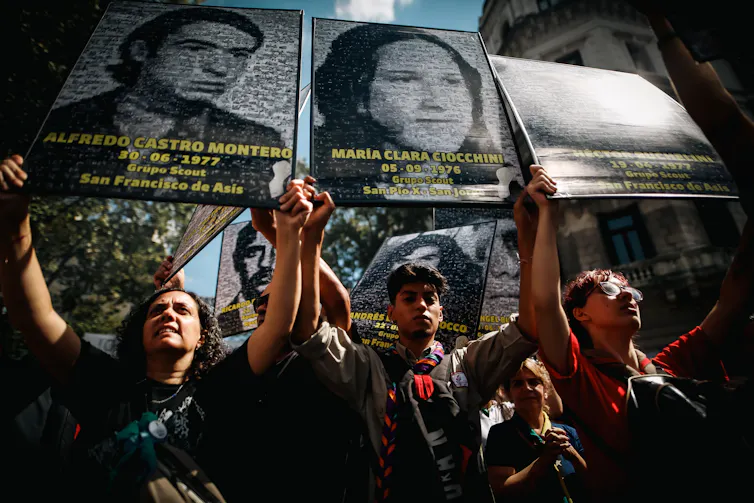
After transitioning back to democracy, Argentina transformed into a pioneer of accountability. In 1983, the newly inaugurated president, Raúl Alfonsín, created the Conadep and ordered the prosecution of nine military commanders for the crimes of murder, unlawful deprivation of freedom and torture committed between March 1976 and June 1982.
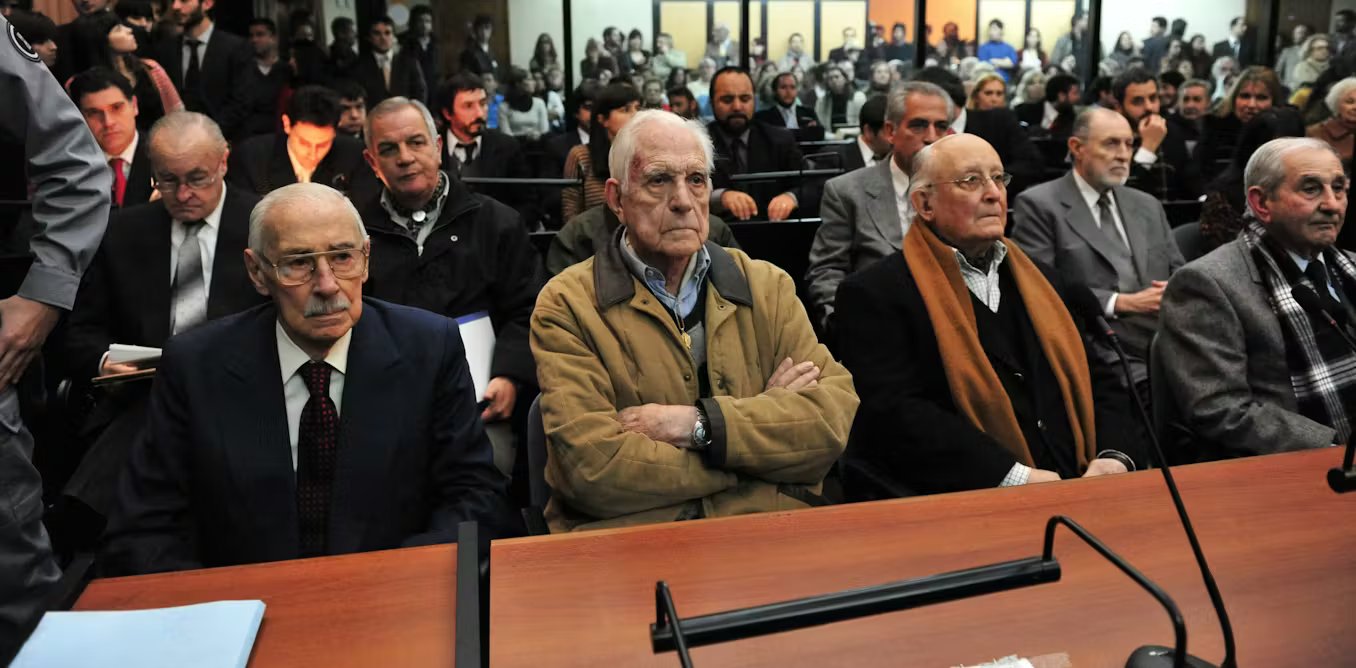
The Conadep became the first truth commission in the world to complete a final, publicly available report in 1984. And the following year, five of the nine military commanders on trial (including Videla and Massera) were convicted. Argentina’s supreme court confirmed this verdict in 1986, officially acknowledging that systematic political repression had unfolded throughout the country.
However, progress soon slowed. Rising tensions within the armed forces led to the parliamentary sanctioning of a “full stop law” in 1986. This effectively halted investigations into atrocities committed by members of the security forces. The full stop law was followed by a “due obedience law” in 1987, which granted immunity to military personnel for crimes committed during the dictatorship. Two rounds of presidential pardons occurred in 1989 and 1990.
Survivors, their relatives, human rights groups and lawyers maintained their demands for accountability throughout this period. These efforts culminated in a 2005 supreme court decision that invalidated the impunity laws and reopened criminal trials for past atrocities.
Since then, 361 verdicts have been issued. Over 1,200 people have been convicted for their crimes, including Videla over the theft of babies from political prisoners. Almost 1,000 people are still under investigation. Argentina became a global leader in what has become known as the “justice cascade”, the worldwide shift towards increased accountability for past human rights abuses.
Progress under threat
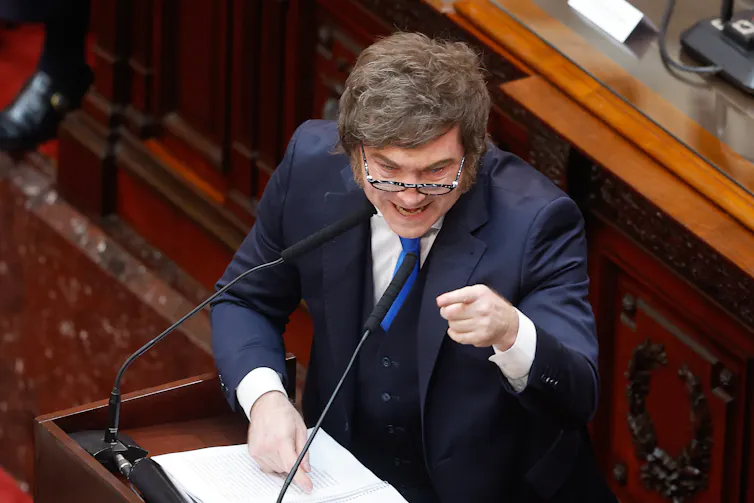
After becoming Argentina’s president in 2023, Javier Milei has taken steps to dismantle the country’s human rights policy. He has simultaneously launched a strong and vicious smear campaign against the victims of the dictatorship and their relatives, as well as human rights groups.
Since entering office, the Milei administration has downgraded Argentina’s National Secretariat for Human Rights to a sub-secretariat. This change in status means the secretariat now has fewer powers and resources, and has lost nearly 60% of its staff. It no longer participates actively in trials, witness support has been reduced and the recording of hearings has been halted.
Under Milei, there has also been a high rate of home detention sentences or acquittals. In 2025, 84% of those currently detained in Argentina for crimes against humanity committed under the dictatorship (425 out of 504 people) were being held under house arrest. And 51 of the 60 people whose cases were decided that year were acquitted.
Meanwhile, the ministry of defence has dismantled the team responsible for surveying the archives of the armed forces. This team had played a fundamental role in identifying those responsible for “death flights”, where drugged prisoners were thrown from aircraft into the Atlantic Ocean. Similar teams working across other ministries have likewise been dissolved.
And in January 2025 the navy was authorised to destroy documents that are held in its general archive. Some of these documents could contain information regarding crimes committed during the dictatorship. Federal judge Alicia Vence has since ordered the navy to preserve documents that could serve as evidence of dictatorship crimes.
The return of military officials to key decision‑making roles in defence and security is another notable setback. Argentina had implemented substantial reforms to promote democratic civilian control of the armed forces and reduce the military’s political involvement. But in 2025, army chief Alberto Presti was appointed as defence minister, making him the first active-duty officer to assume the role since 1983.
Argentina has suffered setbacks in its human rights policy before. The administration of Mauricio Macri, which governed between 2015 and 2019, had introduced a similar pattern of defunding key policies combined with denialist discourses from government officials. But Milei’s actions display a different speed and depth compared with his predecessors.
Together with the prospect that Milei may sign a presidential pardon for military officers convicted of crimes against humanity on the eve of the anniversary, these developments raise concerns about the future of memory, truth and justice in Argentina.
What happens next will show whether this moment represents a temporary interruption or the beginning of a new chapter in Argentina’s struggle to safeguard the achievements secured over four decades of democracy.