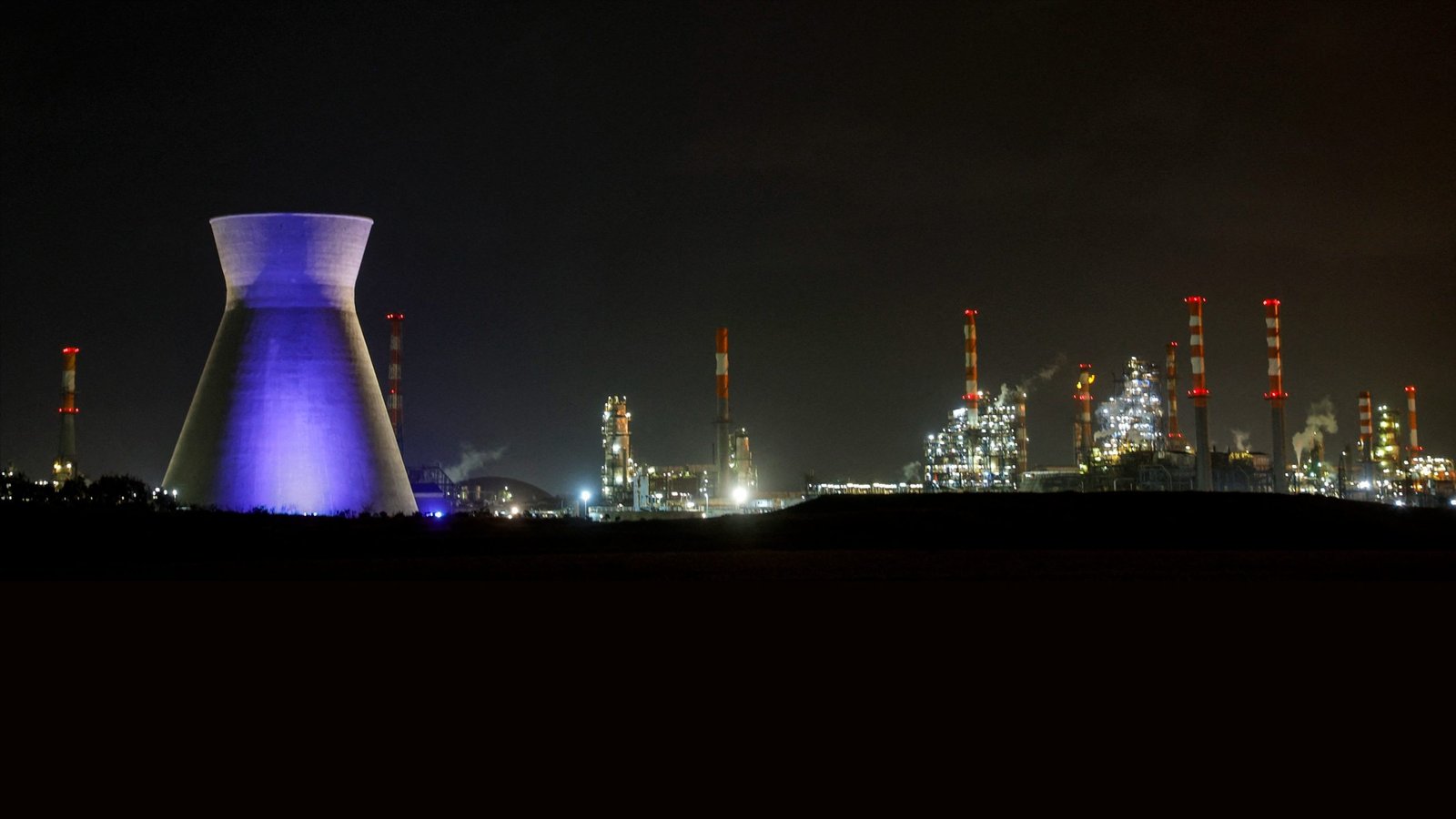
Energy facilities face increasing risk as strikes signal a shift in targeting priorities
Israel’s strike on Iran’s South Pars gas field, along with damage caused by fallen shrapnel at the Bazan oil refinery in Haifa, has raised fears that energy infrastructure may be becoming a more active front in the war.
Until last year, both sides appeared to avoid direct attacks on major fossil-fuel infrastructure. Now, with energy assets apparently no longer off-limits, experts warn that Israel’s interconnected gas, electricity, fuel, and water systems could be dangerously exposed.
In Israel, that reality makes the country “more vulnerable than ever,” according to American Israeli environmentalist and entrepreneur Yosef Abramowitz.
On Sunday morning, a spokesperson for the Iranian Armed Forces Unified Combat Command threatened that “if the enemy attacks fuel and energy infrastructure, all energy, information technology, and desalination infrastructure belonging to the US and the regime in the region will be targeted.”
Israel’s gas rigs, refineries, storage tanks, power infrastructure, and desalination plants are closely linked. A successful strike on one part of that system could disrupt several others, affecting not only energy supplies but also water treatment, refrigeration, and other essential services.
The Institute for National Security Studies (INSS) published a paper in June 2024 on the risks facing Israel’s energy infrastructure from missile attacks. The authors described Israel as an “electricity island,” meaning it is cut off from neighboring power grids and therefore cannot import electricity from other countries during emergencies.
That report also warned that Israel is overly dependent on natural gas, noting that the integration of solar energy into the grid has been delayed despite both security and ecological risks.
The INSS report said that natural gas accounts for more than 75% of Israel’s energy mix.
“The diversification of natural gas sources has improved due to the commercial operation of three reservoirs and the construction of two connections from the gas reservoirs to the coast,” the authors added. “However, Israel does not have facilities for storing natural gas, and damage to one of the reservoirs or pipelines is enough to seriously impair the electricity supply.”
That same INSS report stressed that while power plants have been established with dual-fuel capability, meaning they can operate on diesel in an emergency, securing enough diesel to maintain a full supply could be difficult.
Israel’s strike on South Pars marked the first time either side in the conflict had targeted energy infrastructure used to produce fossil fuels. The site is especially critical to Iran, accounting for about 70% of its total gas production and roughly 90% of its domestic energy use, as Dr. Tina Soliman Hunter, a professor of energy and natural resources law at Macquarie University in Australia, wrote in an article published by The Conversation.
Though Iran’s counterattack may have been aimed at Bazan, the only reported damage was caused by fallen shrapnel after several consecutive missile barrages on Thursday afternoon.
Energy Minister Eli Cohen said, “The damage to the electricity grid in the north [was] localized and not significant,” and that “the barrage to the north did not cause any significant damage to infrastructure sites in the State of Israel.”
The Environmental Protection Ministry also confirmed that no hazardous substances had leaked.
Bazan, located in Haifa Bay, processes around 9.8 million tons of crude annually and provides more than 50% of Israel’s fuel supply. It also supplies roughly 50% to 60% of the country’s diesel and gasoline. The site is considered a known vulnerability and was previously targeted by Iran during one of its 2025 attacks.
Abramowitz said that both the environmental movement and the security establishment have long been concerned about the risk of a direct hit on oil and gas installations and power plants, especially because of their proximity to Israel’s urban environment.
There’s been a sort of deterrence or an understanding that we won’t hit the fossil fuel assets of our enemies, and they won’t hit ours. That’s changed.
“Hezbollah has publicly threatened the gas rigs and specifically Haifa,” Abramowitz noted. “There’s been a sort of deterrence or an understanding that we won’t hit the fossil fuel assets of our enemies, and they won’t hit ours. That’s changed.”
A missile strike on a power plant could bring down parts of the grid or sharply reduce available energy. Still, the most dangerous scenario would be a direct hit on a gas rig, because it could trigger both a major energy disruption and severe environmental damage.
The Leviathan gas rig is located just 10 kilometers off Israel’s northern coast, making it one of the closest gas rigs to a populated area in the Western world.
A key concern is that a hit could release condensate, a highly toxic substance produced alongside natural gas at the rigs. Condensate is a light hydrocarbon liquid that could contaminate water supplies and force the shutdown of the country’s desalination plants.
About half of the condensate would evaporate into the air, causing pollution, while the other half would sink into the sea. Unlike crude oil, which floats and can be cleaned up, condensate is far more difficult to remove and could severely damage marine ecosystems and coastlines.
“Eighty percent of our drinking water is essentially dependent on making sure that there’s no poisons and condensate in the Mediterranean, and hitting a gas rig is the easiest way to make Israelis vulnerable and thirsty,” Abramowitz added, noting that Israel would also face an energy shortage. “When you hit an energy asset like a gas rig, ships will no longer agree to bring in coal or natural gas, even if we can take liquefied gas, because the insurance rates will go up.”
“A direct hit on a gas rig will lead to shutting down all our desalination plants, and the national grid would go down once emergency supplies of back-up coal and diesel are used,” Abramowitz explained. “We won’t be able to replenish these stocks because insurance rates on delivery boats will be prohibitive.”
When you have 75% to 80% of your power plants operating on gas, and your gas is cut off, you get knocked back to the Stone Age
“When you have 75% to 80% of your power plants operating on gas, and your gas is cut off, you get knocked back to the Stone Age,” Abramowitz said.
One example from the region shows how infrastructure disasters can devastate dense urban areas. In Beirut in 2020, an estimated 2,750 tons of improperly stored ammonium nitrate exploded at the city’s port. Some 6,000 people were injured and around 200 were killed in the incident. The blast destroyed large parts of the city, caused more than $10 billion in infrastructure damage, and displaced roughly 300,000 residents. Although the explosion was accidental, its impact was devastating, and years later many of the affected neighborhoods are still rebuilding.
A similar incident, which in Israel’s case would likely be intentional, could have dire results in Haifa. Even so, one major risk has already been reduced: Haifa’s 12,000-metric-ton ammonia storage tank, once used to receive all of Israel’s seaborne ammonia imports, was dismantled in 2017.
Although little can be done immediately, the INSS report presented several steps to reduce future risk. These include expanding renewable energy systems with storage and management technologies, as well as further decentralizing production facilities.
Regarding the natural gas industry, the report also called for regional cooperation to increase redundancy and reduce system vulnerability, expand gas storage capabilities, and maintain liquefied gas import capacity for emergencies.
Abramowitz said that none of the INSS recommendations have been implemented over the past two years.
He argued that the government failed to act on long-standing warnings about Israel’s energy vulnerability.
An ‘infrastructure October 7’ is potentially imminent, and a future commission of inquiry will conclude that the same leaders were guilty and negligent
“The government that was asleep at the wheel on October 7 is the same one that has prevented solar energy from truly scaling to power our energy and transportation and bring us to true energy independence,” Abramowitz said. “An ‘infrastructure October 7’ is potentially imminent, and a future commission of inquiry will conclude that the same leaders were guilty and negligent.”