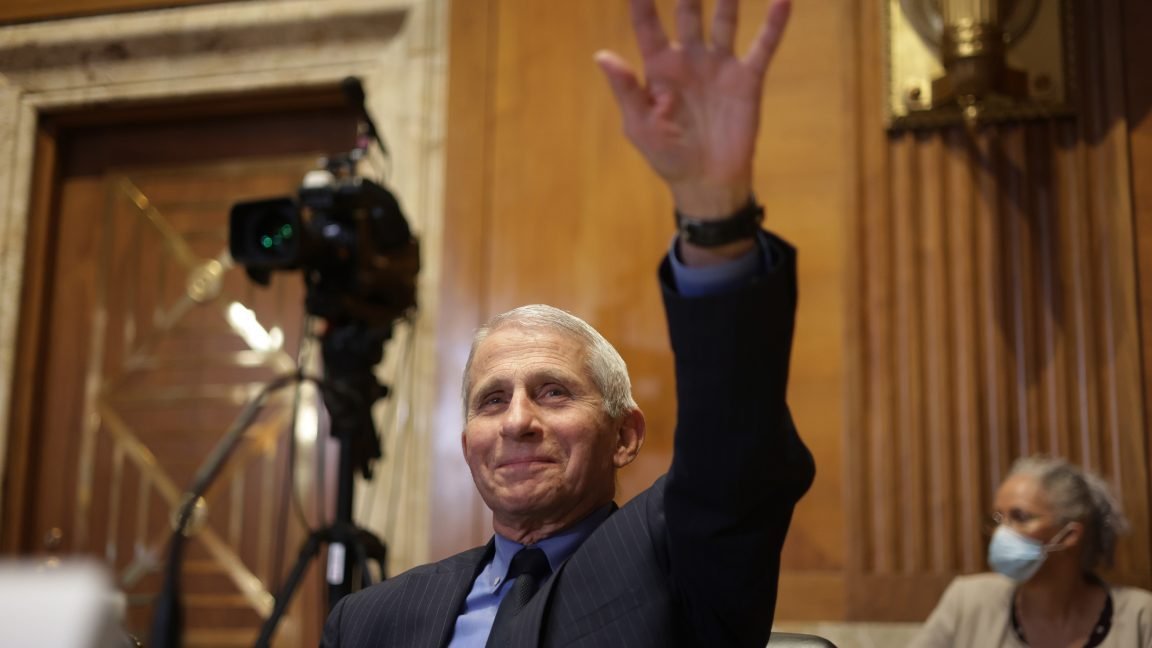
Anti-vaccine activist and current Health Secretary Robert F. Kennedy Jr. has worked hard to villainize infectious disease expert Anthony Fauci, even writing a conspiracy-laden book lambasting the former director of the National Institute of Allergy and Infectious Diseases.
But a year into the job as the country’s top health official, Kennedy—who has no background in medicine, science, or public health—still holds less sway with Americans than the esteemed physician-scientist.
In a nationally representative survey conducted in February by the Annenberg Public Policy Center at the University of Pennsylvania, 54 percent of respondents said they had confidence in Fauci, while only 38 percent had confidence in Kennedy. Breaking those supporters down further, 25 percent of respondents said they were “very confident” in Fauci, while only 9 percent said the same for Kennedy.
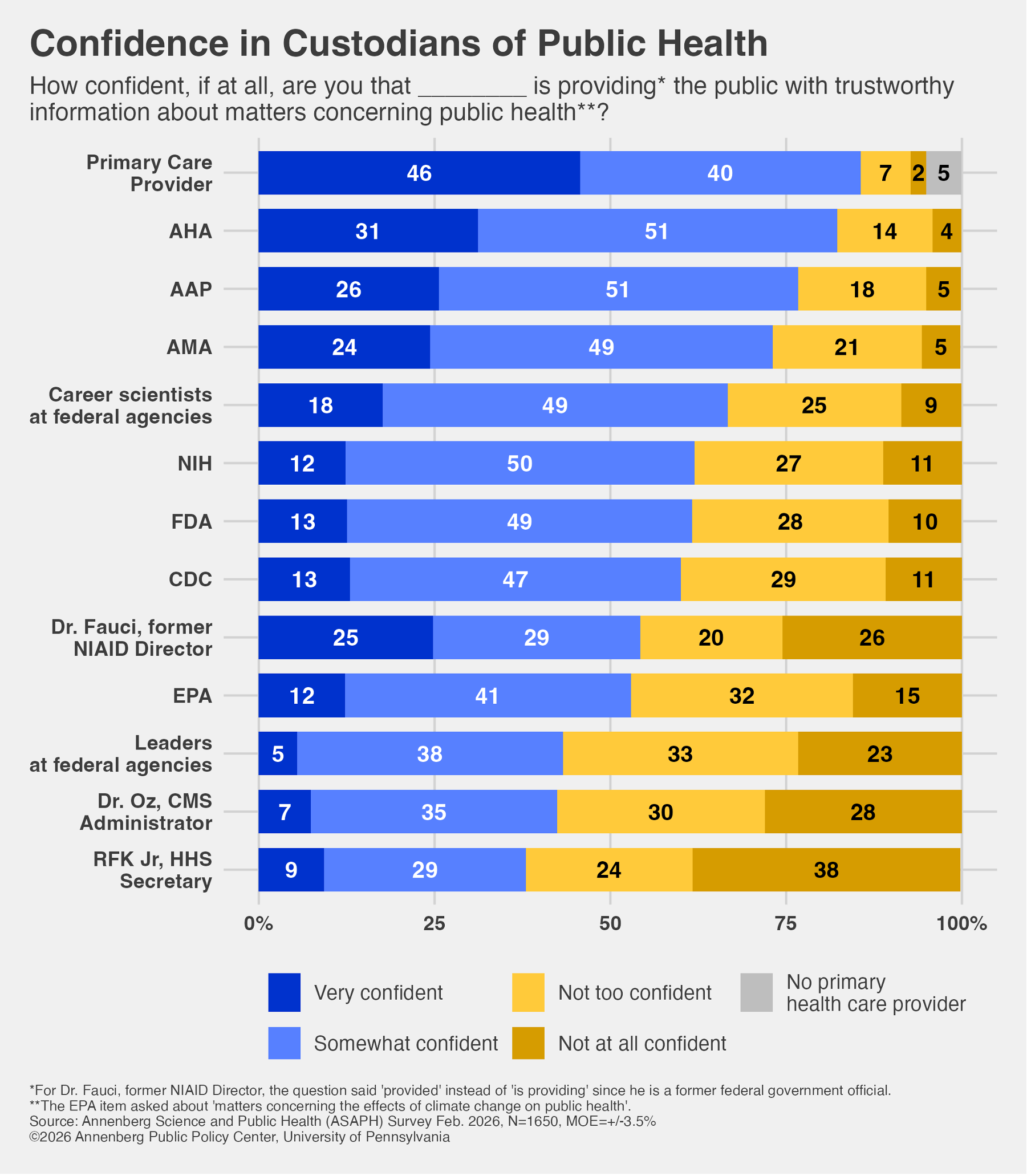
Overall, the survey found a clear divide between the confidence in Kennedy and other Trump administration officials and that of career scientists and medical associations.
Among federal agencies, 67 percent said they had confidence in career scientists at the Centers for Disease Control and Prevention, the Food and Drug Administration, and the National Institutes of Health. But only 43 percent said they had confidence in the leaders of those agencies.
“The public is differentiating the trustworthiness of career scientists in the CDC, NIH, and FDA from that of the leaders of those agencies and recalling substantially higher confidence in the guidance that former director Fauci provided than that offered by Secretary Kennedy or Dr. Oz,” Ken Winneg, APPC’s managing director of survey research, said in a statement.
Overall confidence in federal agencies was also lower than that for medical associations. Sixty-two percent of respondents were confident in the FDA and NIH generally, while 60 percent were confident in the CDC. In contrast, the American Heart Association earned confidence from 82 percent of respondents, while the American Academy of Pediatrics earned confidence from 77 percent, and the American Medical Association earned confidence from 73 percent.
“Trust is the foundation of effective health care and public health,” AMA CEO John Whyte said in a statement. “In a challenging information environment, patients need clear, evidence-based guidance they can rely on… The AMA is dedicated to helping patients cut through the clutter and elevate the valid over the viral. Accurate, trustworthy information saves lives.”
In a statement to Ars Technica, a spokesperson for the Department of Health and Human Services, Andrew Nixon, said the decline in trust in US public health began before the current Trump administration. “Secretary Kennedy was brought in to restore credibility through transparency, gold standard science, and accountability. HHS is focused on rebuilding public confidence by ensuring that decisions are driven by rigorous evidence.”
The survey also found that trust in federal agencies—the CDC, NIH, and FDA—has declined during this administration, falling from 67 percent overall in February 2025 to 60–62 percent in February 2026.