Generally, when you hear “water use” and “sustainability,” you expect those words to be followed by some bad news. Humanity’s enduring ability to ignore the math of declining water supplies is almost impressive. But there are cases where actions have successfully reversed our loss of water resources. A new paper in Science by Scott Jasechko of the University of California, Santa Barbara, examines documented cases of groundwater recovery around the world to identify which strategies have worked.
Groundwater is invaluable for many reasons. For one, it’s (usually) cleaner than surface water. It’s also right under your feet and often close enough to the surface that it doesn’t take much energy to pump it up. And there’s loads of it down there, no matter the season. Because of this, humans use a lot of it for drinking water, agriculture, and every other use you can think of.
Unfortunately, in many places, the rate of groundwater use has grown to exceed the rate at which precipitation soaks into the ground to replenish it.
In shallow aquifers, this causes the water table to fall over time. It falls the most near pumping wells—because groundwater moves slowly through rock and sediment, the water table isn’t flat the way the surface of a lake is. In addition to the obvious fact that your aquifer could eventually become empty, it can also come with knock-on effects like increased energy costs for pumping, wells that run dry, and even land subsidence as desaturated sediment compacts.
Many of these problems are reversible, but it would require the amount of water entering the aquifer to be greater than the amount leaving it.
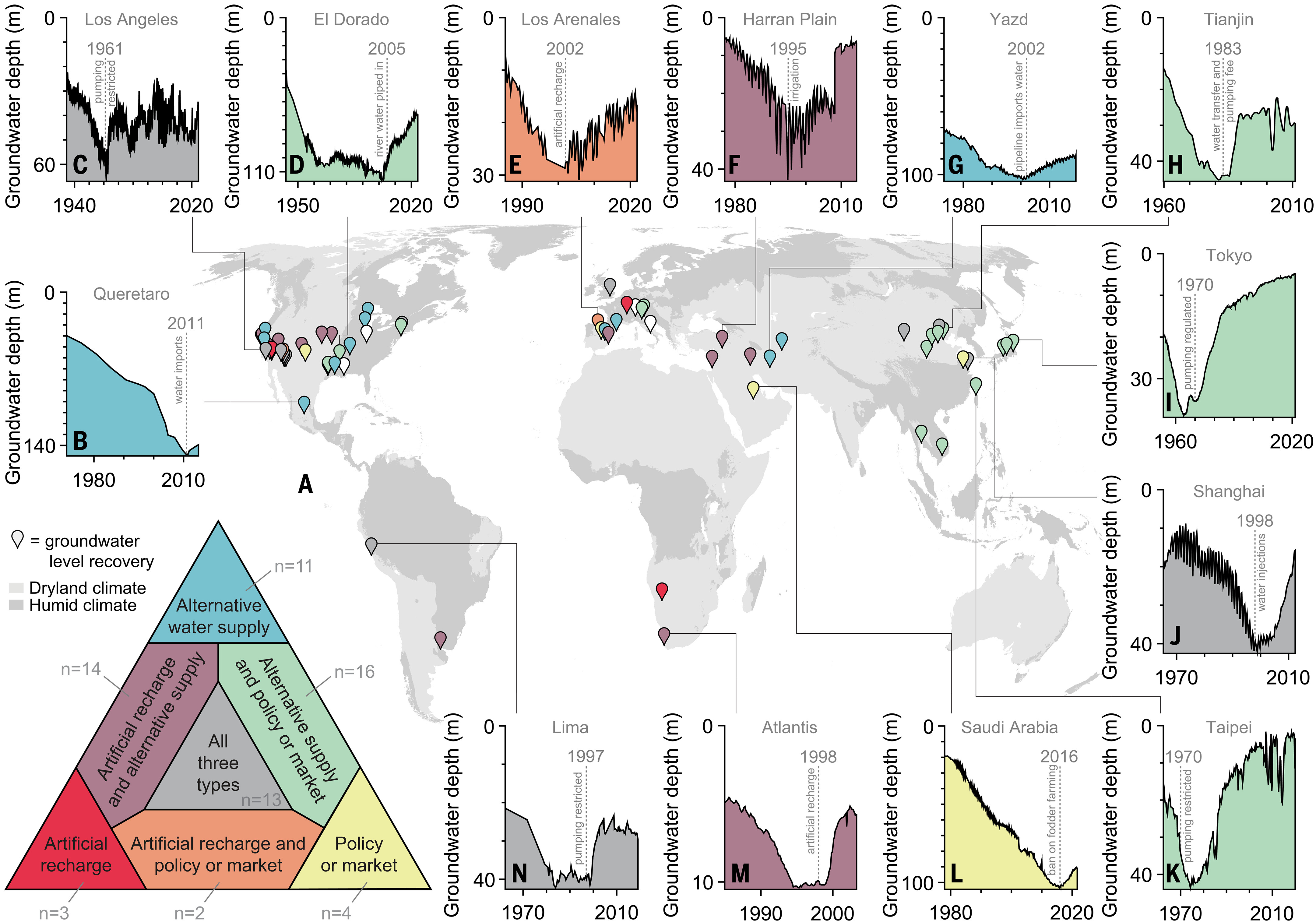
Jasechko compiled 67 published studies documenting cases where groundwater levels rose after spending at least a decade in decline. (You can explore all 67 cases on a map.) His goal was to find commonalities and see if we could learn any general lessons by zooming out to this bigger picture.
How to guide
In 81 percent of the cases, an alternative source of water was part of the answer—change didn’t come about just by reducing overall use through conservation (though some locations also did that). Many times, this involved large infrastructure work, like China’s massive South-to-North Water Diversion Project or the Doosti Dam on the border of Iran and Turkmenistan. Other cases involved much smaller connections. Osaka, Japan, simply began using water from the river that flows right through the city, for example.
In about half of the examples, policy or market changes caused reductions in groundwater pumping, which took many forms. Some were straight-up bans on pumping or drilling of new wells in defined areas, others limited only the largest wells, and yet others established fees for groundwater use. El Dorado, Arkansas, used those fees to pay for a pipeline to bring water in from a nearby river, eventually cutting groundwater use in half.
Other policy changes were less direct but still resulted in large changes to groundwater use. Saudi Arabia banned alfalfa growing, for example—leading to controversy in Arizona as a Saudi company leased land from that state to grow alfalfa for export. In Japan, wastewater pollution regulations changed away from concentration-based limits, as these had resulted in companies pumping up large amounts of groundwater just to dilute their wastewater into compliance.
The third common feature of these groundwater-recovery stories was boosting the amount of water entering aquifers rather than limiting the amount leaving them. Nearly half of the cases included this strategy, known as “artificial recharge.”
This is a little trickier than piping water into a surface reservoir. For a shallow aquifer, the rate at which water can soak into the ground is limited by the properties of the sediment or rock, so achieving a significant amount of recharge requires spreading water over a pretty large surface area. For deeper aquifers sealed off from the surface by impermeable layers, you have to pump water down a well, also at a rate that the well can handle.
In some of these cases, the artificial recharge was not even intentional. Things like leaky diversion canals and water mains or heavy irrigation just ended up delivering some water into the aquifer.
Well connected
Perhaps counterintuitively, groundwater recovery came with both pros and cons. That is, apart from the obvious water resource benefit, there were other knock-on effects.
One positive is that it counteracts saltwater intrusion in coastal areas. Water moves from areas with higher water levels towards lower levels, and the difference between groundwater level and sea level drives flow in one direction or the other. In areas where groundwater has been depleted, ocean water has seeped into the aquifer, affecting aquifer water quality.
Some of the cases collected in the study involved intentional efforts to enhance recharge in specific locations to combat this. In Los Angeles, lines of injection walls along the coast are helping to keep saltwater at bay.
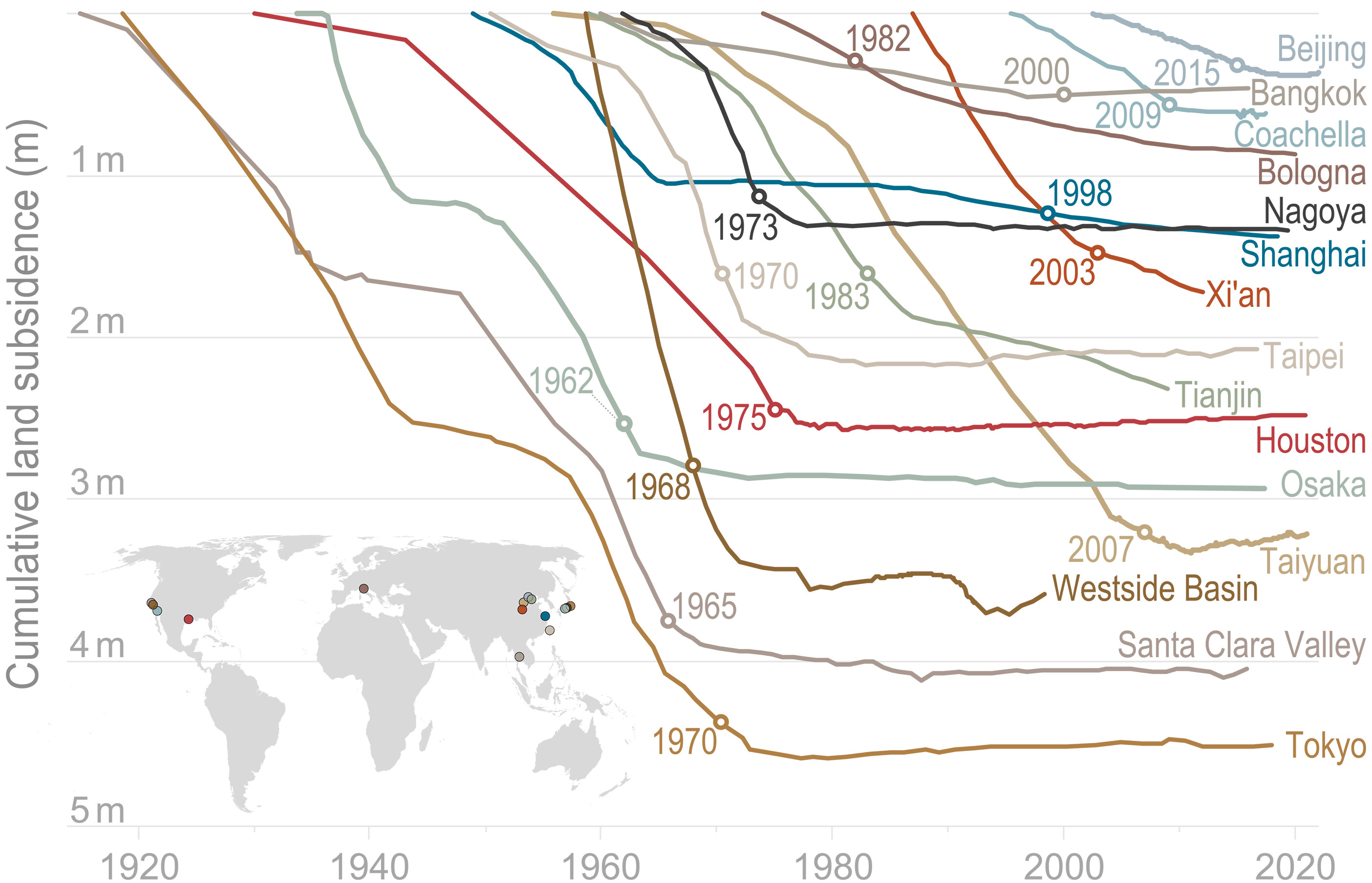
Another problematic consequence of groundwater depletion is subsidence of the land surface. In inland areas like Las Vegas or California’s Central Valley, the primary concern is damage to infrastructure (including surface water canals) as the ground sinks. Coastal locations have to additionally worry about sea level rise and storms interacting with land elevation changes.
Subsidence often isn’t fully reversible, but groundwater recovery can halt the problem and even cause the surface to rebound somewhat. This was part of the story in 39 percent of the cases studied, including places like Shanghai, Bangkok, and Houston.
So how could groundwater recovery be a problem? Some examples could simply be filed under “too much of a good thing”—flooding of tunnels or particularly low areas and cropland. But there were also structural issues as previously dry sediments saturated and the land surface moved upward. Some seismically active areas have even wrestled with increased liquefaction risk during earthquakes.
Separately, chemistry can cause problems. Shallow pollutants and fertilizers have been mobilized as the water table rose up to meet them, for example. And evaporation from waterlogged agricultural land has caused salts to gradually accumulate in the soil in some areas of Turkey and Iran.
The blueprint
Jasechko identified several lessons from comparing all these cases. First, most included at least two of the three common approaches he identified. Problems with complex causes demand multipronged solutions.
Another lesson is that the amount of time it took to see groundwater trends change direction varied pretty widely. In some cases, water level data showed results within a few years, but others took decades. Bangkok started instituting fees on groundwater use in the late 1970s, for example, but over 20 years passed before the fees were raised high enough to have an impact. And then there’s climate variability—stretches of wet or dry years can obscure the results of your actions.
Another lesson is that the details matter. There may be areas where groundwater rising above a certain level will cause problems, and it would be better to identify them in advance rather than through experience. And since every situation is unique, the best approach in each individual case will be a unique set of solutions.
At a fundamental level, this study reminds us that groundwater recovery has happened, so it is possible for communities to turn things around. So when we learn from history, we can find some parts we’d actually like to repeat.
Science, 2026. DOI: 10.1126/science.adu1370 (About DOIs).