In an interview with TML, Ashkan Rostami says the conflict has moved beyond the battlefield, with diaspora appeals, diplomatic fundraising, and signs that children are again being drawn into the regime’s wartime machinery
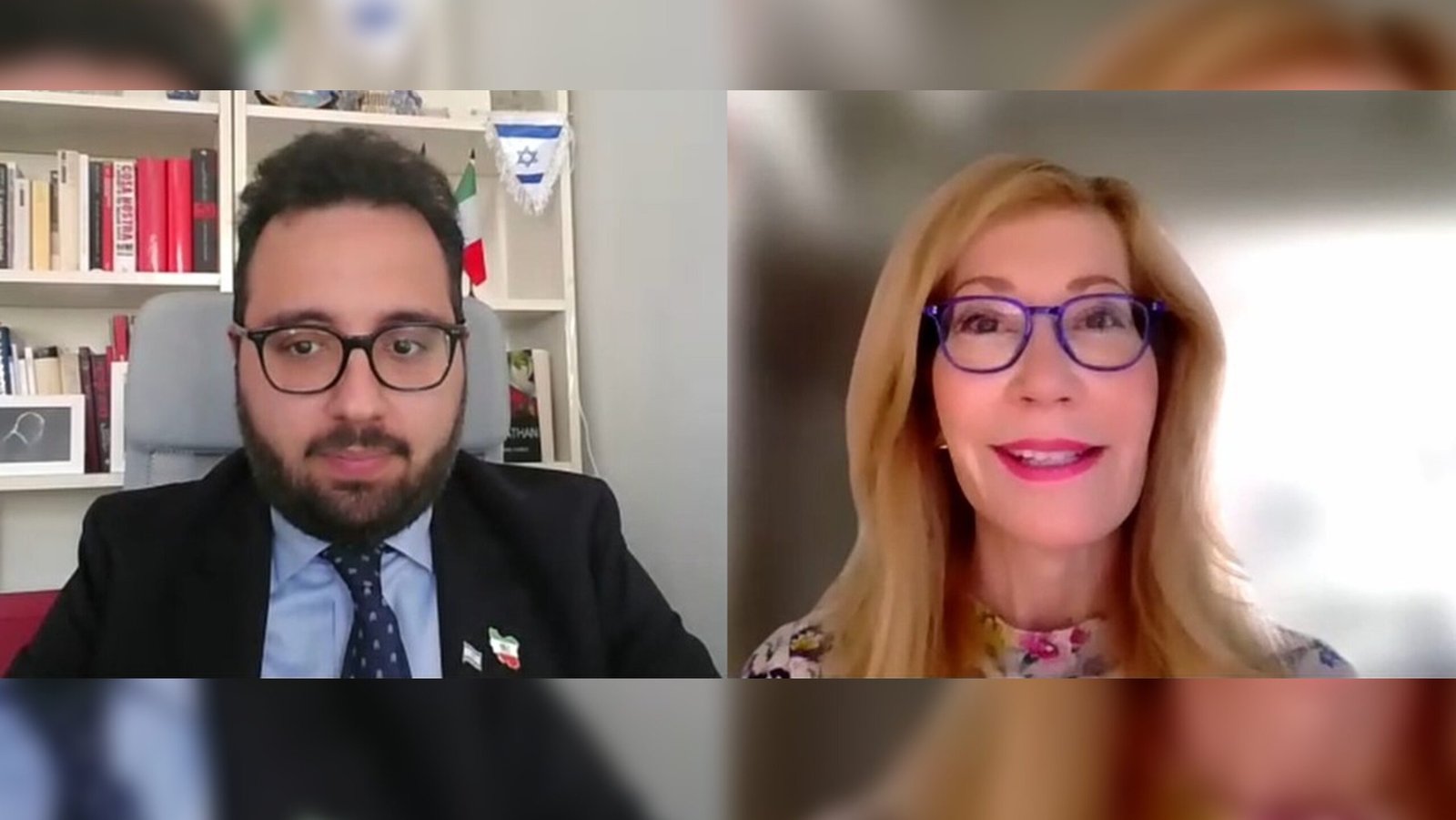
As the war involving Iran, the United States, and Israel grinds on, Ashkan Rostami—an Italian Persian geopolitical analyst focused on Iran, Israel, and regional dynamics in the Middle East, and a member of the Institute for a New Middle East—said one important part of the story was unfolding far from the battlefield. Alongside the military conflict, he pointed to messages sent to Iranians abroad, especially in Europe, as a sign of how the regime was operating under pressure.
They cut the internet and the people inside Iran can’t do anything
Rostami said that after the war began, “the Islamic regime absolutely began to do its propaganda” outside Iran. In his view, it did so because “they cut the internet and the people inside Iran can’t do anything,” while “the people outside Iran, the diaspora, the Iranian diaspora actually talked on behalf of the people inside Iran.”
He described that outreach as broad and deliberate. “It’s actually something normal,” he said, adding that the regime “fortified its propaganda outside of Iran,” “decided to double” what it was doing, and sent an email to Iranian citizens abroad.
According to Rostami, this was not limited to one country. “I know from Italy, I think it happened also in other countries,” he said, with many Iranian citizens in the diaspora receiving two emails.
One of those emails asked whether recipients wanted to join “this campaign of being beside the regime” and “fight for the regime against what they call the big and small Satan, so United States and Israel.” The other, he said, dealt with financial help for the Islamic Republic.
One element of that second message stood out to him. Rostami said one of the routes for support was described as “a Red Cross account in Kenya,” which he called “really strange.” He said recipients were also offered more direct ways to help. They could send money through “the official bank account of the embassy in Italy” or go to the embassy and provide support in cash.
For Rostami, that pointed to a clear purpose. It was “obviously a clear sign that the regime wants to, in some ways, divide the Iranian diaspora and also get help from maybe someone that follows them still and wants to help them.”
On the response from Italy, Rostami said, “As I know, right now, there isn’t any pushbacks, actually,” because “it’s an embassy of another country, and it’s a sovereign country.” That, he suggested, had limited what officials had been willing to do publicly.
He was even more direct about the wider European response. “No European countries, specifically Italy that I know of, they didn’t do anything against the campaign,” he said, although he added that there may have been intelligence efforts to track any help that could reach the regime.
Rostami also pointed to a diplomatic detail that he found notable. He said, “The Italian foreign minister, Mr. Tajani, just talked with the Araghchi, the minister of foreign affairs of the Islamic Republic, yesterday,” and that they discussed collaboration, ending the conflict, and possibly other matters. “It’s really strange,” he said.
When asked about the title of the outreach campaign—“Sacrifice of Life”—Rostami said, “The title is actually not that strange.” He connected it to earlier wartime campaigns used by the regime, especially during the Iran-Iraq war.
He said the regime “did the same campaigns with the same titles” in the 1980s and referred in particular to the “keys to heaven campaign.” In that campaign, he said, “they gave these fake keys to young Iranians to go to the war,” telling them those keys would open heaven if they were martyred.
That part of the discussion also raised a broader concern about money being funneled into terror and into systems that pull children toward violence, even though in any normal, civilized country, young people would be in school and learning the values of civil society instead.
European governments have been slow to act more forcefully against Iranian financing and infrastructure because of economic considerations, Rostami said. “I think there is so many economic interests, especially in Europe,” he said.
He named several countries directly. “The Spanish government actually take a position in favor of the Islamic regime,” he said, and “the same thing for Italy and the same thing for UK.” He argued that their economic ties to the Islamic Republic were stronger than many people had assumed.
From there, the conversation broadened to the course of the war itself. Rostami did not believe it was realistic to expect a rapid collapse. He said some in the opposition and the diaspora may have thought that if the Islamic Republic were attacked, “it will fall in less than a month.” But he added, “I don’t think that the US and Israel thought that actually,” because they understood “that it could be a medium-long war.”
At the same time, he did not describe it as endless. “It will not go ahead for years,” he said, but he also assessed that “it couldn’t end in one month or two.”
Part of the reason, he said, was that the conflict now had several dimensions. “They began with the actual war using the military,” but “we are now at a level of the economic war, and maybe political war, and in some ways, propaganda war.”
According to Rostami’s assessment, that broader pressure was already affecting the regime. “They are really fractured right now,” he said. “Economically, they can’t control the country.”
He supported that claim with a financial estimate, saying “they are losing $500 million a day, because of the blockade.” He argued that the regime could no longer manage the economic situation in the way it once did.
Either [the] Islamic Republic will surrender, or in some ways, they will get obliterated, they will not exist anymore
That led him to a stark conclusion. He said the regime would “either surrender using the negotiations, or they will surrender using military force,” and later added that “either [the] Islamic Republic will surrender, or in some ways, they will get obliterated, they will not exist anymore.”
Rostami said the estimate that it could take six months to clear mines from the Strait of Hormuz “was actually a right military estimation.” From his perspective, that time frame matched not only the military effort but also the economic and political dimensions of the conflict. His own estimate was slightly shorter. He said the war could continue for “at least four or five months.”
Another issue raised was whether the security apparatus had begun to crack. Rostami said, “I’m a little bit surprised, obviously, especially on the military side, not the IRGC, but the army,” because “army was what we counted on, that take the side of the people at a point like this, but it didn’t happen.”
At the same time, he repeatedly stressed the limits of outside knowledge. “We don’t know much about what is happening in Iran,” he said.
That uncertainty extended to the IRGC itself. He noted that it was not clear whether “the IRGC remained compact, and they are still want to be in power,” or whether meaningful cracks had opened inside the system.
Still, he mentioned several figures to illustrate the uncertainty at the top. Rostami said commander Ahmad Vahidi, “one of the remaining commanders of IRGC right now, is in some ways in power” and “has direct contacts with [Supreme Leader] Mojtaba Khamenei.” At the same time, he said, “we have [Iranian Parliament Speaker Mohammad-Bagher] Ghalibaf,” who “wants to negotiate. At least it looks like this.”
On defections, Rostami remained cautious. “We don’t have the exact information if any IRGC forces actually defected,” he said, or whether some may have simply left their posts and decided, ‘OK, we cannot take this anymore’.”
But he did point to what he saw as signs worth watching. He said that when control posts were set up in Tehran and other cities during the war, “they used children, young children as forces to keep this control post,” which, in his judgement, suggested the regime had lost enough experienced personnel from the IRGC and Basij that it could not rely on them in the usual way.
He added that families thought to support the Islamic Republic were asked to send their children to take part in those control posts. Still, he stopped short of making a definitive claim. “There are small signs like this,” he said, “but obviously, we don’t have the exact data,” and “If there is any defection, we don’t know that exactly.”
Taken together, Rostami’s comments describe a regime under pressure on several fronts at once. The messages sent abroad, the financial appeals, the references to earlier martyrdom campaigns, the lack of visible European pushback, the economic strain, and the uncertainty inside the security structure all point, in his view, to a system facing serious pressure both inside and outside the country.
For Rostami, the war is not only a military contest. It is also a struggle over money, messaging, political support, and the regime’s ability to maintain control as the conflict continues.