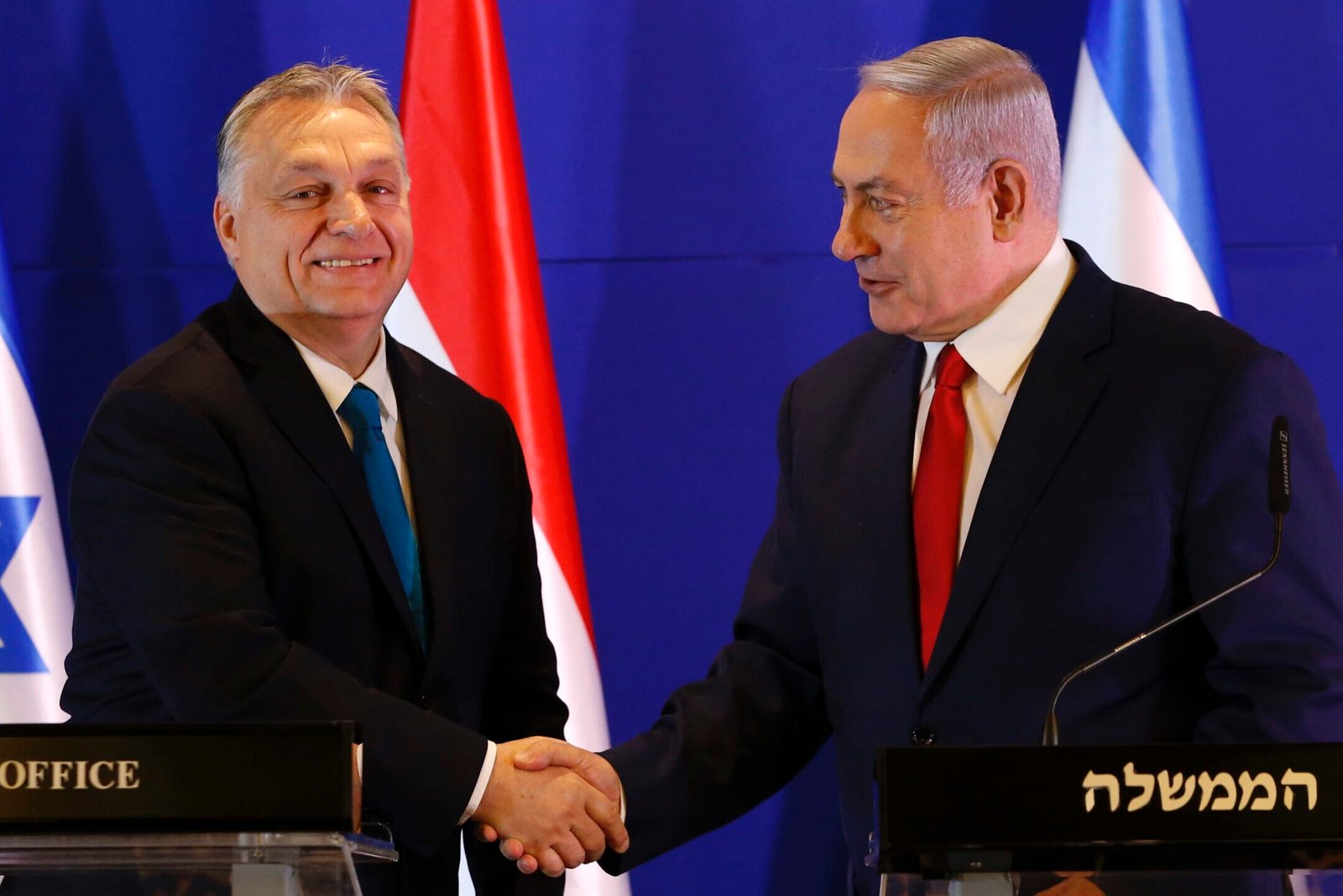
Personal alliances with controversial leaders leave Israel exposed when political winds shift in Europe and beyond
“And a new Pharaoh arose who did not know Joseph.” This is the introductory sentence in the first chapter of Exodus, where the children of Israel were enslaved. Leadership changes often have dramatic consequences.
Hungary is about to undergo a major shift in leadership—almost a regime change—following its elections, and it will have major ramifications for Prime Minister Benjamin Netanyahu, Israel, and its relationship with Europe.
In politics and government, when elections result in the ruling party being replaced by the opposition, there often is a major departure from the policies and direction of the outgoing regime, driven by grievances and resentments.
Hungary was ruled by Viktor Orbán for 16 years. He was a controversial leader of the far-right Fidesz party and governed in a semi-authoritarian manner. While Hungary was a member of the European Economic Community, Orbán often adopted policies opposing it. He also opposed European support for Ukraine in its war with Russia.
Had Orbán been born 50 years earlier, he would have been the perfect prototype to lead Hungary’s communist regime under the tutelage of its Soviet patrons.
Although his Fidesz party was alleged to have had antisemitic roots, Orbán positioned himself as an outlier in his support of Israel. There was also a bromance between him and Netanyahu, which ran counter to the general disdain that many Europeans hold toward Netanyahu and his conduct in the current conflict between Israel and the Islamic Republic of Iran.
Orbán’s rule was also marked by his efforts to control the judiciary and restrict freedom of speech, as well as by accusations of corruption.
This culminated in his overwhelming defeat in the recent election, which saw the rise of Péter Magyar, a former member of his party who defected and established Tisza, a new center-right party whose platform advocated realignment with Europe.
In monitoring the reactions to his ascent to power, the soothsayers like to point out that his center-right party won’t alter direction in the same manner as would the election of a left-wing party. They are wrong.
One of Magyar’s first acts was to overturn Orbán’s rejection of the International Court of Justice based in The Hague.
Magyar is also likely to have taken umbrage with Netanyahu as a result of Netanyahu’s personal investment in strong ties with Orbán. Orbán’s other bromance was with President Donald Trump, who went so far as to send Vice President JD Vance on the eve of the election in an effort to boost him.
The US has already downgraded its relations with Europe, especially over the North Atlantic Treaty Organization, the Iranian conflict, and Europe’s disastrous economic, immigration, and social policies. Yet for the US, Hungary is largely irrelevant in its efforts to adjust its relations with Europe.
The same cannot be said for Israel. Israel’s relations with the major European powers have steadily eroded to varying degrees since October 7.
France and the UK, both with large Muslim constituencies, have already recognized the State of Palestine without predicating it on the disarmament of Hamas and the reform of the Palestinian Authority.
Embargoes on arms sales have been imposed by most European countries.
Antisemitism is rife, with synagogues being attacked and Jews being targeted in the streets. Anti-Israel demonstrations are occurring throughout Europe. Israeli tourists are being attacked in the streets, and Israeli artists are being canceled in the arts. Campaigns are ongoing to further isolate Israel in trade, commerce, and sports.
The cowboy-style diplomacy conducted by President Trump, first in relation to Greenland and later through the joint attacks with Israel on Iran, has further alienated Europeans. They have long adopted policies of appeasement toward Iran, often at Israel’s expense.
European leaders will grumble but succumb to President Trump. They will take out their frustrations on Israel.
France and the UK have already called on Israel to cease hostilities against Hezbollah in Lebanon, despite Hezbollah having entered the war on behalf of its Iranian patrons and against the wishes of the Lebanese government.
Italy, whose right-wing government was initially very supportive of Israel in 2023, has gradually shifted away. Cracks are even emerging in Germany, whose unique relationship with Israel has been a bulwark against European efforts to further isolate Israel.
The European Economic Community is one of Israel’s major trading partners because of trade agreements that provide Israel with access to European markets. Israel participates in numerous areas of cooperation in science, technology, research and development, and agriculture.
Europe’s embrace of human rights language and the redefinition of international law through the International Court of Justice and the United Nations Human Rights Council have caused major harm to Israel’s standing.
These bodies have adopted a pro-Palestinian approach. The outrageous arrest warrants issued against Netanyahu and former Defense Minister Yoav Gallant for alleged war crimes have left Netanyahu not only unable to visit most European capitals but also seeking to avoid flying over their territory.
Unlike Macron and Starmer, Orbán refused to recognize the International Court of Justice and pointedly hosted Netanyahu on a state visit to Hungary.
Retribution and revenge will prevail, and while Magyar will be eager to demonstrate that his government will not embark on a new radical agenda that will cause mayhem in Hungary, he will find Israel an easy target for venting pent-up frustrations after 16 years of Orbán’s rule.
For Netanyahu, his foreign policy of cavorting with controversial leaders such as Orbán carried huge risks. With Orbán’s departure, he will find it extremely difficult to nurture a similar relationship with Magyar. Orbán’s inclination to veto European Economic Community moves against Israel has been eliminated.
More worrying for Israel has been the manner in which Netanyahu has managed relations with the US.
On the one hand, the personal relationship he has fostered with President Trump has brought immediate and major results, especially in the current conflict with Iran and its proxies. For this, Netanyahu deserves credit.
Yet he has also echoed President Trump’s ongoing tirades against the Biden administration’s management of the conflict before President Trump’s return to office.
There was much to criticize in the Biden administration’s management of the conflict after the initial month. Its ongoing calls for a two-state solution, its restraint of Israel from entering Rafah, and its limits on sales of certain kinds of munitions were damaging.
It is nonetheless unseemly for Israel, and especially its prime minister, to be seen engaging in the same kind of rhetoric employed by President Trump. Former President Joe Biden was personally favorably disposed toward Israel throughout his term, as was his secretary of state, Antony Blinken. The US still provided a veto at the United Nations Security Council.
The concern is that if and when the Democrats return to power, they will also regard Israel as a soft target for venting their frustrations from the Trump years. Whether that happens in two years or later, the Democratic Party’s automatic support for Israel is being eviscerated.
The radical left is determined to purge the moderates and replace them with members who have adopted extremely hostile positions toward Israel. By attacking the Biden years, Netanyahu is alienating whatever support Israel can hope to receive from what remains of the moderate base of the Democratic Party.
The only saving grace is that by the time 2028 arrives, Israel will hopefully have eliminated many of the threats it has faced since October 7 and made itself an indispensable actor in the Middle East that no administration can ignore.