Some 80 million years ago, the late Cretaceous oceans were patrolled by 17-meter mosasaurs, long-necked plesiosaurs, and massive, predatory sharks. For decades, the paleontological consensus was that this was the age of vertebrates; anything without a backbone was lunch.
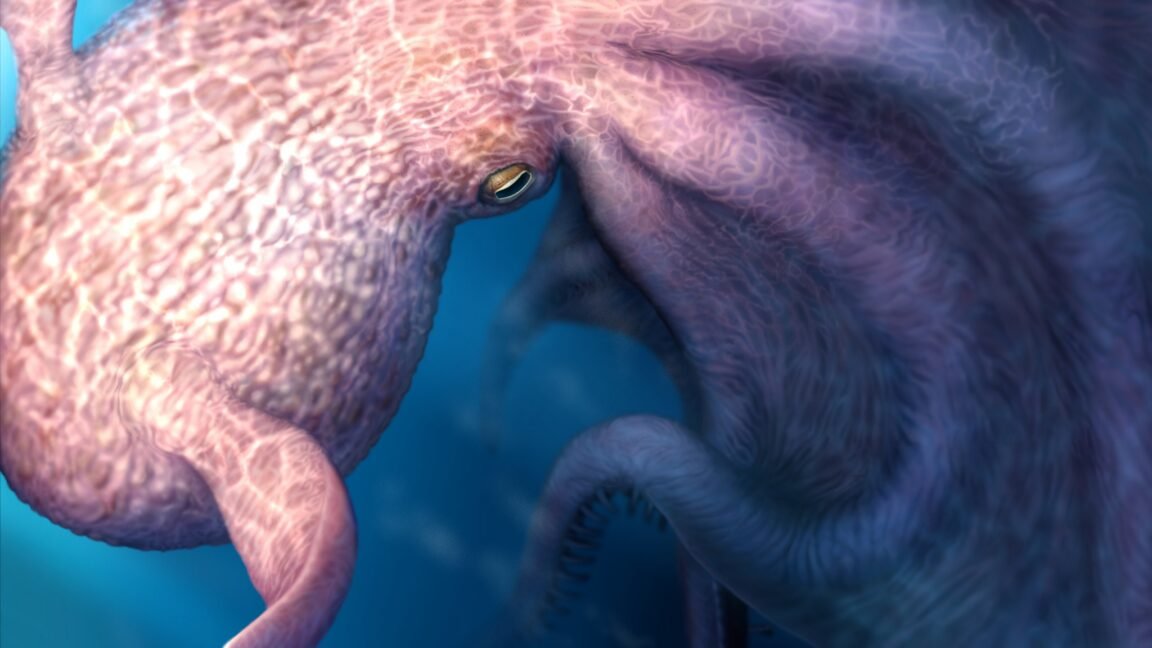
However, a new Science paper argues there was another apex predator lurking in the depths, and it didn’t have a single bone in its body. Researchers have uncovered the fossilized remains of ancient, finned octopuses that likely reached lengths of up to 19 meters. They were armed with powerful, hardened beaks and likely had high intelligence.
Reverse 3D printing
“Before this study, Cretaceous marine ecosystems were generally understood as worlds in which large vertebrate predators occupied the top of the food web,” said Yasuhiro Iba, a paleontologist at Hokkaido University and co-author of the study. Invertebrates, on the other hand, were seen as prey that evolved protective structures such as hard shells in response to predation. Octopuses were especially difficult to evaluate because they rarely fossilize. “Our study changes that picture,” Iba said.
The reason it has taken so long to place a giant octopus at the top of the Mesozoic food chain is that octopuses are essentially highly organized bags of water and muscle. When they die, their soft tissues decay rapidly, leaving almost nothing behind for the fossil record. The only octopus body parts that do fossilize are their chitinous jaws, which look a bit like parrot beaks. These beaks, though, are also extremely hard to spot when they are embedded in dense marine rock formations. To find them, Iba’s team deployed a technique they called Digital Fossil Mining.
Instead of relying on traditional imaging techniques based on X-rays, Iba and his colleagues used high-resolution grinding tomography to physically shave away microscopic layers of the rock. It worked like a destructive 3D printer working in reverse. Rocks that could potentially be hiding the beaks were first embedded in resin to hold them together and then ground layer by layer with every individual slice photographed along the way. Then, thousands of resulting images were compiled into full-color, 3D digital datasets of the rock’s interior. “We then used an AI model to analyze these large datasets and detect fossils embedded inside,” Iba said. “Once detected, the fossils were digitally extracted as 3D models.”
When Iba and his colleagues examined these digitally reconstructed beaks, it became apparent that the creatures they belonged to must have been terrifying.
Sizing a kraken
“We were very surprised,” Iba said. “We already knew that the jaws were large, but the body size estimates were striking.” The largest fossilized lower jaws Iba’s team has recovered surpassed the size of the modern giant squid by a factor of 1.5—and giant squids can grow up to 12 meters. According to the study, Nanaimoteuthis haggarti, the species this jaw belonged to, may have reached between 6.6 and 18.6 meters in total length. “It was comparable in size to some of the largest marine predators of the Cretaceous,” Iba said. But because we’ve never recovered a complete Nanaimoteuthis haggarti’s body, these size estimates come with a caveat.
The team evaluated the size of the ancient octopuses using allometric calculation—a method that used the proportional growth rates of modern, long-bodied finned octopuses to extrapolate the size of their extinct relatives. “The main limitation is that body size estimates have a range,” Iba acknowledges. “Different modern species have different allometric relationships between jaw size and body size.” But even assuming the smallest possible size, Nanaimoteuthis haggarti was still huge for an octopus.
The Digital Fossil Mining, besides discovering the beaks in the first place, enabled Iba’s team to observe very fine details of their structure. “This was essential for reconstructing feeding behavior,” Iba said. That reconstruction suggests that Nanaimoteuthis haggarti was a brutal hunter.
Reading the beaks
The outer surfaces of the fossilized beaks were heavily polished, their sharp edges rounded off, and their surfaces marred by deep scratches and millimeter-scale chips. According to the team, this wasn’t post-mortem damage from tumbling in the current, as the geological context of the find indicated transport abrasion was unlikely. Additionally, the researchers found that this wear was present only in adult specimens, was completely absent in juveniles, and was missing from the jaws of squids.
“This strongly suggests that the wear was produced during life by feeding, not by fossilization or later damage,” Iba said. “In other words, these animals were repeatedly using their jaws to crush hard structures such as shells and possibly bones.” The wear, the researchers demonstrate in their study, was more severe than what is typically seen in modern cephalopods that feed on hard prey.
On top of that, when analyzing the beaks, the team noticed a distinct pattern. The wear wasn’t uniform. The right edge of the jaw was consistently more worn down, chipped, and scratched than the left. The team concluded this asymmetry wasn’t an accident but a proof of lateralized behavior. It’s a tendency we observe in modern octopuses, which often favor a specific side of their body or a particular eye when performing complex tasks.
In biology, lateralized behavior is usually linked to a highly sophisticated, specialized nervous system. “Of course, we cannot directly measure intelligence from a fossil,” Iba said. “But the asymmetric wear suggests that these animals may also have had advanced and individualized hunting behavior, similar in some ways to modern octopuses.”
They were not just huge and powerful. They were probably smart.
The evolutionary arms race
A highly intelligent, 19-meter-long cephalopod actively hunting and crushing prey suggests that the Cretaceous evolutionary arms race wasn’t entirely dominated by vertebrates. By shedding heavy shells like those seen in early nautiloids and ammonites, the ancestors of modern octopuses traded passive defense for active offense. They gained explosive swimming speed, vast improvements in eyesight, and the neurological capacity required for advanced cognition.
“Our study highlights convergent evolution. Vertebrates and cephalopods have very different evolutionary origins, but both evolved toward becoming large, intelligent marine predators with powerful jaws, flexible bodies, high mobility, and advanced behavior,” Iba said. He notes that Cretaceous marine ecosystems were most likely way more complex than we thought.
Iba also hopes the Digital Fossil Mining technique can be used to learn more about this complexity. “One major direction is to apply Digital Fossil Mining to many more fossil-bearing rocks,” he told Ars. “This approach allows us to uncover organisms and structures that were previously almost invisible in the fossil record.” The technique, he thinks, is especially important for animals like octopuses and squids, which rarely fossilize.
The team ultimately wants to reconstruct a more complete history of cephalopods. “More broadly, our goal is to reveal the hidden components of ancient ecosystems and build a much more complete picture of how past ecosystems really worked,” Iba said.
Science, 2026. DOI: 10.1126/science.aea6285