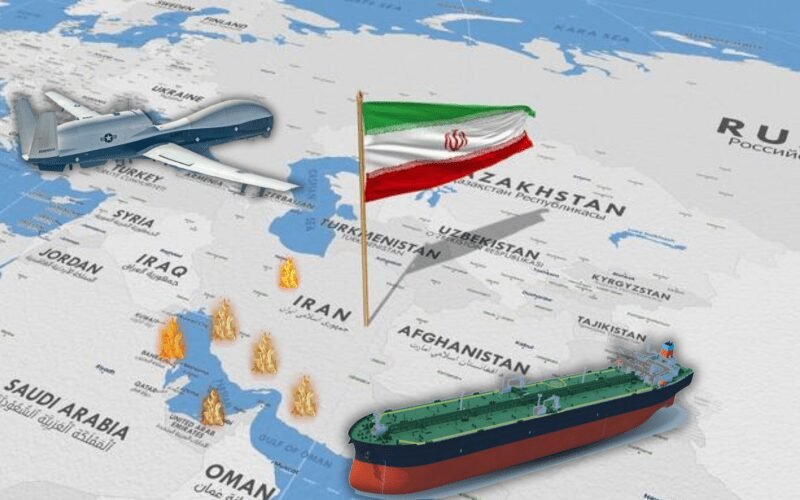
The U.S.-Israeli war with Iran and the closure of the Strait of Hormuz have caused the biggest oil supply disruption on record by daily output lost, though at least one earlier shock had a greater cumulative impact, according to Reuters calculations based on International Energy Agency and U.S. Department of Energy data.
The IEA said on Tuesday that the conflict is the worst energy crisis the world has faced, when combined with the tail end of the European gas crisis caused by Russia’s invasion of Ukraine in 2022.
The scale of the disruption has revived comparisons with past energy shocks, from the 1973 Arab oil embargo to the Iranian Revolution and the 1991 Gulf War, while underscoring how much global energy markets have changed.
A DIFFERENT KIND OF ENERGY SHOCK
Unlike earlier crises, the Iran war has simultaneously hit crude, natural gas, refined fuel and fertiliser supplies, exposing new vulnerabilities created by decades of rising demand, deeper global trade links and the Middle East’s expanded role as a supplier of finished fuels.
Earlier energy shocks of the 1970s caused lasting economic damage, weakened governments and remain etched in the memory of citizens in industrialised nations such as the United States, which faced months of fuel supply shortages and queues at the gas pumps.
The IEA was established in the wake of the Arab oil embargo to advise industrialised countries on energy supply and security. The IEA also manages its members’ emergency oil stocks and has responded to the crisis by releasing a record 400 million barrels from strategic stockpiles to stabilise oil prices and offset lost Middle Eastern supply.
HOW DOES THE CURRENT DISRUPTION COMPARE BY SCALE?
The peak supply loss from the current crisis stands at more than 12 million barrels per day, the IEA said earlier this month. That is equivalent to 11.5% of global oil demand, which this year is expected to average around 104.3 million bpd.
The outright daily supply loss is larger than earlier peak supply losses of 4.5 million bpd during the 1973-74 Arab oil embargo and of 5.6 million bpd during the Iranian Revolution in 1978-79 combined, the IEA said. It is also higher than the estimated peak supply losses of 4.3 million bpd during the 1991 Gulf War, the IEA said.
The Iran war has also triggered the shutdown of roughly a fifth of the world’s liquefied natural gas production in Qatar. The world consumes much more gas than it did during the oil shocks of the 1970s-1990s. During the Arab oil embargo and the Iranian Revolution, the LNG industry was nascent. Qatar first exported LNG in 1996.
The current disruption also extends beyond crude and gas into fuel markets. The U.S.-Israeli war on Iran has disrupted millions of barrels per day of fuel production and exports from refineries in the Gulf, triggering shortages of jet fuel and diesel. Huge refineries built inside the Gulf in recent decades are key to global fuel supplies. They send jet fuel to Africa, Europe and Asia, for example.
HOW DO DURATION AND LOSSES COMPARE WITH PAST SHOCKS?
The International Energy Agency did not immediately respond to a Reuters request for comment on how the current disruption compares with earlier energy shocks in terms of cumulative supply losses.
In the absence of official comparisons, Reuters assessed cumulative losses by calculating the scale and duration of major supply disruptions.
Based on that approach, the current conflict has lasted 52 days and removed an estimated 624 million barrels from the market, assuming a loss of 12 million barrels per day over that period, according to Reuters calculations.
Even if a peace deal is reached quickly, supply disruptions are expected to persist for months and, in the case of gas, for years, pushing the final cumulative impact significantly higher.
The IEA says the 1978-79 Iranian Revolution resulted in a peak loss of 5.6 million bpd, smaller in scale than the current disruption. The revolution, however, led to a larger cumulative loss, according to Reuters calculations.
According to the U.S. Department of Energy, the revolution caused an average drop of 3.9 million bpd in Iran’s crude oil production from 1978 to 1981 – a loss of some 4.27 billion barrels over three years according to Reuters calculations – although the Energy Department says much of this loss was compensated by Iran’s Gulf neighbours.
During this crisis, the countries with spare capacity – Saudi Arabia, the United Arab Emirates – have been unable to compensate – because they themselves have been hit by the halt in shipments through the Strait of Hormuz.
Oil journalist and author Ian Seymour estimates Iran pumped an average of 3.1 million bpd during 1979 compared to 6 million bpd in late 1978 – resulting in a cumulative loss of over 1 billion barrels in 1979 alone.
During the 1973-1974 Arab oil embargo, producers took three months to reach full production cuts of 4.5 million bpd. The embargo lasted from October 1973 to March 1974, resulting in around 530 million to 650 million barrels of lost production, according to Reuters calculations. That would mean the Arab oil embargo was comparable in its cumulative impact to the disruption caused by the U.S.-Israeli war on Iran.
SHORTAGES IN ASIA, AFRICA
The current crisis has played out initially in shortages of supply to Asia and Africa. Top oil consumer the United States was much harder hit by the Arab oil embargo, which led to motorists enduring long lines for gasoline. The disruption lasted months and sparked an overhaul of energy policy and a rethinking of what constituted energy supply security.
The 1991 Gulf War, which disrupted oil output for four months according to a government document from IEA member Australia, resulted in a cumulative loss of at least 516 million barrels according to Reuters calculations assuming losses at 4.3 million bpd over that time, making the cumulative losses smaller than the current crisis and the Arab oil embargo.
Russia’s invasion of Ukraine in 2022 triggered a global energy crisis as European countries scrambled to reduce their dependence on Russian oil and gas.
Russian oil output declined by 9% in April 2022, according to the U.S. Energy Information Administration, or roughly 1 million bpd and much smaller than the current disruption. Russia’s output stabilised in later months as Moscow rerouted exports to counter Western sanctions, although in 2026 Ukrainian drone attacks are causing output cuts.